
The self-taught artist and Georgia native St. EOM established the visionary art site Pasaquan in the mid-1950s. Located in Marion County, Pasaquan is maintained and operated today by Columbus State University, which assumed control of the site in 2016.
St. EOM was born Eddie Owens Martin on July 4, 1908, in Marion County to Lydia Pearl and Julius Roe Martin, a sharecropper. Martin’s early life was marked by his father’s violence and long hours laboring in the fields. In interviews, Martin noted that he often felt as though he did not belong in rural Georgia. He would watch the Seminole passenger train on its route between Chicago and Jacksonville, Florida, and think, “Them people must have come where I really come from.”
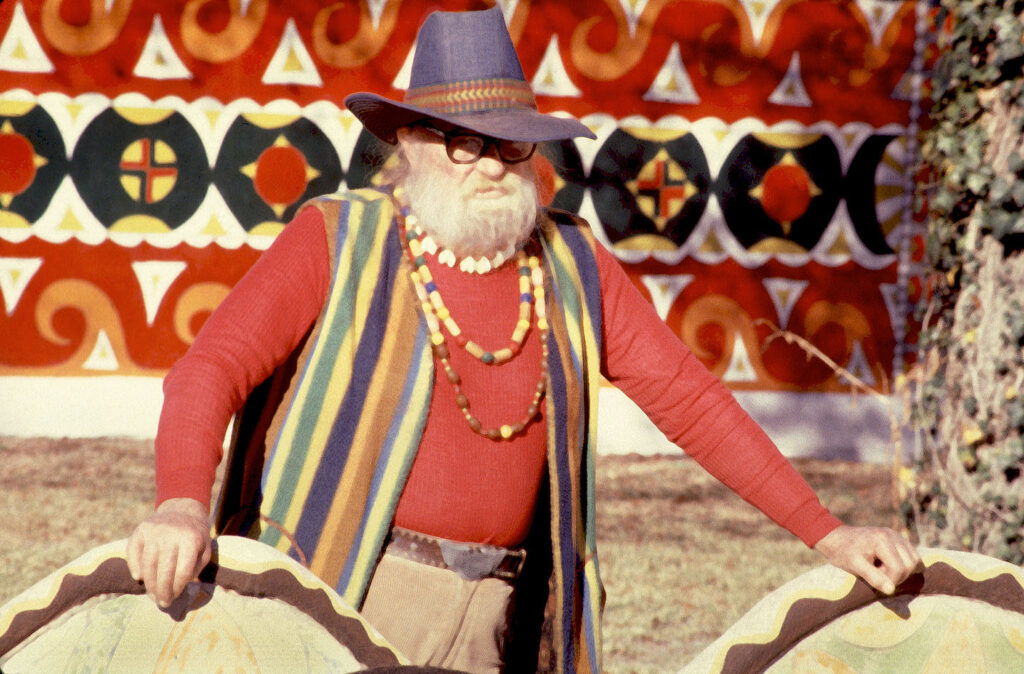
In 1922 at the age of fourteen, seeking to escape rural life, he left home and ultimately moved to New York City, where he supported himself at various times with sex work, fortune-telling, gambling, selling art, and other odd jobs. Though Martin occasionally had sexual relationships with women, he defined himself primarily as gay and surrounded himself with an eclectic group of characters in New York’s hustling scene. After his father’s death in 1928, Martin would periodically return to Georgia to help his mother harvest the crop, but he always eventually returned to New York.
In his late twenties, Martin had a series of visions while suffering from a high fever. In his visions, three “people of the future” from a place called Pasaquan selected him to depict, through art, a peaceful future for human beings. After receiving these visions, Martin began to call himself St. EOM. He increasingly focused on art in the decades that followed, frequenting New York’s many museums and libraries and studying the traditions of cultures both ancient and modern.
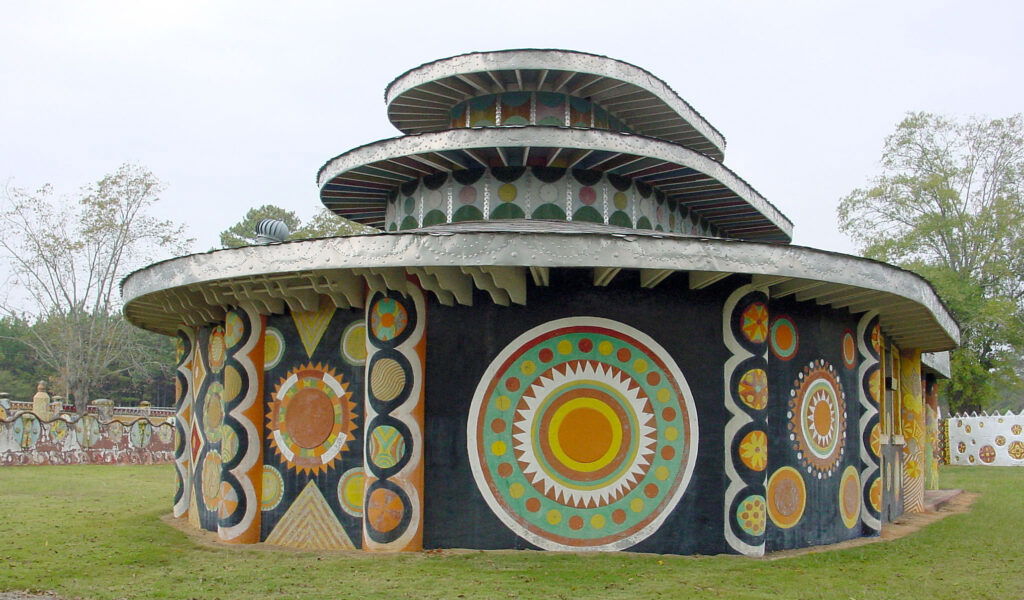
According to St. EOM, the Pasaquan messengers eventually instructed him to “return to Georgia and do something.” His response was the establishment of Pasaquan, a visionary art site that he began building around 1957 on land he had inherited from his mother. Drawing from a variety of non-western traditions, he set himself to building an ornate series of pagodas, temples, and murals in the backwoods of south Georgia.
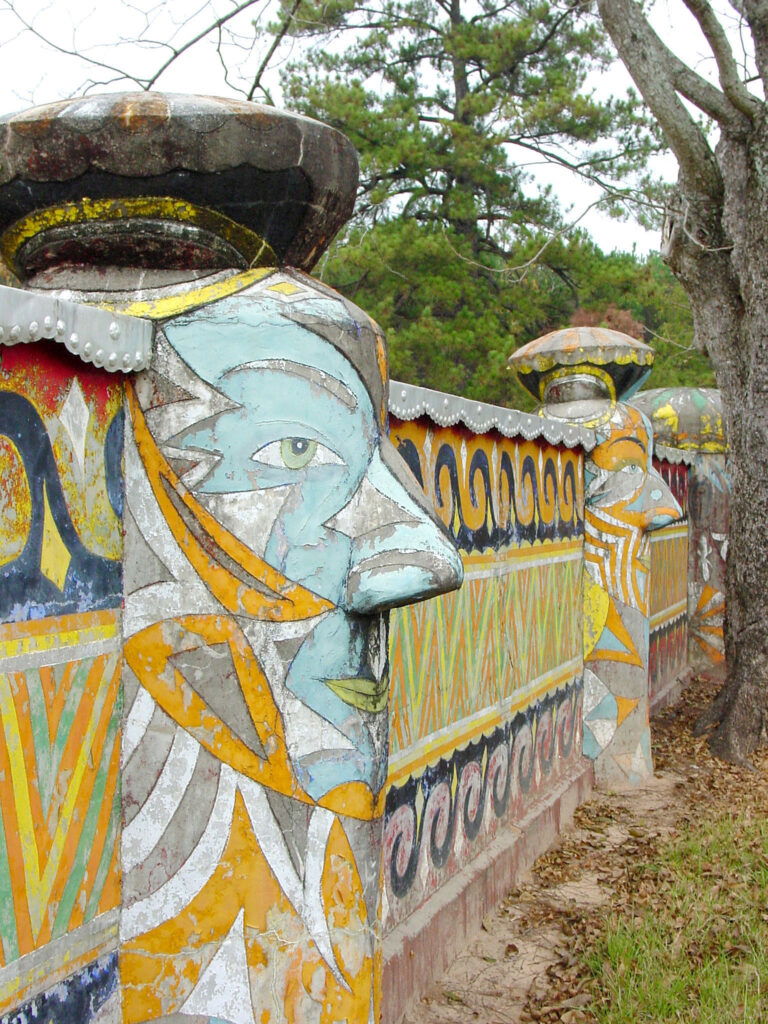
Covering seven acres in Marion County, the Pasaquan artscape includes six buildings, the oldest of which is a late-nineteenth-century farmhouse. Both the interior and exterior walls of the structures are painted in vibrant colors and bold patterns, often incorporating human figures and nature imagery. The buildings are connected by painted concrete walls, which often feature raised sculptural elements. More than 2,000 pieces of St. EOM’s artwork, including paintings, sculptures, and drawings, are also housed at Pasaquan.
Drawing from his New York drag ball experience and his knowledge of world religions, St. EOM would fashion ceremonial costumes and perform elaborate rituals, particularly for the visitors who would pay him to tell their fortunes. In the last decade of his life, Martin enjoyed greater renown as a folk artist, though he often felt his work was not taken seriously by the broader art community.
St. EOM, who committed suicide in April 1986 after years of failing health, bequeathed Pasaquan to the Marion County Historical Society, which later formed the Pasaquan Preservation Society. The society also arranged for the placement of St. EOM’s work in a number of museums around the country, including the National Museum of American Art in Washington, D.C.; the American Folk Art Museum in New York City; and the Los Angeles County Museum of Art in California. In Georgia, St. EOM’s work is part of the collections at the Albany Museum of Art in Albany and the High Museum of Art in Atlanta.
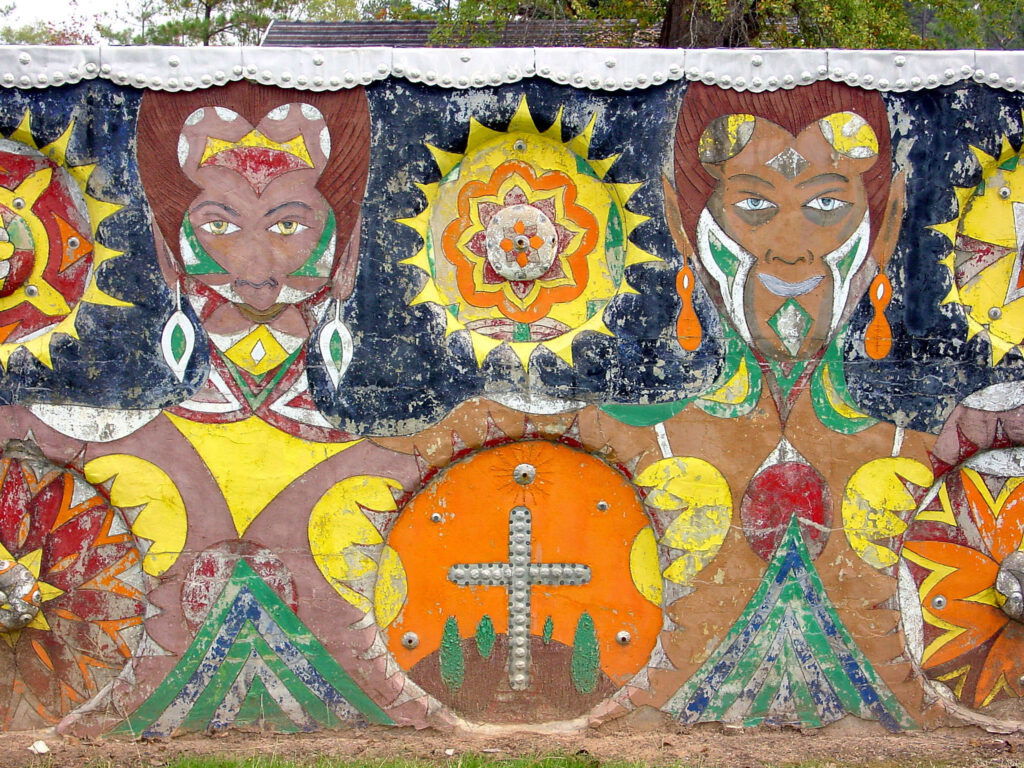
In 2014 the Pasaquan Preservation Society, Columbus State University (CSU), and the Wisconsin-based Kohler Foundation partnered to refurbish and preserve the site. After two years of work, the site reopened on October 22, 2016. CSU students, professional art restorers, and local artisans participated in the site’s renewal. CSU was charged with caring for Pasaquan in the future and now operates the site. It continues to be a site of experiential learning for CSU students and attracts thousands of visitors a year.


