
Gwinnett County, in the Atlanta metropolitan area, has been one of the fastest growing counties in the United States since the 1970s.
According to the 2020 U.S. census, its population is 957,032, an increase from the 2010 population of 805,321. Gwinnett County’s close proximity to downtown Atlanta, along with its commitment to expansion of both economic and civic infrastructures, has contributed to its rapid growth. Interstates 85 and 985 traverse the county, as do numerous highways.
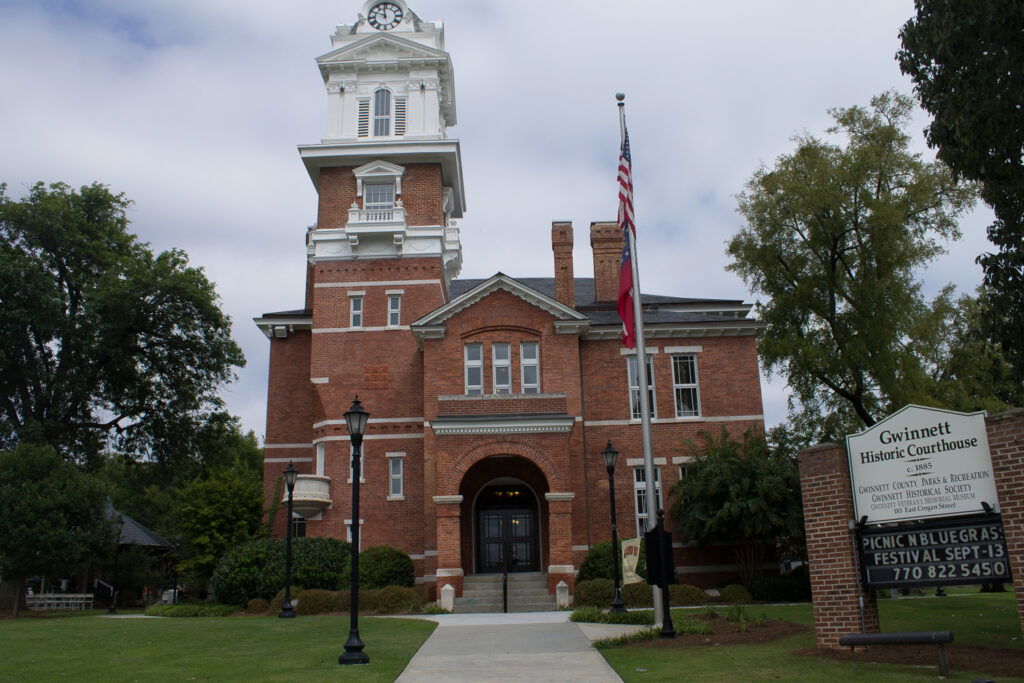
Created from land ceded by the Cherokee and Muscogee (Creek) Indians, Gwinnett County was established on December 15, 1818. By 1820 Georgia’s forty-fourth county had a population of 4,589. Lawrenceville, the county seat, was incorporated on December 15, 1821, and is the oldest city in the county. Other incorporated cities in Gwinnett are Berkeley Lake, Buford, Dacula, Duluth, Grayson, Lilburn, Norcross, Peachtree Corners, Snellville, Sugar Hill, and Suwanee, as well as parts of Auburn, Braselton, Loganville, and Rest Haven.
The county was named for Button Gwinnett, one of Georgia’s three signers of the Declaration of Independence. Farming, particularly cotton, was the main industry, with enslaved labor contributing to the wealth of the area. The Civil War (1861-65) destroyed much of that economic prosperity but actually caused little physical damage in the county. With the completion of the Southern Railroad in 1871, and the Seaboard Air Line Railroad in 1892, Dacula, Lilburn, and other new towns began to spring up. By 1900 the population had more than doubled to 25,585 people. In the early twentieth century the boll weevil and falling cotton prices, along with a population boom in Atlanta, led to a large-scale switch from cotton to dairy farming. In 1957 the Buford Dam was completed. It blocks the Chattahoochee River (which forms the northwest border of the county) to form Lake Lanier, thereby occasioning the rise in tourism as a significant industry for Gwinnett County.
Gwinnett County boasts numerous recreational opportunities. Outdoor options include the Chattahoochee River National Recreation Area, Vines Botanical Gardens in Loganville, and Stone Mountain Park, on Gwinnett’s border with DeKalb County. Sporting venues include the Road Atlanta raceway and the Ice Forum. Museums are as diverse as the Lanier Museum of Natural History in Buford, the Southeastern Railway Museum in Duluth, and the Gwinnett History Museum in Lawrenceville, housed in the circa 1855 Lawrenceville Female Seminary. The Infinite Energy Center in Duluth is a convenient venue for exhibitions (such as woodworking, craft, and home and garden shows) and performances in the Infinite Energy Arena and the Infinite Energy Theater. The county also includes three sizable indoor malls, including the Mall of Georgia in Buford, the largest mall in the state.
Only a handful of plantation houses from the 1800s still exist in Gwinnett County, and most are privately owned. The Gwinnett Historical Society offers a driving tour of those still in existence with information on those that are open to the public, such as the Elisha Winn House (1811) and the Wynne-Russell House (ca. 1826).
Gwinnett County is home to several institutions of higher learning. Gwinnett Technical College, one of the largest technical schools in the state, opened in Lawrenceville as Gwinnett Area Technical School in 1984. In the fall of 1987 DeKalb College (later Georgia State University Perimeter College) began offering college courses in the county, and the University of Georgia began offering graduate courses in 1990 at a site in Lawrenceville. In late 2001 Gwinnett Technical College’s campus was relocated to a new site and named the Gwinnett University Center (GUC). In 2005 the Board of Regents of the University System of Georgia approved the transition of the GUC to Georgia Gwinnett College, the first new university system member to be named since 1970. Another private college, a branch of the Philadelphia College of Osteopathic Medicine, based in Pennsylvania, is located in Suwanee.


