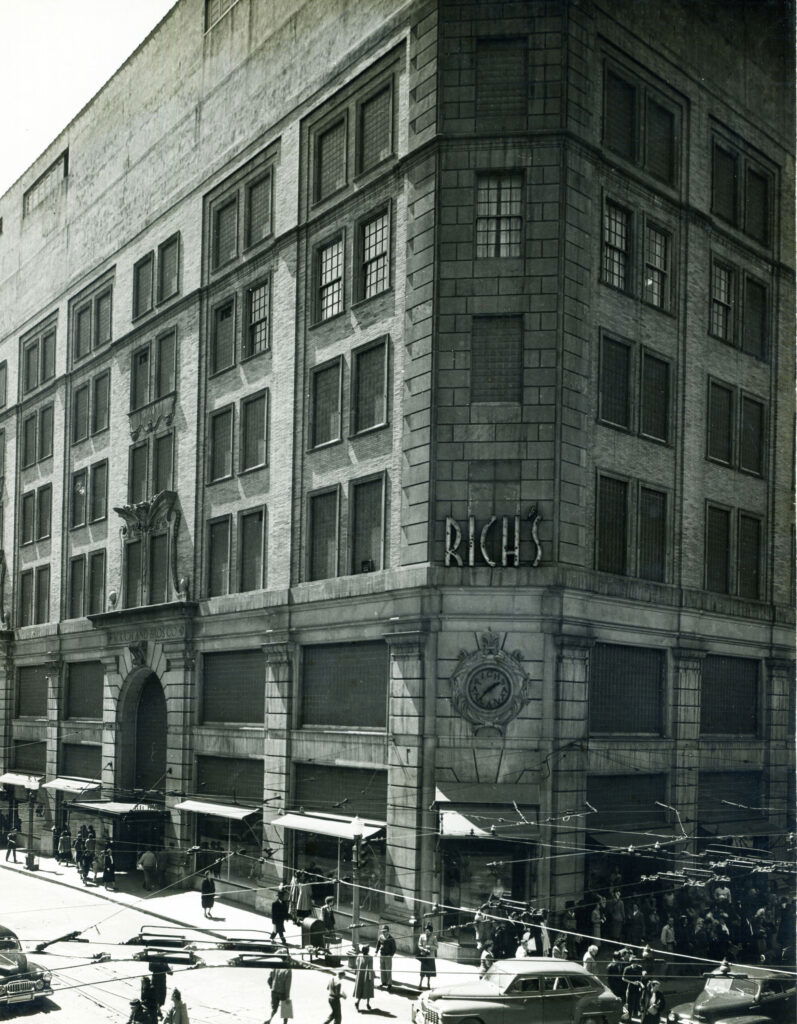
Founded in 1867, Rich’s Department Store came to symbolize the retail shopping experience in Atlanta during the twentieth century. Through a commitment to its customers and a strong sense of civic responsibility, Rich’s is inextricably linked with the history of the city. Although the Rich’s name merged in 2003 with the well-known New York City department store Macy’s, generations of shoppers will remember the store as both an integral part of Georgia life and a southern institution.
Courtesy of William Breman Jewish Heritage Museum, Ida Pearle and Joseph Cuba Community Archives for Southern Jewish History.
In 1867 Morris Rich, a Jewish Hungarian immigrant who grew up in Cleveland, Ohio, borrowed $500 from his brother and opened a dry goods store on Whitehall Street in Atlanta. The store prospered in its first year, and the flourishing business required several expansions over the next five decades. In 1924 the downtown Atlanta store moved to its final location at the corner of Alabama and Broad streets. Rich’s grew along with the city in the 1960s and 1970s, expanding into malls throughout metropolitan Atlanta.
A commitment to the community and excellent customer service reinforced Rich’s role as an Atlanta institution. In 1914 a dramatic drop in the price of cotton financially crippled many Georgia farmers. To help ease the crisis, Rich’s accepted bales of cotton as payment for merchandise, taking a financial loss. In another incident, when the city of Atlanta was unable to pay teachers’ salaries during the Great Depression of the 1930s, Rich’s agreed to cash the worthless checks until the city government could reimburse the store.
In the early 1920s, Rich’s enacted a liberal exchange and credit policy whereby any item could be exchanged and nearly anybody could receive store credit. It was not uncommon for Rich’s to provide refunds on merchandise not carried by its stores or to provide full refunds on noticeably used items. Rich’s operated under the philosophy that all people were inherently honest and that going the extra mile for customers would benefit the company in the long run. Although this approach had many detractors, the store’s continued sales growth helped prove the soundness of this philosophy and endeared Rich’s to its customers.
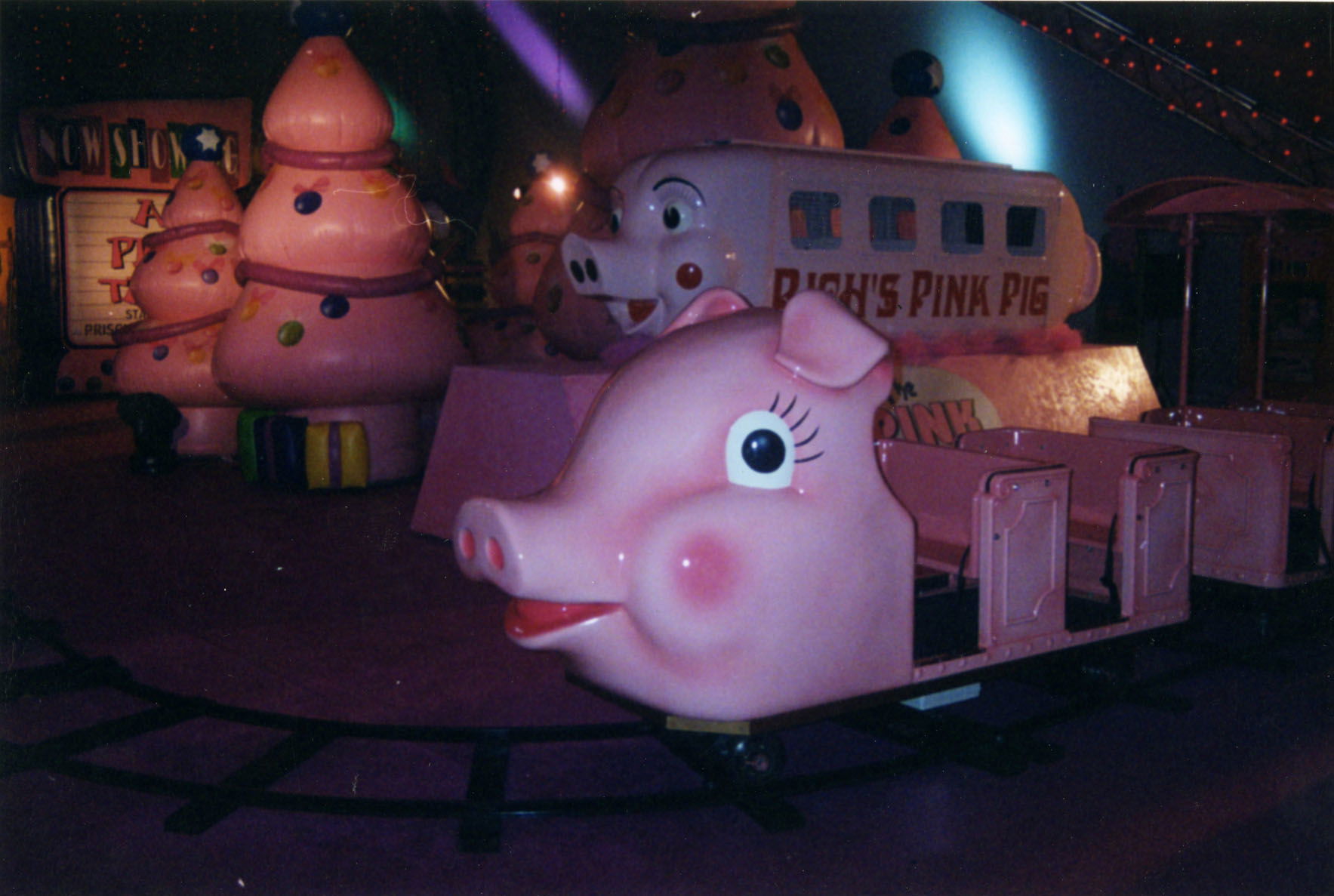
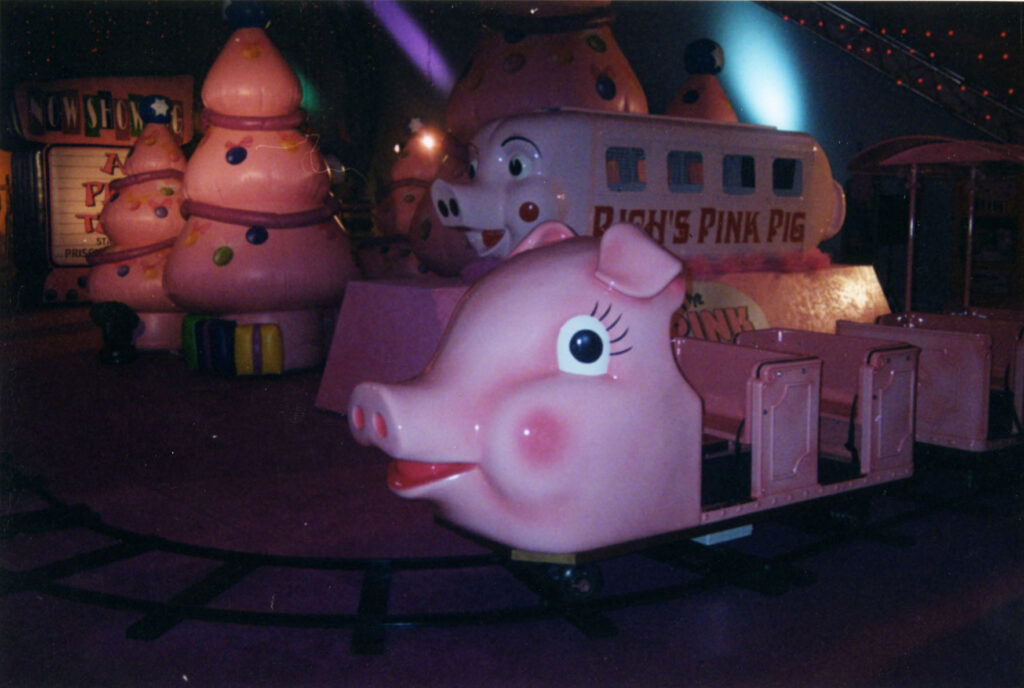
Christmas celebrations at Rich’s further reinforced the bond between the store and Atlanta. In 1948 a seventy-foot live Christmas tree was first placed on the roof of Rich’s downtown department store. Thereafter, the Lighting of the Great Tree became an Atlanta tradition, with thousands of people attending the event each Thanksgiving. The tree-lighting ceremony now takes place at the Lenox Square Mall store in Buckhead. In 1953 Rich’s introduced Priscilla the Pink Pig, a children’s train ride around the toy department. It was so popular that Rich’s added a second train, Percival, and moved the ride outside to encircle the Great Tree. There the ride remained until the downtown store closed in 1991. The trains then ran at Egleston Children’s Hospital (later Children’s Healthcare of Atlanta) before being donated to the Atlanta History Center in 1995. In 2003 a new version of Priscilla was revived at the Rich’s store in Lenox Square Mall.
Photograph by Kate Howard, New Georgia Encyclopedia
Although possessing a reputation for being more tolerant toward African American customers than many other stores in the South, Rich’s still found itself the target of the civil rights movement in the 1960s. Local African American college students staged sit-ins at the store, in large part because of its prominence in the community. Well-known civil rights activist and sit-in participant Julian Bond later noted that “if Rich’s went, so would everybody else,” meaning that other stores would desegregate if Rich’s did. The students targeted the Magnolia Room, Rich’s segregated restaurant. In October 1960, several students, along with Martin Luther King Jr., were arrested while conducting a sit-in at the Magnolia Room. A boycott of the store followed the arrests, and by the fall of 1961, Rich’s began to desegregate.
In 1975 Nathalie Dupree, a prominent Georgia chef, opened a cooking school at Rich’s that ran for nearly ten years. Federated Department Stores acquired Rich’s in 1976 and later merged with the New York–based R. H. Macy and Company in 1994. In 2003 Federated integrated the separate Rich’s and Macy’s department stores in Georgia under one nameplate, Rich’s-Macy’s. As a result of these and other mergers, Federated became a leading department store retailer in the nation, with net sales in 2004 exceeding $15.4 billion. The creation of the Rich’s-Macy’s nameplate signaled the end of an era for many Georgians who had been raised on shopping trips to the downtown store, meals in the Magnolia Room, and rides on the Pink Pig. Finally in 2005, Rich’s-Macy’s became just Macy’s, after Federated elected to drop the name of the Atlanta institution.

Courtesy of Nathalie Dupree
An exhibition entitled Return to Rich’s: The Story behind the Store ran at the William Breman Jewish Heritage Museum in Atlanta from November 2013 to May 2014.