Skip to content
New Georgia Encyclopedia
  • Home
  • Articles & Media
  • Browse by Topic
  • Browse Collections
  • Browse Georgia Standards
  • A-Z Index
  • Exhibitions
  • Educators
  • Browse    Chevron down
  • Exhibitions
  • Educators
By Topic Content Collections Georgia Standards A-Z Index Arrow right
  • Arts & Culture

    Arts & Culture

  • Business & Economy

    Business & Economy

  • Counties, Cities & Neighborhoods

    Counties, Cities & Neighborhoods

  • Education

    Education

  • Geography & Environment

    Geography & Environment

  • Government & Politics

    Government & Politics

  • History & Archaeology

    History & Archaeology

  • People

    People

  • Science & Medicine

    Science & Medicine

  • Sports & Outdoor Recreation

    Sports & Outdoor Recreation

Frankie Welch’s Americana
Featured

Frankie Welch’s Americana

Fashion and politics from Georgia-born designer Frankie Welch

Stamp Collection
Featured

Stamp Collection

Stamps honoring the political figures, artists, and culture of Georgia.

Recently Added
View All Arrow right
City Page: Atlanta

City Page: Atlanta

Stamp Collection

Stamp Collection

Frankie Welch’s Americana

Frankie Welch’s Americana

  • Georgia Studies

    Georgia Studies

    Eighth Grade
  • Georgia, My State

    Georgia, My State

    Second Grade
All Topics Arrow right History & Archaeology Arrow right Colonial Era, 1733-1775 Arrow right

Colonial Groups & Organizations

Colonial Military

Colonial Military

Enslaved Women

Enslaved Women

French Presence in Georgia

French Presence in Georgia

Malcontents

Malcontents

Salzburgers

Salzburgers

Slave Patrols

Slave Patrols

Women in Colonial Georgia

Women in Colonial Georgia

Yamacraw Indians

Yamacraw Indians

Loading
Star

Featured Content

Civil Rights Movement

Civil Rights Movement

Mid- to Late 20th Century Topics
Harriet Powers

Harriet Powers

People
Trending

Trending

Nancy Harts Militia

Nancy Harts Militia

Civil War & Reconstruction Groups & Organizations
Harriet Powers

Harriet Powers

People
Georgia Guidestones

Georgia Guidestones

Sites & Museums
Ebos Landing

Ebos Landing

Antebellum Places
Clock

Updated Recently

Dougherty County

Dougherty County

1 week ago
Mary Frances Early

Mary Frances Early

1 week ago
Darton State College

Darton State College

1 week ago
Georgia Southwestern State University

Georgia Southwestern State University

1 week ago

A More Perfect Union

The New Georgia Encyclopedia is supported by funding from A More Perfect Union, a special initiative of the National Endowment for the Humanities.

Learn More
New Georgia Encyclopedia
ISSN 2765-8732
Project Partners
logo-press UGA Press logo-galileo GALILEO logo-humanities Georgia Humanities logo-seal Office of the Governor logo-libraries UGA Libraries
Articles & Media
  • Browse by Topic
  • Content Collections
  • Georgia Standards
Special Content
  • Quizzes
  • Exhibitions
  • Spotify Playlists
  • Georgia Exhibits
  • Educator Resources
About
  • The Project
  • The People
  • Sponsors & Partners
Editorial
  • Our Process
  • Contributor Info
  • Permissions & Use
Stay in Touch
Facebook Instagram Twitter Contact Us
Donate to the NGE

Your support helps us commission new entries and update existing content.

Donate

© 2004–2026 Georgia Humanities, University of Georgia Press

  • Terms of Use
  • Privacy Policy

Media gallery

New Ebenezer

New Ebenezer

  • Info Details
  • Citation Terms of Use

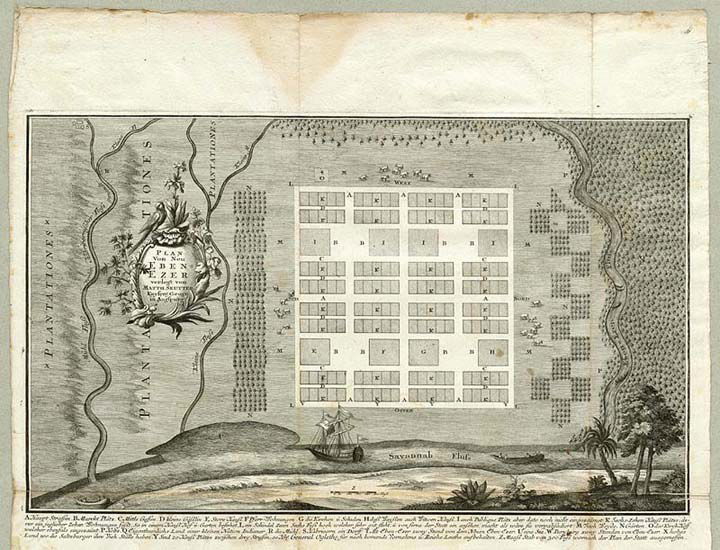
German artist Philip Georg Friedrich von Reck drew a map of New Ebenezer during his visit to the settlement in 1736. New Ebenezer, located on the bluffs above the Savannah River, was the second settlement established by the Georgia Salzburgers, a group of Protestants expelled from the Catholic province of Salzburg in 1731.

Illustration by Philip Georg Friedrich von Reck

The New Georgia Encyclopedia does not hold the copyright for this media resource and can neither grant nor deny permission to republish or reproduce the image online or in print. All requests for permission to publish or reproduce the resource must be submitted to the rights holder.

Jerusalem Church

Jerusalem Church

  • Info Details
  • Citation Terms of Use

Jerusalem Church was established by the Salzburgers in Ebenezer during the 1730s. Ebenezer, left in ruins after the Revolutionary War, had disappeared by 1855, but Jerusalem Church, now known as Jerusalem Evangelical Lutheran Church, still stands. It is one of the few buildings in Georgia left intact after the Revolutionary War.

Photograph by Bruce Tuten

The New Georgia Encyclopedia does not hold the copyright for this media resource and can neither grant nor deny permission to republish or reproduce the image online or in print. All requests for permission to publish or reproduce the resource must be submitted to the rights holder.

Early Ebenezer

Early Ebenezer

  • Info Details
  • Citation Terms of Use

This sketch of the early Ebenezer settlement was drawn in 1736 by Philip Georg Friedrich von Reck. That same year the Salzburger settlement moved to a location closer to the Savannah River, where conditions were better for farming.

Print from Von Reck Archive, Royal Library of Denmark, Copenhagen

The New Georgia Encyclopedia does not hold the copyright for this media resource and can neither grant nor deny permission to republish or reproduce the image online or in print. All requests for permission to publish or reproduce the resource must be submitted to the rights holder.

Yamacraw Territory

Yamacraw Territory

  • Info Details
  • Citation Terms of Use

A map of Georgia, circa 1745, shows the territory inhabited by the Yamacraw Indians, a group formed in 1728 by disaffected Muscogee (Creek) and Yamasee Indians. The Yamacraws, led by Tomochichi, established their first community on the bluffs of the Savannah River. After the arrival of James Oglethorpe in 1733, the group agreed to move north to accomodate Oglethorpe's plans to build an outpost, which later became the city of Savannah.

From History of Georgia, by C. Howell

The New Georgia Encyclopedia does not hold the copyright for this media resource and can neither grant nor deny permission to republish or reproduce the image online or in print. All requests for permission to publish or reproduce the resource must be submitted to the rights holder.

Tomochichi

Tomochichi

  • Info Details
  • Citation Terms of Use

As a principal mediator between the native Muscogee (Creek) and English settlers during the first years of Georgia's settlement, Tomochichi (left) contributed to the establishment of peaceful relations between the two groups. His nephew, Toonahowi, is seated on the right in this engraving, circa 1734-35, by John Faber Jr.

Courtesy of Hargrett Rare Book and Manuscript Library, University of Georgia Libraries.

The New Georgia Encyclopedia does not hold the copyright for this media resource and can neither grant nor deny permission to republish or reproduce the image online or in print. Requests for permission to publish or reproduce the resource should be submitted to the Hargrett Manuscript and Rare Book Library at the University of Georgia.

James Oglethorpe

James Oglethorpe

  • Info Details
  • Citation Terms of Use

James Oglethorpe founded the colony of Georgia in 1733 and built Fort Frederica, which became the center of colonial frontier defense, on St. Simons Island in 1736. Oglethorpe also recruited men from along the colonial milita to form the Rangers, a full-time military force.

Courtesy of Georgia Historical Society, Georgia Historical Society collection of portraits, #GHS 1361-PH-25-08-4841.

View on partner site

The New Georgia Encyclopedia does not hold the copyright for this media resource and can neither grant nor deny permission to republish or reproduce the image online or in print. All requests for permission to publish or reproduce the resource must be submitted to Georgia Historical Society.

Sixtieth Regiment of Foot

Sixtieth Regiment of Foot

  • Info Details
  • Citation Terms of Use

Three companies of the British Sixtieth Regiment of Foot were sent to the Georgia colony in 1763 by King George III to strengthen the defense of colonial garrisons against attack by the French and Spanish.

Courtesy of The Company of Military Historians
The New Georgia Encyclopedia does not hold the copyright for this media resource and can neither grant nor deny permission to republish or reproduce the image online or in print. All requests for permission to publish or reproduce the resource must be submitted to the rights holder.

  • Info Details
  • Citation Terms of Use

The New Georgia Encyclopedia does not hold the copyright for this media resource and can neither grant nor deny permission to republish or reproduce the image online or in print. All requests for permission to publish or reproduce the resource must be submitted to the rights holder.

James Wright

James Wright

  • Info Details
  • Citation Terms of Use

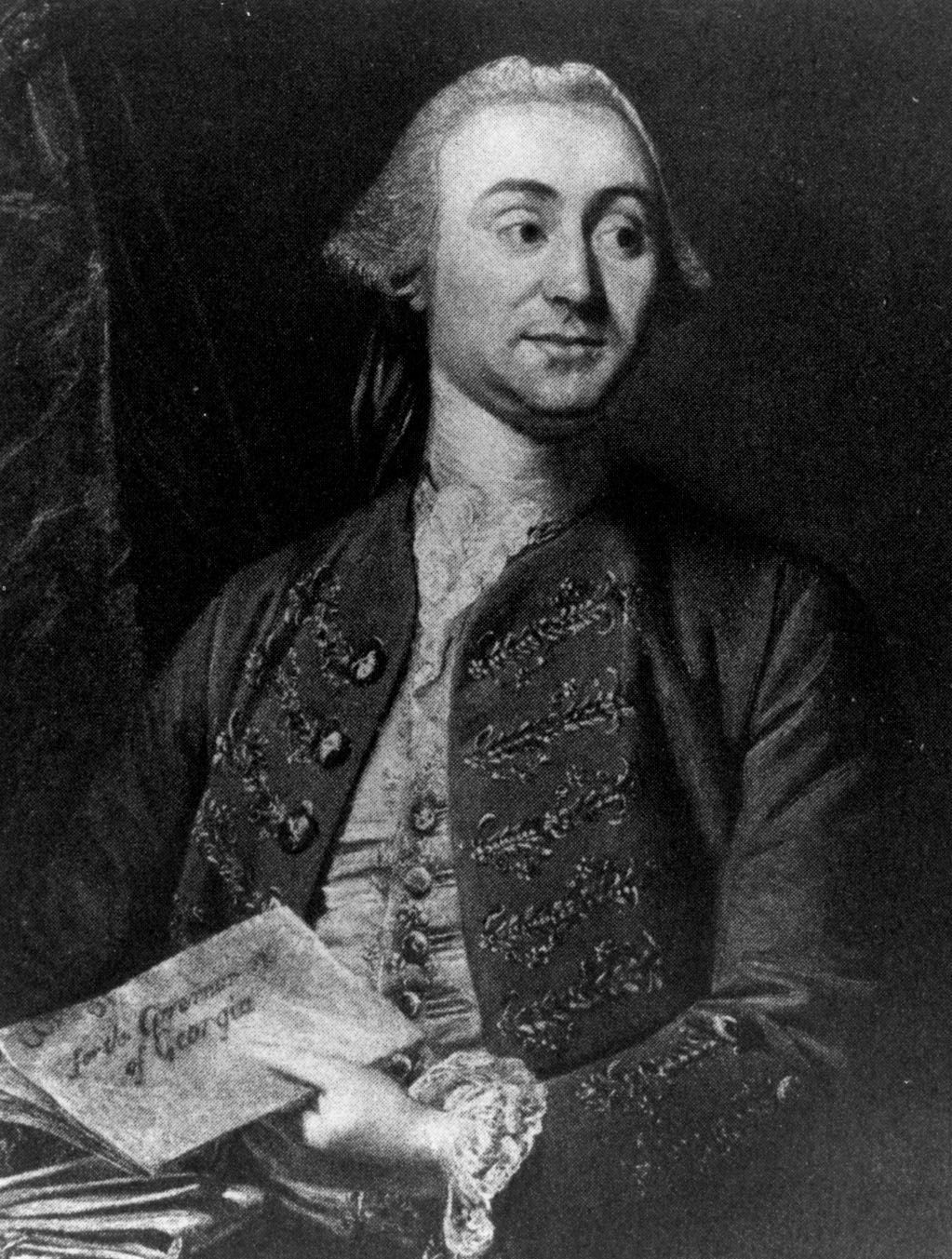
James Wright replaced Henry Ellis as royal governor of Georgia in 1760 and proved to be an efficient and popular administrator. During his tenure in office (1760-76) Georgia enjoyed a period of remarkable growth.

Courtesy of Hargrett Rare Book and Manuscript Library, University of Georgia Libraries, Georgia Photo File.

The New Georgia Encyclopedia does not hold the copyright for this media resource and can neither grant nor deny permission to republish or reproduce the image online or in print. Requests for permission to publish or reproduce the resource should be submitted to the Hargrett Manuscript and Rare Book Library at the University of Georgia.

Mary Musgrove

Mary Musgrove

  • Info Details
  • Citation Terms of Use

Mary Musgrove (pictured with her third husband, the Reverend Thomas Bosomworth) served as a cultural liaison between colonial Georgia and her Native American community in the mid-eighteenth century. She took advantage of her biculturalism to protect Muscogee (Creek) interests, maintain peace on the frontier, and expand her business as a trader.

Courtesy of Hargrett Rare Book and Manuscript Library, University of Georgia Libraries.

The New Georgia Encyclopedia does not hold the copyright for this media resource and can neither grant nor deny permission to republish or reproduce the image online or in print. Requests for permission to publish or reproduce the resource should be submitted to the Hargrett Manuscript and Rare Book Library at the University of Georgia.

  • Info Details
  • Citation Terms of Use

The New Georgia Encyclopedia does not hold the copyright for this media resource and can neither grant nor deny permission to republish or reproduce the image online or in print. All requests for permission to publish or reproduce the resource must be submitted to the rights holder.

Woodcut from 1839 Anti-Slavery Almanac

Woodcut from 1839 Anti-Slavery Almanac

  • Info Details
  • Citation Terms of Use

A woodcut depicts the capture of a fugitive from slavery by a slave patrol. Slave patrols were common in Georgia from 1757 until the end of the Civil War in 1865.

From The American Anti-Slavery Almanac for 1839

The New Georgia Encyclopedia does not hold the copyright for this media resource and can neither grant nor deny permission to republish or reproduce the image online or in print. All requests for permission to publish or reproduce the resource must be submitted to the rights holder.

Slave Patrols

Slave Patrols

  • Info Details
  • Citation Terms of Use

A Georgia statute ordered white adults to ride the roads at night, stopping all enslaved people they encountered and making them prove that they were engaged in lawful activities. Patrollers required enslaved people to produce a pass, which stated their owner's name as well as where and when they were allowed to be away from the plantation and for how long.

From The Underground Railroad, by William Still
The New Georgia Encyclopedia does not hold the copyright for this media resource and can neither grant nor deny permission to republish or reproduce the image online or in print. All requests for permission to publish or reproduce the resource must be submitted to the rights holder.

Daguerreotype of Enslaved Woman

Daguerreotype of Enslaved Woman

  • Info Details
  • Citation Terms of Use

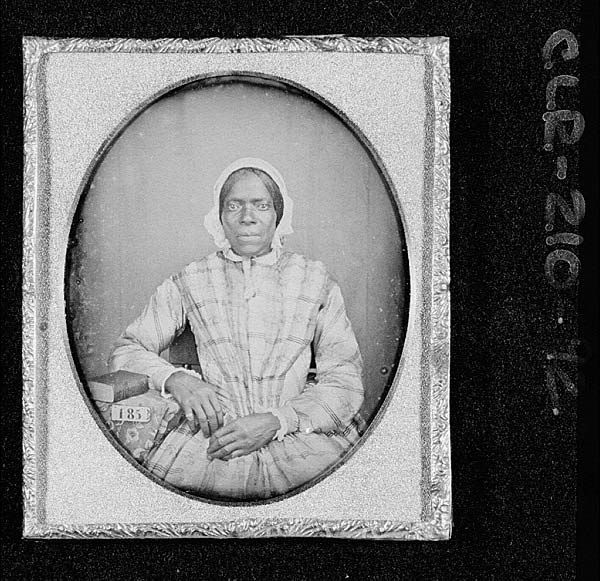
Rare daguerreotype of an enslaved woman in Watkinsville, photographed in 1853. A placard with the date "1853," which reads correctly for the camera, is visible. The use of a book as a prop is unusual for an image of an enslaved person.

Courtesy of Georgia Archives, Vanishing Georgia, #
clr210-92.

View on partner site

The New Georgia Encyclopedia does not hold the copyright for this media resource and can neither grant nor deny permission to republish or reproduce the image online or in print. Requests for permission to publish or reproduce the resource should be submitted to the Georgia Archives.

Enslaved Woman

Enslaved Woman

  • Info Details
  • Citation Terms of Use

Enslaved women played an integral part in Georgia's colonial and antebellum history. Scholars are beginning to pay more attention to issues of gender in their study of slavery and are finding that enslaved women faced additional burdens and even more challenges than did some enslaved men.

Courtesy of Hargrett Rare Book and Manuscript Library, University of Georgia Libraries, Robert E. Williams Photographic Collection.

The New Georgia Encyclopedia does not hold the copyright for this media resource and can neither grant nor deny permission to republish or reproduce the image online or in print. Requests for permission to publish or reproduce the resource should be submitted to the Hargrett Manuscript and Rare Book Library at the University of Georgia.

Enslaved Woman

Enslaved Woman

  • Info Details
  • Citation Terms of Use

Antebellum planters kept meticulous records of the people they enslaved, identifying several traditionally female occupations, including washerwomen.

Courtesy of Hargrett Rare Book and Manuscript Library, University of Georgia Libraries, Robert E. Williams Photographic Collection.

The New Georgia Encyclopedia does not hold the copyright for this media resource and can neither grant nor deny permission to republish or reproduce the image online or in print. Requests for permission to publish or reproduce the resource should be submitted to the Hargrett Manuscript and Rare Book Library at the University of Georgia.

Enslaved Children

Enslaved Children

  • Info Details
  • Citation Terms of Use

Enslavers clothed both male and female enslaved children in smocks and assigned them such duties as carrying water to the fields. As the children neared the age of ten, slaveholders began making distinctions between the genders.

Courtesy of Hargrett Rare Book and Manuscript Library, University of Georgia Libraries, Robert E. Williams Photographic Collection.

The New Georgia Encyclopedia does not hold the copyright for this media resource and can neither grant nor deny permission to republish or reproduce the image online or in print. Requests for permission to publish or reproduce the resource should be submitted to the Hargrett Manuscript and Rare Book Library at the University of Georgia.

  • Info Details
  • Citation Terms of Use

The New Georgia Encyclopedia does not hold the copyright for this media resource and can neither grant nor deny permission to republish or reproduce the image online or in print. All requests for permission to publish or reproduce the resource must be submitted to the rights holder.

Ellen Craft

Ellen Craft

  • Info Details
  • Citation Terms of Use

The daughter of an African American woman and her white enslaver, Ellen looked white and was able to escape slavery by disguising herself as a southern slaveholder.

From The Underground Rail Road, by W. Still

The New Georgia Encyclopedia does not hold the copyright for this media resource and can neither grant nor deny permission to republish or reproduce the image online or in print. All requests for permission to publish or reproduce the resource must be submitted to the rights holder.

Fanny Kemble

Fanny Kemble

  • Info Details
  • Citation Terms of Use

An English actress, Kemble married Pierce Mease Butler and was upset to learn of the family's slave labor operations. She eventually published an account of her impressions of slavery, after divorcing Butler and losing custody of their two children.

Courtesy of Hargrett Rare Book and Manuscript Library, University of Georgia Libraries, Georgia Photo File.

The New Georgia Encyclopedia does not hold the copyright for this media resource and can neither grant nor deny permission to republish or reproduce the image online or in print. Requests for permission to publish or reproduce the resource should be submitted to the Hargrett Manuscript and Rare Book Library at the University of Georgia.

Tailfer’s Title Page

Tailfer’s Title Page

  • Info Details
  • Citation Terms of Use

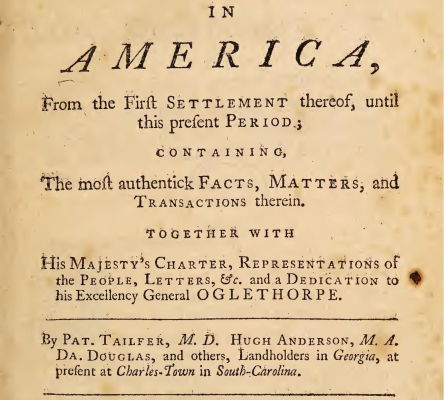
During the 1730s, Scottish settler Patrick Tailfer led a group of colonists, knowns as the Malcontents, in protest of various laws and policies enforced by the Georgia Trustees. His 1740 tract, entitled A True and Historical Narrative of the Colony of Georgia, was read in influential circles but failed to make a substantial impact on the circumstances of the Malcontents.

From A True and Historical Narrative of the Colony of Georgia in America, by P. Tailfer
The New Georgia Encyclopedia does not hold the copyright for this media resource and can neither grant nor deny permission to republish or reproduce the image online or in print. All requests for permission to publish or reproduce the resource must be submitted to the rights holder.

Hermitage Plantation

Hermitage Plantation

  • Info Details
  • Citation Terms of Use

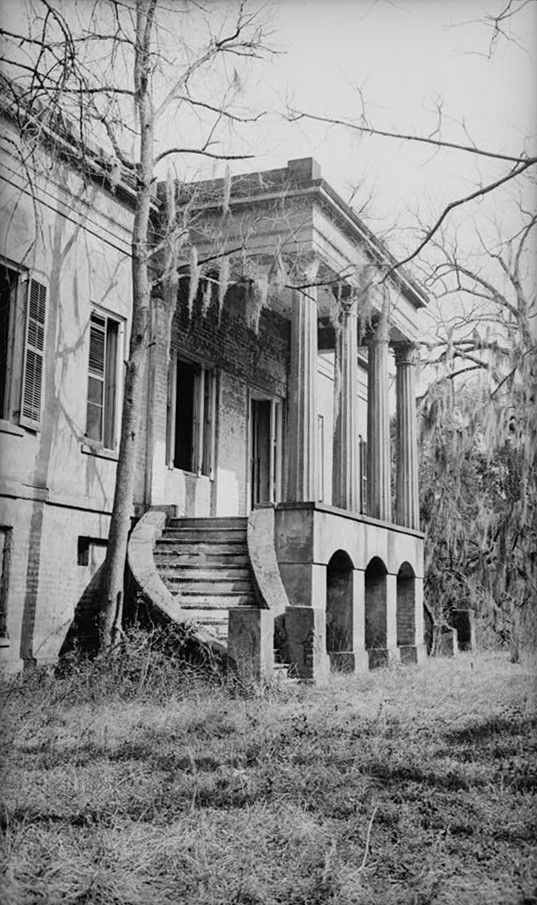
The Hermitage Plantation (1830), outside of Savannah, was owned by the French settler the Marquis de Montalet. Architect Charles Cluskey designed the house. Handmade bricks made at the plantation in the 1840s can be seen in some Savannah houses.

Courtesy of Library of Congress, Prints and Photographs Division

The New Georgia Encyclopedia does not hold the copyright for this media resource and can neither grant nor deny permission to republish or reproduce the image online or in print. All requests for permission to publish or reproduce the resource must be submitted to the rights holder.

Lafayette in Georgia

Lafayette in Georgia

  • Info Details
  • Citation Terms of Use

In this painting, Lafayette is portrayed reviewing the Georgia Hussars, the Chatham Artillery, and the Savannah Volunteer Guards from the balcony of the Owens-Thomas House in Savannah during his 1825 visit to the state.

Courtesy of Preston Russell

The New Georgia Encyclopedia does not hold the copyright for this media resource and can neither grant nor deny permission to republish or reproduce the image online or in print. All requests for permission to publish or reproduce the resource must be submitted to the rights holder.

New Ebenezer Jerusalem Church Early Ebenezer Yamacraw Territory Tomochichi James Oglethorpe Sixtieth Regiment of Foot
James Wright Mary Musgrove
Woodcut from 1839 Anti-Slavery Almanac Slave Patrols Daguerreotype of Enslaved Woman Enslaved Woman Enslaved Woman Enslaved Children
Ellen Craft Fanny Kemble Tailfer’s Title Page Hermitage Plantation Lafayette in Georgia