
Candidates running for office in Georgia come under one of two sets of laws, federal and state, that govern the raising and spending of campaign funds. Both federal and state campaign finance laws have been frequent targets of reform efforts.
Federal Laws
Candidates for federal office must follow restrictions first established by the Federal Election Campaign Act (FECA) in 1971. To this day, FECA forms the basis for federal laws around campaign financing and spending. In 1974 FECA restrictions were tightened in the wake of the Watergate scandal.
In the 1990s critics began to charge that the system bred corruption, and a populist agenda emerged to reform the system. In every session of Congress from 1995 to 2001, Senators John McCain (a Republican from Arizona) and Russ Feingold (a Democrat from Wisconsin) sponsored major legislation to overhaul FECA.

In 2002 a modified version of the McCain-Feingold bill was passed by Congress and signed into law by President George W. Bush. Entitled the Bipartisan Campaign Reform Act (BCRA) of 2002, the law mandated several changes in the financing of campaigns as established in FECA. It made recommendations to the Federal Election Commission (FEC), the bipartisan board that enforces federal campaign finance laws, on ways to create easier access for the public to review campaign contributions and expenditures. It also placed restrictions on contributions to political parties, thereby limiting the ability of parties to raise large undisclosed contributions from a single entity.
Overall, BCRA put limits on the amount of direct contributions campaigns could receive from a single donor, but it also imposed restrictions on the amount of money that corporations, unions, and special interest groups could spend on electioneering activity. Such funds—which are raised outside of the limitations placed on direct donations to candidates—are often referred to as “soft money.”
In 2010, however, many of the BCRA’s changes to campaign financing would be undone with the Supreme Court’s ruling in Citizens United v. FEC. The court ruled in favor of the complainant, arguing that corporations had free speech rights similar to those of individuals, and that the government therefore could not uphold BCRA’s restrictions on independent corporate expenditures, including the amount spent on electioneering activity. The ruling meant that large organizations could indirectly support campaigns with fewer restrictions on their soft money spending.
The Citizens United ruling and subsequent challenges to BCRA opened the floodgates for the proliferation of sizeable anonymous donations in American politics. There was an increase in the creation of large political action committees known as “super PACs,” a type of political nonprofit that—so long as it makes no direct donations to candidates’ campaigns—can receive an unlimited amount of donations and spend an unlimited amount of funds on electioneering activities like advertising and opinion polling. Since the ruling, the precedent set by Citizens United has regularly faced pushback. Some members of Congress continue to introduce bills that would establish firmer regulations around corporate campaign spending.
Most of FECA’s laws (and by extension, BRCA’s provisions) surrounding direct campaign contributions still stand. As of 2025, candidates running for federal office are required to report all direct campaign contributions over $200. Contributions by an individual to a single candidate are limited to $3,500 per election, with the primary and general election counting as separate elections. The restrictions on direct contributions from groups follow the same principle but with higher per election limits: $5,000 from a PAC, $5,000 combined total from state and local political parties, and $5,000 (U.S. House only) from a national political party. The only exception is the U.S. Senate, which limits contributions by national party committees to $62,000 per campaign (including the primary and general elections). The FEC maintains an extensive online record base that is easily searchable by the public.
There are no restrictions on the amount of one’s own money a candidate may spend in a quest for public office, federal or state. The U.S. Supreme Court ruled in Buckley v. Valeo (1976) that a candidate’s personal contributions are an exercise of free speech and thus are not subject to limitations.
Georgia State Laws
Campaigns for state office, such as governor or General Assembly, are bound by state laws, which differ from federal statutes. The responsibility for ensuring compliance with Georgia’s campaign finance laws falls to the State Ethics Commission. That office compiles and publishes reports on all registered campaigns. Traditionally, the standards set by the state for candidates under its jurisdiction have been much less restrictive than those set for candidates running for federal office.
The state laws governing elections and campaign activity are found in title twenty-one of the Georgia Code, and more-specific campaign finance rules are codified in chapter five. These statutes restrict the ways a candidate can raise money and set standards for record keeping, use, and distribution of campaign money. For example, a candidate must establish a separate bank account for the receipt of campaign funds, and all contributions over $101 must be disclosed.
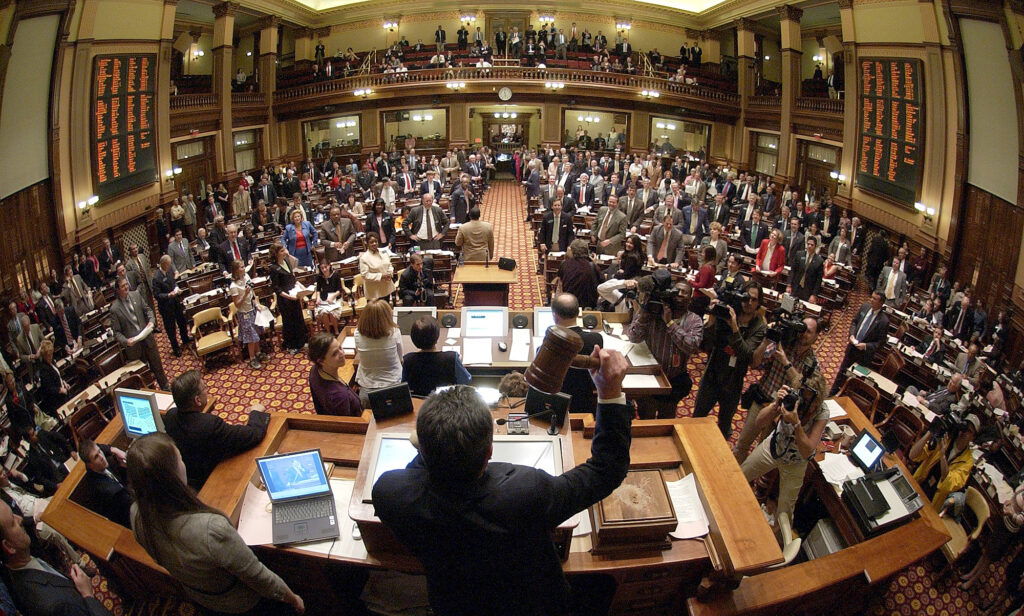
Georgia’s campaign contribution limits were once among the least restrictive in the nation, but as the campaign reform agenda began to gain momentum at the national level, calls for reform became louder in the state as well. Roy Barnes made campaign finance reform an issue in his 1998 gubernatorial campaign, and in 2000, as governor, he sent legislation to the floor of the General Assembly. The governor and proponents of reform legislation in the General Assembly sought to bring state limits close to those imposed on federal candidates. As the reform bill made its way through the legislative process, however, it was significantly altered; the enacted version actually raised the amount of money that could be contributed to campaigns. This 2000 law set different limits for candidates running for statewide office and those running for the General Assembly or local office. It also required electronic filing of disclosure reports with the secretary of state.
The amounts candidates in Georgia can receive regularly rises to keep pace with inflation. New limits went into effect in 2023. From a single source (for example, an individual, corporation, PAC, or political party), candidates running for statewide office can receive up to $8,400 for the primary election, $8,400 for the general election, and $4,800 for any runoff election that results from a primary or general election. All other candidates can, from a single source, receive up to $3,300 for the primary election, $3,300 for the general election, and $1,800 for any runoff election that results from a primary or general election. Candidates must file these contributions with the State Ethics Commission.
In 2021 a Georgia senate bill passed that allowed for the creation of “leadership committees.” Leadership committees can be formed by candidates running for governor or lieutenant governor (both incumbents and nominees) and the majority and minority caucuses of the Georgia senate and House of Representatives. Leadership committees may, per Georgia Law, use funds “for the purpose of affecting the outcome of any election or advocating for the election or defeat of any candidate.” Leadership committees must report all accepted contributions and expenditures over $500; but unlike with candidates’ campaigns, individual donors are allowed to contribute an unlimited amount of funds to a leadership committee. This characteristic, along with leadership committees’ abilities to use funds with such broad discretion, has made leadership committees controversial. They have been the subject of lawsuits from both Democrats and Republicans in Georgia.
Georgia, unlike some other states, does not offer candidates any public funds for campaigning. Georgia law also prohibits candidates from paying personal expenses with campaign funds. Leftover funds may be transferred to another campaign, saved for a future campaign, spent to retire campaign debt, donated to a political party, or donated to charity. A candidate will sometimes make a personal loan to his or her campaign with the expectation that once campaign contributions begin to arrive, the loan will be paid back. This practice is legal under both Georgia and federal law.


