
The Fernbank Science Center in Atlanta is a unique combination of urban forest, planetarium, observatory, and exhibit hall. It sits on four acres of land in DeKalb County on the edge of a sixty-five-acre forest preserved for educational purposes. The center’s mission is to increase the public’s science literacy and to improve science education at the local, state, and nation levels, with particular focus on the DeKalb County School System.
Fernbank Forest
After the death of Col. Z. D. Harrison in 1935, his daughter, Emily Harrison, an environmentalist, wished to preserve the land—which was once part of the Muscogee (Creek) and Cherokee Nations—and turn it into an outdoor classroom. Partnering with Dr. Woolford Baker, a biologist at Emory, and several other environmentalists, Harrison led the push to purchase the land and establish Fernbank, Inc. as a charity in 1939.
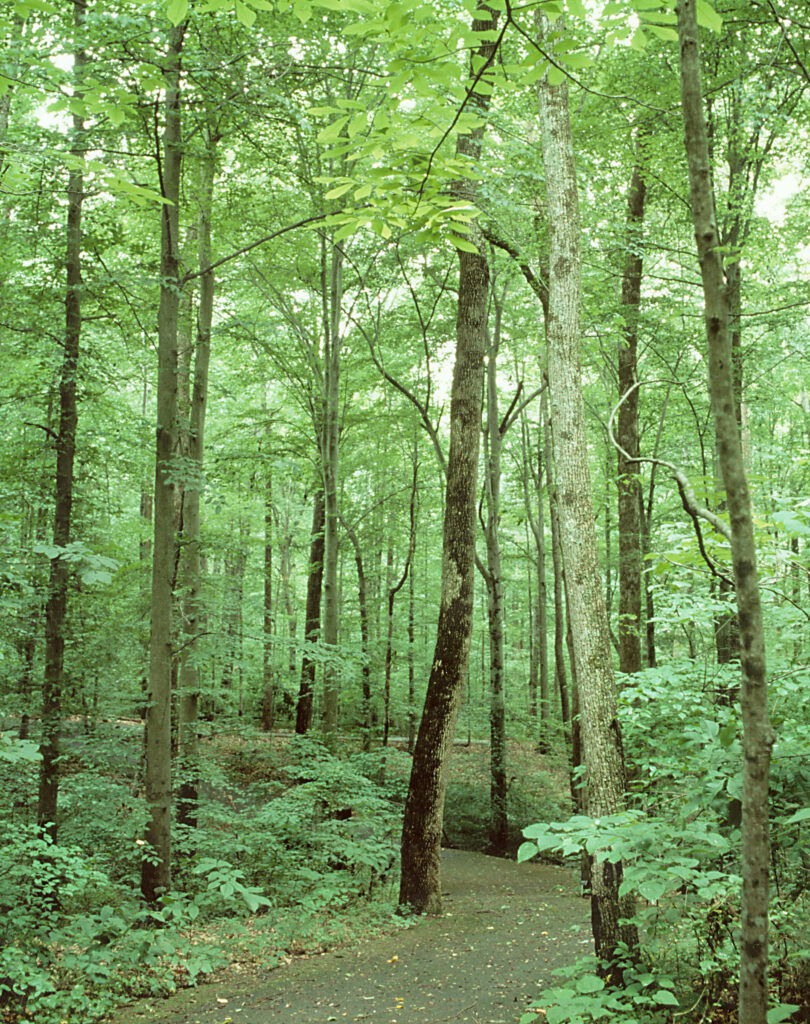
In 1964 the Fernbank Trustees leased the forest for public and school use to the DeKalb County Board of Education, stipulating that the area be protected and maintained in as close to its natural state as possible. Nearly all of Atlanta’s original vegetation has been destroyed, first by farming and later by urban and suburban development. Visitors to Fernbank Forest can observe a tract of relatively undisturbed mature mixed-hardwood forest, a remnant of the type of forest vegetation that originally covered the Piedmont region of Georgia, including the Atlanta metropolitan area.
Fernbank Forest is used as a “living laboratory” throughout the year. During school hours, Fernbank Science Center biology and horticulture instructors offer a variety of scheduled programs in Fernbank Forest to visiting students. In the afternoons and on weekends, visitors can walk the one and a half miles of paved trails, accompanied by trail guides knowledgeable in such areas as tree identification, wildflowers, or forest ecology.
Science Center and Museum
The Science Center building was completed and dedicated in December 1967 at a cost of about $1 million, which was generated by a school bond issue. The Science Center now operates on a budget from the DeKalb County School System.
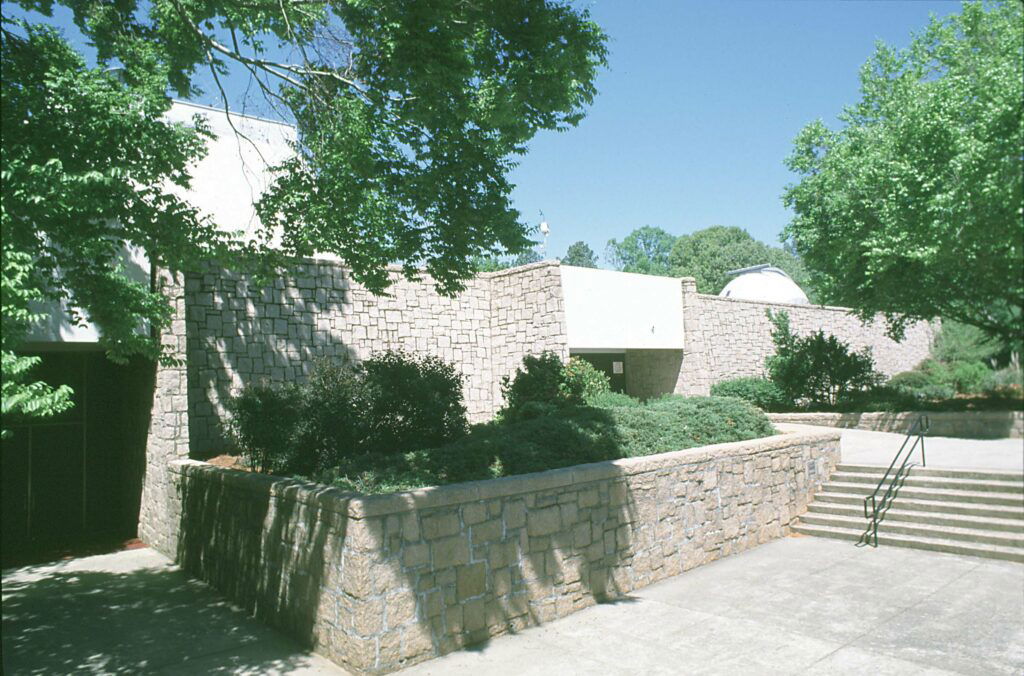
In 1989 the special relationship between Fernbank Science Center and Fernbank Inc. was formalized in a public ceremony during which both groups were designated as Partners-in-Education. In October 1992 Fernbank Inc. opened the new 160,000-square-foot Fernbank Museum of Natural History. Though sharing the same first name and nearby locations, the Fernbank Museum of Natural History and the Fernbank Science Center are two distinct entities. While the Science Center is affiliated with the DeKalb County School System, the Museum of Natural History is an independent nonprofit, receiving its funding through various giving societies and private donations.
In 2012 the DeKalb County Board of Education announced the possibility of closing the Science Center in an effort to cut spending. Yet, a community-wide protest led the Board to backtrack their announcement, highlighting the importance of the Science Center’s public engagement efforts.
Observatory and Planetarium
The Fernbank Observatory at the Science Center houses the largest telescope in the southeastern United States, a 0.9-meter (36-inch) Cassegrain reflector, beneath a 10-meter (30-foot) dome. One of the largest instruments ever dedicated to education and public viewing, the telescope is used for observations of the moon, planets, and such deep-sky objects as nebulae, star clusters, and galaxies. Astronomy programs at the observatory range from elementary to college levels and also include adult education courses and public viewing.
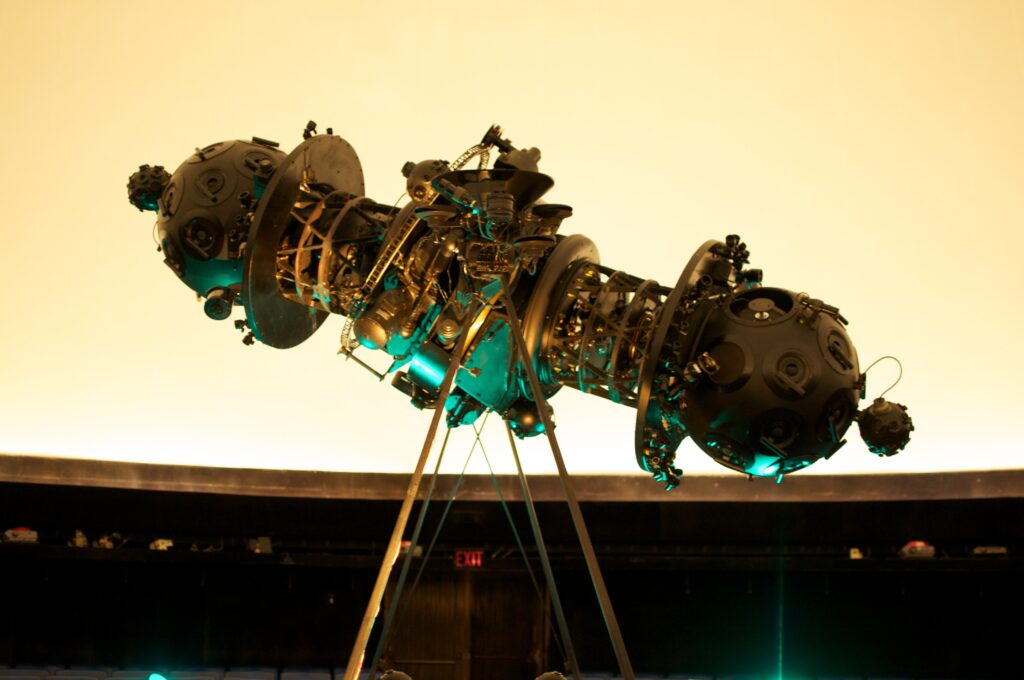
Since its opening in 1967, the Science Center’s Jim Cherry Memorial Planetarium has attracted nearly 5 million visitors. The planetarium ranks as one of the largest in the Southeast. The German-built Carl Zeiss Mark V projector is the centerpiece of the facility and is used, along with more than 200 other projectors, to present programs written and produced by the planetarium staff.
Exhibit Hall
The exhibit hall at Fernbank Science Center spans some 9,000 square feet and circles the planetarium’s theater. Some of the highlights in the exhibit area include an Apollo 6 space capsule, moon rocks, georgiaites, animals of the Okefenokee Swamp, songbirds of the Fernbank Forest, rocks and minerals, and a live bee exhibit.


