
South Georgia Technical College is located in Americus, the seat of Sumter County, in southwest Georgia. A satellite campus in Crisp County (in Cordele), together with the main campus, provides education and employment training to the college’s seven-county service delivery area, which includes Crisp, Macon, Marion, Schley, Sumter, Taylor, and Webster counties. South Georgia Tech is a member of the Technical College System of Georgia (TCSG).
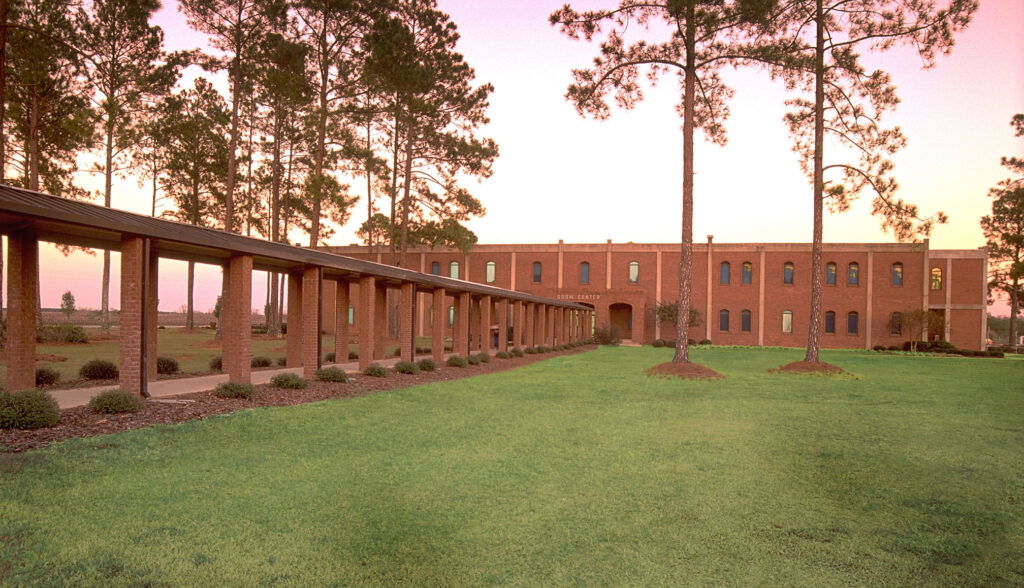
South Georgia Tech is often associated with the field of aviation—a one-third-sized replica of Lockheed Martin’s F-22 Raptor fighter jet is attached to the school’s entrance sign, and the college’s grounds rest on part of Souther Field, where Charles Lindbergh made his first solo flight in 1923. Today, the college offers more than 200 associate degree, diploma, and technical certificate programs.
History
South Georgia Trade and Vocational School opened in 1948 under the directorship of Jed B. Yingling and offered programs in aircraft mechanics, auto mechanics, cabinetmaking, diesel mechanics, radio and television repair, and upholstery refinishing. It was the second vocational school in Georgia. Horace P. Odom succeeded Yingling as director in 1950. In 1963 the school became known as South Georgia Technical and Vocational School, and in 1967 Hugh Ford Hayes became director, followed by Dea O. Pounders in 1970. In 1988 the school came under the governance of the newly formed Department of Technical and Adult Education (DTAE) and at that time became known as South Georgia Technical Institute.
South Georgia Tech opened the Crisp County Center, its satellite campus in Cordele, in 1990. Jon E. Johnson was appointed president of the school in 1996. In 2000, due to legislation (Georgia House Bill 1187) that allowed technical institutes offering associate degrees to be called colleges, South Georgia Tech officially acquired the name South Georgia Technical College. The college’s men’s basketball team, the Jets, was established in 2001, followed by the women’s team, the Lady Jets, in 2004.
In 2007 the DTAE created the Technical College System of Georgia, an entity comprising the technical colleges under its administration, and in 2008 the DTAE’s name officially changed to TCSG.
South Georgia Tech enrolled 2,617 students in fiscal year 2024. The college also reports a 99 percent job placement rate for graduates. In additional to its credit programs, South Georgia Tech offers adult education, dual enrollment, learning support, general core, and noncredit continuing education classes.
Technical Education and Economic Development Programs
The TCSG, in overseeing the state’s system of twenty-two technical colleges, its economic and workforce development programs, and its adult education program, has as its primary objective to create a well-educated, technically trained, and highly competitive workforce to ensure the economic success of the state and its citizens.
As with other technical colleges governed by the TCSG, admission to South Georgia Tech relies on eligibility and academic criteria: candidates must be at least sixteen years old, although some programs have higher age or additional admissions requirements. A high school diploma or state-authorized high school equivalency credential is generally required for entry into most programs. Students pursuing degree or diploma programs must also have a high school diploma or high school equivalency credential before graduating from South Georgia Tech. After meeting admission and program requirements, students may pursue one of the three postsecondary credential routes: an associate degree, which generally provides technical and academic preparation for employment or further study; a postsecondary diploma, which offers longer-term occupational training than a certificate but less than a degree; or a technical certificate of credit, which provides short-term training for specific employment needs.
South Georgia’s Tech’s credit programs include accounting, business technology, aviation maintenance technology, avionics maintenance technology, aircraft structural technology, criminal justice technology, culinary arts, and welding and joining technology, among others. The college’s aviation-related programs build on its long association with aviation and prepare students for employment in aircraft maintenance, avionics, and aircraft structural technology. Across its academic programs, South Georgia Tech emphasizes hands-on training, the latest industry equipment, and workforce preparation for students entering the workforce or advancing in technical fields.
South Georgia Tech’s Economic Development Services offers customized training and workforce development programs for business, industry, and community organizations. Current services include partnerships, professional testing and license renewal, WorkKeys assessments, facility rental, and the Business Expansion Center, which uses evaluations, mentors, and training to help the entrepreneurs plan new businesses. Through Georgia Quick Start, a nationally recognized program that provides customized training at no cost to qualified new and expanding businesses in Georgia, South Georgia Tech also helps employers assess training needs, develop curricula, and keeps workers’ skills current.
South Georgia Tech participates in dual enrollment programs for eligible high schools and approved home-study students. Through dual enrollment, students may take academic core courses that transfer to TCSG or University System of Georgia colleges and universities, as well as occupational courses and diploma-level courses. Some students enroll fully in a degree, diploma, or technical certificate of credit program, while others take only a few courses. Students may use dual enrollment to begin a technical credential, move directly into the job market, continue their technical education at South Georgia Tech or another technical college, or transfer eligible core credits toward further study.


