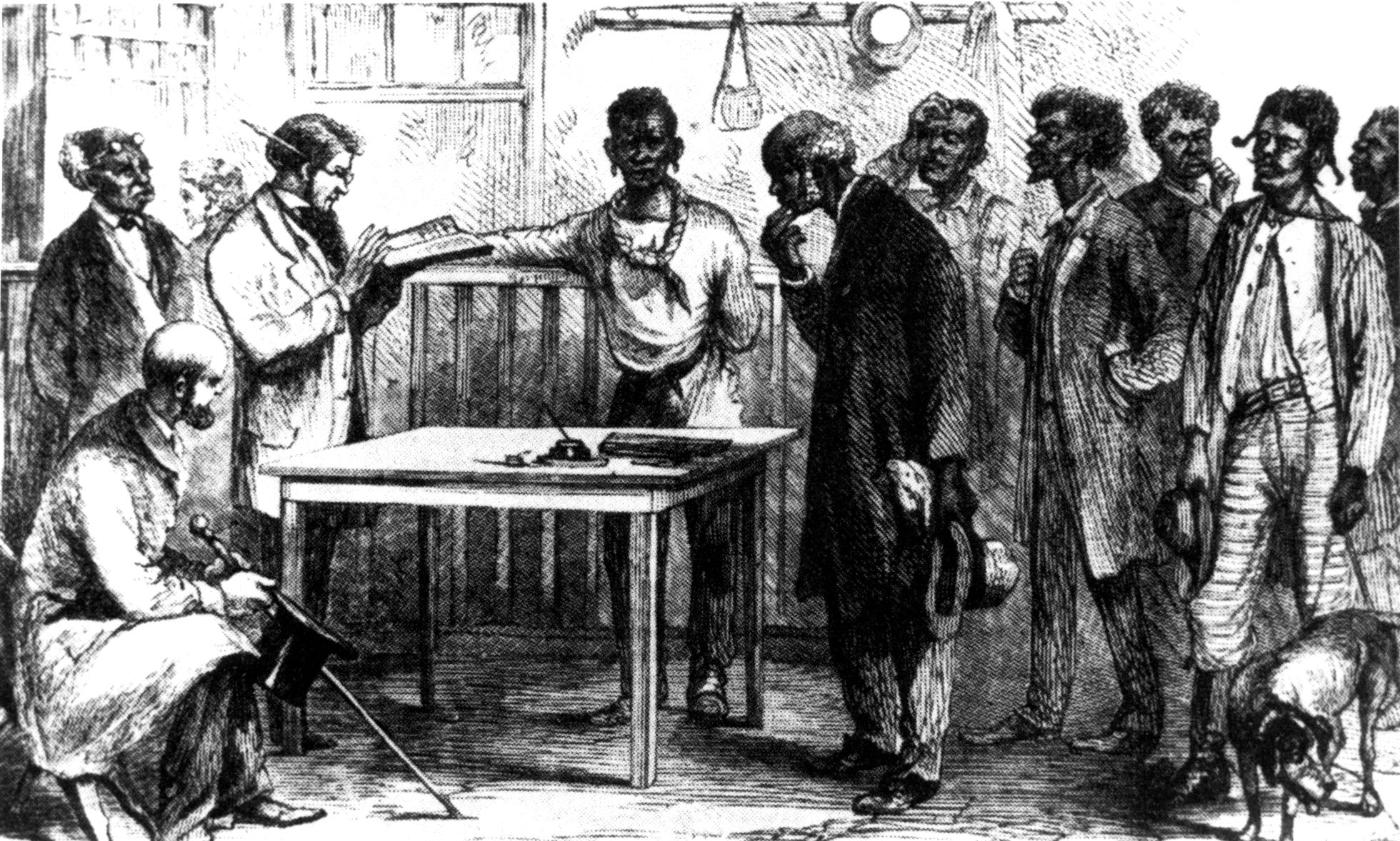
Georgia’s first Black legislators, later known as the Original 33, started their terms at the new capital of Atlanta on Independence Day, 1868. Two months later, white legislators expelled nearly all of them, asserting that Black men did not possess the right to hold office. A pivotal moment in the history of Reconstruction in Georgia, the expulsion of Black legislators reveals how postwar economic development and profits came at the expense of Black Georgians.
Congressional Reconstruction: Prelude to Expulsion
Disappointed with the lenient approach of President Andrew Johnson towards former Confederate states after the Civil War, Republicans in Congress took control of the ongoing process of Reconstruction. After southern states attempted to send high-ranking Confederates like Alexander Stephens to Congress and refused to ratify the Fourteenth Amendment, it became clear that a heavier hand would be necessary if there were to be any hope for Black rights in the South. Consequently, in 1867 Congress passed the First Reconstruction Act, which placed ten southern states, including Georgia, under military rule. To be readmitted to the Union, these states would not only have to ratify the Fourteenth Amendment but also write new state constitutions guaranteeing the right to vote to Black men.
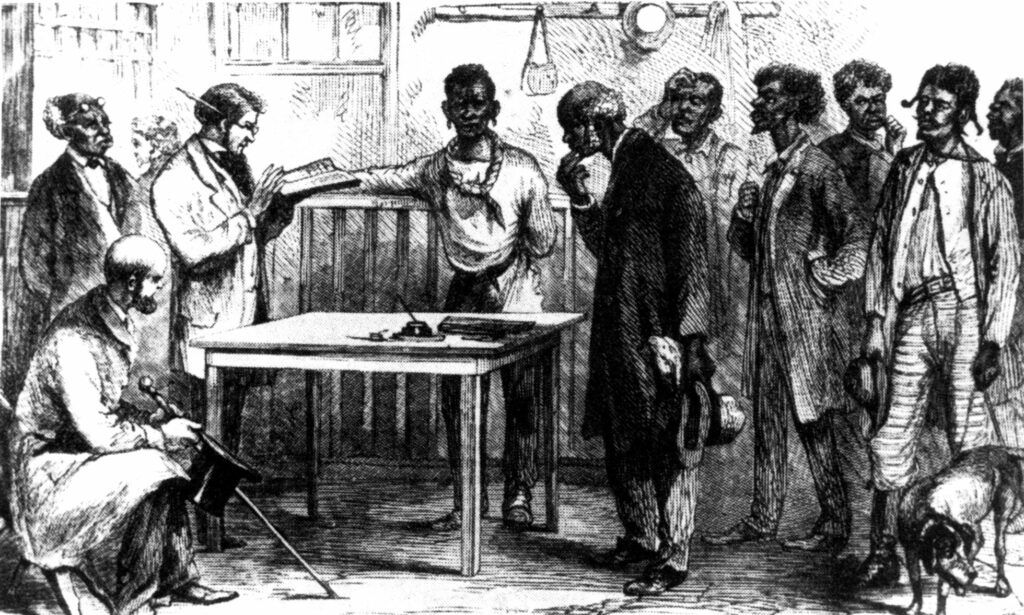
Unreconstructed Democrats like Benjamin Hill obstinately opposed this policy and encouraged white Georgians to do all in their power to resist. Meanwhile, leaders of Georgia’s nascent Republican Party, men like Rufus B. Bullock, John Emory Bryant, Tunis G. Campbell, and Henry McNeal Turner, energetically organized Black and white voters throughout the state in hopes of electing delegates sympathetic to the plans of Congress. Because many Democrats boycotted the election altogether, the vote in favor of the convention was an overwhelming 96 percent.
Despite this seeming solidity, however, it soon became clear that the victorious Republicans were deeply divided, particularly on the questions of voting rights and officeholding.
Of course, the Reconstruction Acts mandated voting rights for Black men. But some Republicans hoped to prevent the return to power of those most responsible for secession by disfranchising former Confederates. A smaller contingent of delegates, fearing that white supremacist lawyers and politicians would exploit any legal ambiguities in the new constitution, favored including a clause specifically guaranteeing Black men the right to hold office.
Moderate Republicans, on the other hand, took their lead from former governor Joseph E. Brown. Speaking to the convention, Brown urged prompt accession to the terms set by Congress so that Georgia could be readmitted to statehood as soon as possible. Yet he warned the convention not to “go a step beyond what Congress has required.” Confederate disfranchisement and Black officeholding, he said, were steps too far. According to Brown, Black men were to have the ballot and nothing more; Georgia was to be ruled by white men.
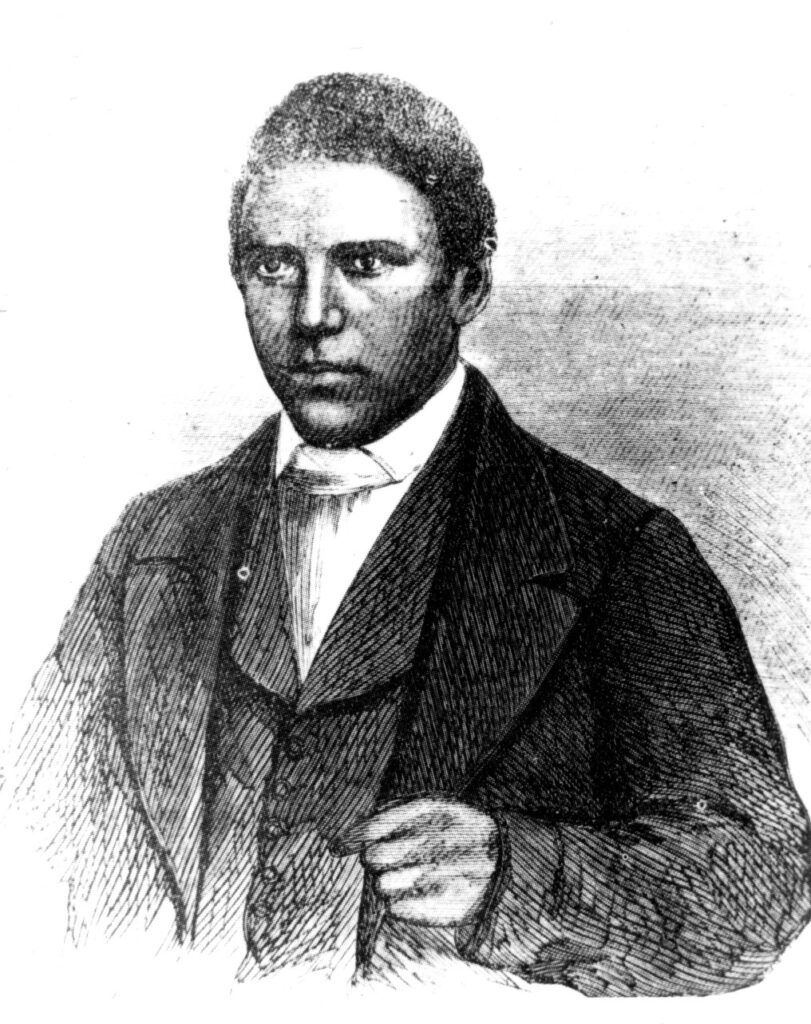
With support from nearly all of the thirty-seven Black delegates, the convention overwhelmingly heeded Brown’s call for “moderation.” Some Black delegates hoped to show they were not motivated by prejudice against the men who fought to keep them in chains. And many considered officeholding a right protected by the Fourteenth Amendment, believing also that a clause specifically recognizing race belied the idea that Black Georgians were inherently equal citizens. Though it would not have changed the outcome, Black delegates came to regret their votes. Henry McNeal Turner, for instance, later said to Tunis Campbell, “We all joined in and struck it out. I foolishly voted for it and you foolishly voted for it.”
Restoration, Expulsion, Military Rule (Again)
In April 1868 Georgians voted to ratify the new constitution and elected a new government. Republican Rufus Bullock narrowly defeated the Democratic nominee and reputed head of the Georgia Ku Klux Klan, John B. Gordon, to become governor. Republicans secured a tenuous majority in the legislature, which included thirty Black representatives and three Black senators, a group who would later be known as the Original 33. After ratifying the Fourteenth amendment, Georgia was officially readmitted to the Union.
Assembling at the new capital of Atlanta, legislators quickly enacted laws to spur economic development. A homestead exemption and a debt relief law helped lift the crippling burdens under which many Georgians struggled. Most significant, though, were bills providing financial aid to several railroad corporations. Leading Republicans like Governor Bullock, who had longstanding connections to these corporations, believed that an expanded rail system was essential to growing and diversifying Georgia’s economy.
At the same time, white legislators of both parties moved to expel their Black colleagues. Democrats specifically cited Joe Brown’s words in a resolution calling for expulsion. The Republican Speaker of the House not only allowed a vote on the resolution to expel the Black representatives but prohibited them from voting in their own defense. With bipartisan support, white legislators voted in September 1868 to remove all but two Black legislators. Madison Davis of Athens and Edwin Belcher of Wilkes County were ironically saved because their Black ancestry could not be definitively proven under the terms of Georgia law.
It was clear that Black Georgians had been betrayed. Representative Henry McNeal Turner, known generally for conservatism and a desire to appease whites, declared that he had “had quite enough.” “No man,” Turner exclaimed, “has ever been more deceived in [the white] race than I…. The treachery…has shaken my confidence in it more than anything.”
Two weeks later, expelled representative Philip Joiner led a protest march from Albany to Camilla. Exemplifying Reconstruction’s white supremacist violence, a sheriff’s posse fired into the crowd, killing protestors and chasing fleeing marchers into the woods with hunting dogs. The event became known as the Camilla Massacre.
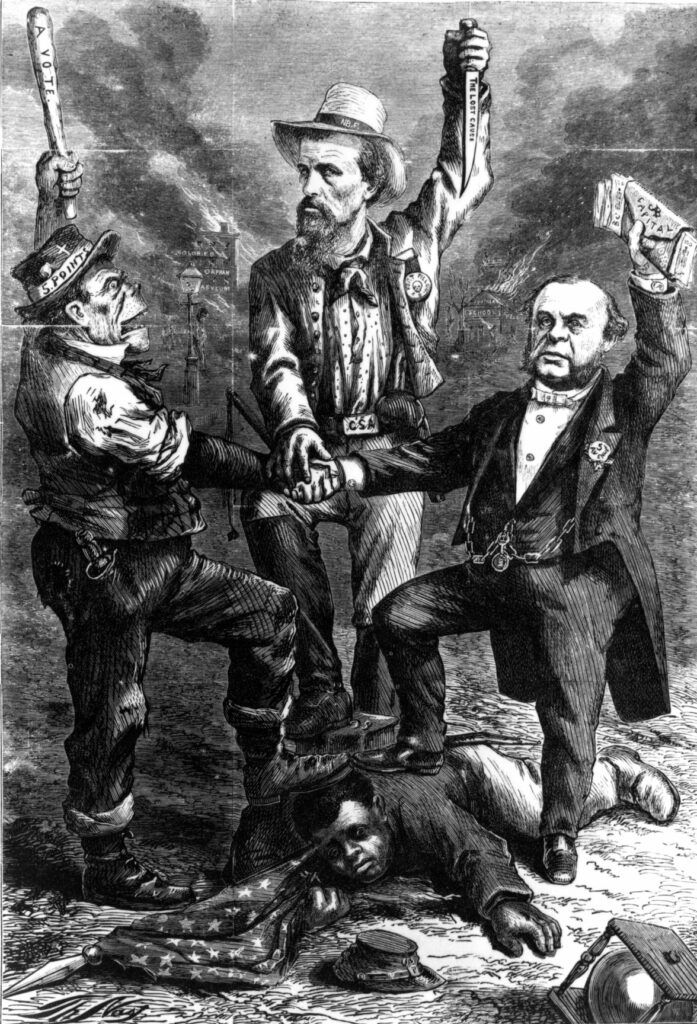
Pointing to the legislative expulsion, the Camilla Massacre, Klan activity, and surging violence during the national elections in November, Governor Bullock and other Republicans, including expelled legislators James Simms and Henry McNeal Turner, testified before Congress in December 1868 that Georgia remained thoroughly unreconstructed. In December 1869, after a year’s delay, Georgia became the only state placed under military rule for a second time.
Reinstatement of Black Legislators, Unlikely Alliances, and “Redemption”
In early 1870 General Alfred Terry ordered the reinstatement of Black legislators and the removal of ineligible ex-Confederates—the latter action coming to be known as Terry’s Purge. Restored to office, Black legislators resumed their work with vigor. James Porter of Savannah introduced the bill creating Georgia’s public school system. Ulysses L. Houston, also of Savannah, pushed through a bill requiring equal accommodations for all races on public carriers such as passenger trains and streetcars. And Henry McNeal Turner unsuccessfully attempted to grant women the right to vote. Black legislators also sought to guarantee the right of Black men to serve on juries. They likewise hoped to rein in the notorious abuses of Georgia’s convict leasing system, which was increasingly relied on for the construction of railroads.
Yet the Republicans were now even more deeply divided, and several began actively working with Democrats. Earlier, hoping to prevent Congress from reinstituting military rule, anti-Bullock Republicans and Democrats attempted to walk back the expulsion of Black legislators. They passed a joint resolution asking the Supreme Court of Georgia to decide whether Black men possessed the right to hold office. In June 1869 the court decided in White v. Clements that they did. In a stunning, politically motivated reversal of opinion, Joe Brown, now serving as Chief Justice, cast the deciding vote. Though this effort failed to stay Congress’s hand, it foreshadowed the alliance to come.
In making the case for reinstituting military rule—as well as delaying the upcoming state elections—Governor Bullock and several Black legislators charged that the legislative proceedings before 1870 had been illegitimate. Significantly, however, this called into question the railroad aid bills passed both before and after the expulsion of Black legislators. The corporations receiving this aid could not abide such a cloud hanging over their finances, and old corporate and political rivals joined forces to “redeem” the state.
Almost as stunning as Joe Brown’s reversal on Black officeholding was the sudden conversion of virulently unreconstructed Democrat, Ben Hill. No longer encouraging rabid resistance to Reconstruction, Hill now urged white Georgians to accept the Fourteenth and Fifteenth Amendments as established facts. While the sudden change confused some, they soon learned its cause.
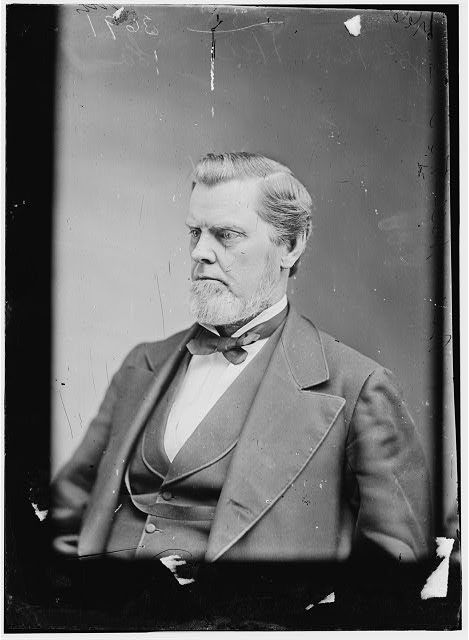
Alleging corruption in the administration of the state-owned Western & Atlantic Railroad, anti-Bullock Republicans and Democrats voted in October 1870 to lease the road to private interests. The highest bidder was a company comprised of Republican Joe Brown, Democrat Ben Hill, and capitalists associated with the Pennsylvania Railroad and other Georgia railroads, all of which had earlier received state aid that was now at risk of being deemed illegitimate. Business and the promise of profits papered over seemingly irreconcilable political differences. Black Georgians were to pay the price. With both sides of the aisle now in greater cooperation, federal troops left the state, leaving Black voters vulnerable at the polls.
Democrats, again resorting to violence and intimidation, often with the help of the Ku Klux Klan, won a resounding victory in the 1870 elections. Some still-unreconstructed Democrats were outraged by Hill’s apparent betrayal, as well as the politico-corporate alliance it embodied, and launched investigations into the Western & Atlantic lease. But Brown and Hill—political enemies turned business partners, now firmly in control of the state’s legislative machinery—made sure their investment remained secure. Upholding the validity of the lease, the Democratic investigations nevertheless painted the Bullock administration and Black legislators as corrupt robbers of the state. While Democrats divided over economic policy, they were more than willing to unite against Black political power.
Over the next decades, Democrats firmly controlled state politics, whittled away at Black political and civil rights, and starved Black schools of funds. All the while, they strengthened the convict leasing system, which exploited coerced Black labor to build Georgia’s railroads and mines. Having returned to the Democratic Party, Joe Brown became one of the most notoriously ruthless lessees of convict labor, amassing a fortune in the process. Though many of the Original 33 would continue to hold office, disenfranchisement measures and extralegal violence would whittle away at Black voting power and representation. By 1907, only one Black legislator, W. H. Rogers, was part of the General Assembly. It would not be until 1963, with the election of Leroy Johnson, that another Black legislator would be sworn into office.
In 2025 the General Assembly unanimously approved the Original 33 Memorial Act, which provides for the installation of a memorial, inside the state capitol, honoring the thirty-three legislators. An earlier sculpture, “Expelled Because of Color,” has stood on the capitol grounds since 1978.