Skip to content
New Georgia Encyclopedia
  • Home
  • Articles & Media
  • Browse by Topic
  • Browse Collections
  • Browse Georgia Standards
  • A-Z Index
  • Exhibitions
  • Educators
  • Browse    Chevron down
  • Exhibitions
  • Educators
By Topic Content Collections Georgia Standards A-Z Index Arrow right
  • Arts & Culture

    Arts & Culture

  • Business & Economy

    Business & Economy

  • Counties, Cities & Neighborhoods

    Counties, Cities & Neighborhoods

  • Education

    Education

  • Geography & Environment

    Geography & Environment

  • Government & Politics

    Government & Politics

  • History & Archaeology

    History & Archaeology

  • People

    People

  • Science & Medicine

    Science & Medicine

  • Sports & Outdoor Recreation

    Sports & Outdoor Recreation

Stamp Collection
Featured

Stamp Collection

Stamps honoring the political figures, artists, and culture of Georgia.

Frankie Welch’s Americana
Featured

Frankie Welch’s Americana

Fashion and politics from Georgia-born designer Frankie Welch

Recently Added
View All Arrow right
City Page: Atlanta

City Page: Atlanta

Stamp Collection

Stamp Collection

Frankie Welch’s Americana

Frankie Welch’s Americana

  • Georgia Studies

    Georgia Studies

    Eighth Grade
  • Georgia, My State

    Georgia, My State

    Second Grade
All Topics Arrow right History & Archaeology Arrow right

Archaeology & Early History

Sub-Topics
  • Archaeological Periods
  • Culture of Georgia Indians
  • Early History
African American Archaeology

African American Archaeology

Archaeology in Historic Preservation

Archaeology in Historic Preservation

Archaic Period

Archaic Period

Overview
Cane Island Site

Cane Island Site

Civil War Archaeology

Civil War Archaeology

Coastal Shell Rings

Coastal Shell Rings

Muscogee (Creek) Indian Leaders

Muscogee (Creek) Indian Leaders

Muscogee (Creek) Indians

Muscogee (Creek) Indians

Hernando de Soto in Georgia

Hernando de Soto in Georgia

English Trade in Deerskins and Enslaved Indians

English Trade in Deerskins and Enslaved Indians

Etowah Mounds

Etowah Mounds

Georgia History

Georgia History

Overview
Indian Missions

Indian Missions

Indian Pottery

Indian Pottery

Indian Projectile Points

Indian Projectile Points

Indian Trails

Indian Trails

Indian Warfare

Indian Warfare

Irene Mounds

Irene Mounds

King Site

King Site

Kolomoki Mounds

Kolomoki Mounds

Lamar Period

Lamar Period

Languages of Georgia Indians

Languages of Georgia Indians

Late Prehistoric/Early Historic Chiefdoms

Late Prehistoric/Early Historic Chiefdoms

ca. A.D. 1300-1850
Macon Trading Post

Macon Trading Post

Mission Santa Catalina de Guale

Mission Santa Catalina de Guale

Mississippian Period

Mississippian Period

Overview
Nacoochee Mound

Nacoochee Mound

Ocmulgee Mounds

Ocmulgee Mounds

Paleoindian Period

Paleoindian Period

Overview
Public Archaeology Programs

Public Archaeology Programs

Rock Mounds and Structures

Rock Mounds and Structures

Singer-Moye Mounds

Singer-Moye Mounds

Society for Georgia Archaeology

Society for Georgia Archaeology

Spanish Exploration

Spanish Exploration

Spanish Missions

Spanish Missions

Stallings Island Site

Stallings Island Site

Swift Creek Culture

Swift Creek Culture

Weeden Island Culture

Weeden Island Culture

Westo Indians

Westo Indians

Woodland Period

Woodland Period

Overview
Loading
Star

Featured Content

James Oglethorpe

James Oglethorpe

Colonial Figures
Civil Rights Movement

Civil Rights Movement

Mid- to Late 20th Century Topics
Trending

Trending

Georgia Guidestones

Georgia Guidestones

Sites & Museums
Bobby Cox

Bobby Cox

People
Dixiecrats

Dixiecrats

Political Parties, Interest Groups & Movements
Augusta Riot

Augusta Riot

Mid- to Late 20th Century Events
Clock

Updated Recently

Morris Brown College

Morris Brown College

6 days ago
Burke County

Burke County

6 days ago
CNN

CNN

6 days ago
Ted Turner

Ted Turner

1 week ago

A More Perfect Union

The New Georgia Encyclopedia is supported by funding from A More Perfect Union, a special initiative of the National Endowment for the Humanities.

Learn More
New Georgia Encyclopedia
ISSN 2765-8732
Project Partners
logo-press UGA Press logo-galileo GALILEO logo-humanities Georgia Humanities logo-seal Office of the Governor logo-libraries UGA Libraries
Articles & Media
  • Browse by Topic
  • Content Collections
  • Georgia Standards
Special Content
  • Quizzes
  • Exhibitions
  • Spotify Playlists
  • Georgia Exhibits
  • Educator Resources
About
  • The Project
  • The People
  • Sponsors & Partners
Editorial
  • Our Process
  • Contributor Info
  • Permissions & Use
Stay in Touch
Facebook Instagram Twitter Contact Us
Donate to the NGE

Your support helps us commission new entries and update existing content.

Donate

© 2004–2026 Georgia Humanities, University of Georgia Press

  • Terms of Use
  • Privacy Policy

Media gallery

Confederate Earthwork

Confederate Earthwork

  • Info Details
  • Citation Terms of Use

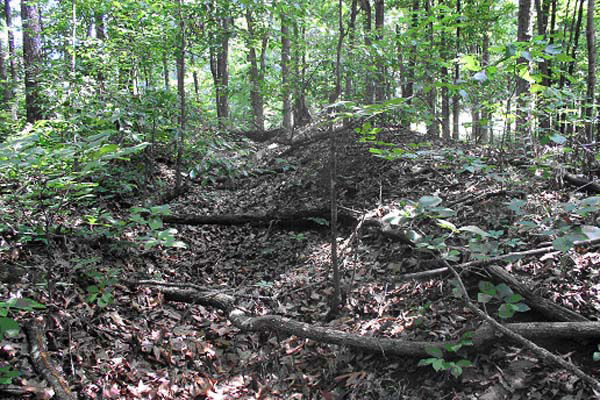
The remains of a Confederate earthwork, used during the Battle of Kennesaw Mountain in June 1864. In the1930s archaeologist Charles Fairbanks, in one of the earliest Civil War excavations, documented the earthworks on top of Kennesaw Mountain in Cobb County.

Courtesy of Garrett W. Silliman

The New Georgia Encyclopedia does not hold the copyright for this media resource and can neither grant nor deny permission to republish or reproduce the image online or in print. All requests for permission to publish or reproduce the resource must be submitted to the rights holder.

  • Info Details
  • Citation Terms of Use

The New Georgia Encyclopedia does not hold the copyright for this media resource and can neither grant nor deny permission to republish or reproduce the image online or in print. All requests for permission to publish or reproduce the resource must be submitted to the rights holder.

Etowah Mounds

Etowah Mounds

  • Info Details
  • Citation Terms of Use

The Etowah Mounds in Bartow County include one of the largest Indian mounds in North America. The mounds, constructed during the Mississippian Period, served as platforms for public buildings in a town that occupied the site from around 1100 until the 1600s.

Courtesy of Historic Preservation Division, Georgia Department of Community Affairs.

The New Georgia Encyclopedia does not hold the copyright for this media resource and can neither grant nor deny permission to republish or reproduce the image online or in print. Requests for permission to publish or reproduce the resource may need to be submitted to the Georgia Department of Community Affairs, Historic Preservation Division.

Rock Eagle

Rock Eagle

  • Info Details
  • Citation Terms of Use

Rock Eagle, a stone effigy built by Native Americans during the Woodland Period, circa A.D. 200, is located in Putnam County. The structure, made of quartz cobbles, measures 102 feet across the wings.

Courtesy of Explore Georgia, Photograph by Ralph Daniel.

The New Georgia Encyclopedia does not hold the copyright for this media resource and can neither grant nor deny permission to republish or reproduce the image online or in print. Requests for permission to publish or reproduce the resource may need to be submitted to Explore Georgia.

  • Info Details
  • Citation Terms of Use

The New Georgia Encyclopedia does not hold the copyright for this media resource and can neither grant nor deny permission to republish or reproduce the image online or in print. All requests for permission to publish or reproduce the resource must be submitted to the rights holder.

De Soto Crossing the Chattahoochee

De Soto Crossing the Chattahoochee

  • Info Details
  • Citation Terms of Use

A drawing from Lambert A. Wilmer's Life, Travels and Adventures of Ferdinand de Soto, Discoverer of the Mississippi (1859) depicts Hernando de Soto and his men crossing the Chattahoochee River. The accidental introduction of European diseases by explorers destroyed many of the civilizations along the river's banks.

Courtesy of Florida State Archives, Photographic Collection.
The New Georgia Encyclopedia does not hold the copyright for this media resource and can neither grant nor deny permission to republish or reproduce the image online or in print. All requests for permission to publish or reproduce the resource must be submitted to the rights holder.

Georgia Trustees

Georgia Trustees

  • Info Details
  • Citation Terms of Use

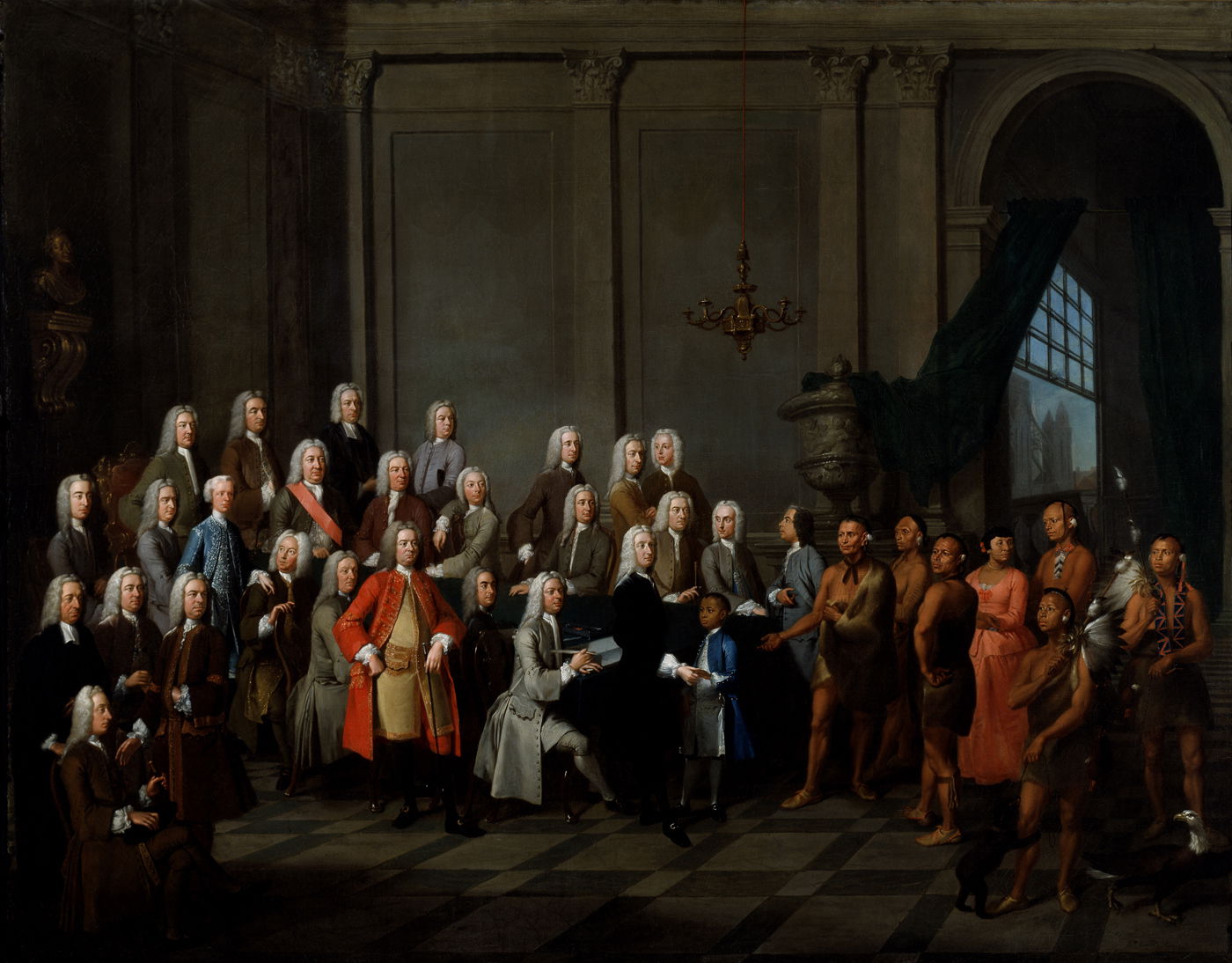
This oil painting by William Verelst shows the founders of Georgia, the Georgia Trustees, and a delegation of Georgia Indians in July 1734. One year later the Trustees persuaded the British government to support a ban on slavery in Georgia.

Courtesy of Georgia Info, Digital Library of Georgia.

The New Georgia Encyclopedia does not hold the copyright for this media resource and can neither grant nor deny permission to republish or reproduce the image online or in print. Requests for permission to publish or reproduce the resource may need to be submitted to the Digital Library of Georgia.

  • Info Details
  • Citation Terms of Use

The New Georgia Encyclopedia does not hold the copyright for this media resource and can neither grant nor deny permission to republish or reproduce the image online or in print. All requests for permission to publish or reproduce the resource must be submitted to the rights holder.

Battle of Kettle Creek

Battle of Kettle Creek

  • Info Details
  • Citation Terms of Use

This sketch, likely a small portion of a larger work, depicts the Battle of Kettle Creek, which took place in Wilkes County on February 14, 1779, during the Revolutionary War. The original caption reads: "Engagement between the Whigs and Tories."

Courtesy of Kettle Creek Chapter of the National Society Daughters of the American Revolution

The New Georgia Encyclopedia does not hold the copyright for this media resource and can neither grant nor deny permission to republish or reproduce the image online or in print. All requests for permission to publish or reproduce the resource must be submitted to the rights holder.

Eli Whitney

Eli Whitney

  • Info Details
  • Citation Terms of Use

The inventor of the cotton gin, Eli Whitney lived in Georgia for just a year, on Catharine Greene's Mulberry Grove plantation near Savannah. After learning of the difficulty planters had with separating seeds from fibers in upland, or "short-staple," cotton, he set out to create a machine that could perform such a task more efficiently. His invention, the cotton gin, revolutionized the southern economy.

Courtesy of Library of Congress, Prints and Photographs Division

The New Georgia Encyclopedia does not hold the copyright for this media resource and can neither grant nor deny permission to republish or reproduce the image online or in print. All requests for permission to publish or reproduce the resource must be submitted to the rights holder.

  • Info Details
  • Citation Terms of Use

The New Georgia Encyclopedia does not hold the copyright for this media resource and can neither grant nor deny permission to republish or reproduce the image online or in print. All requests for permission to publish or reproduce the resource must be submitted to the rights holder.

Cherokee Trail of Tears

Cherokee Trail of Tears

  • Info Details
  • Citation Terms of Use

In his 1942 painting Cherokee Trail of Tears, Robert Lindneux depicts the forced journey of the Cherokees in 1838 to present-day Oklahoma.

Courtesy of Woolaroc Museum, Bartlesville, Oklahoma

The New Georgia Encyclopedia does not hold the copyright for this media resource and can neither grant nor deny permission to republish or reproduce the image online or in print. All requests for permission to publish or reproduce the resource must be submitted to the rights holder.

Secession Ordinance

Secession Ordinance

  • Info Details
  • Citation Terms of Use

On January 21, 1861, the ordinance of secession was publicly signed in a ceremony by Georgia politicians. Two days earlier, delegates to a convention in Milledgeville voted 208 to 89 for the state to secede from the Union.
Courtesy of Hargrett Rare Book and Manuscript Library, University of Georgia Libraries.

The New Georgia Encyclopedia does not hold the copyright for this media resource and can neither grant nor deny permission to republish or reproduce the image online or in print. Requests for permission to publish or reproduce the resource should be submitted to the Hargrett Manuscript and Rare Book Library at the University of Georgia.

Robert Toombs

Robert Toombs

  • Info Details
  • Citation Terms of Use

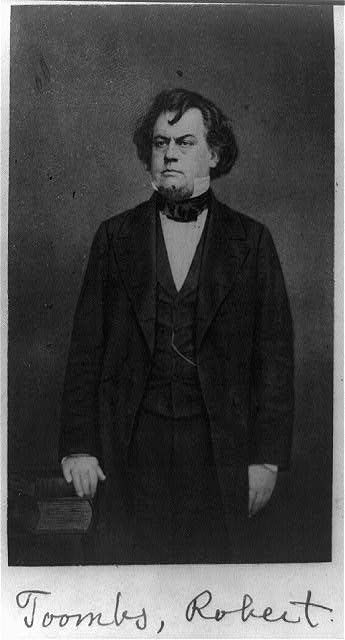
Wilkes County native Robert Toombs, pictured circa 1865, served briefly as the Confederate government's secretary of state and as a brigadier general during the Civil War.

Courtesy of Library of Congress, Prints and Photographs Division
The New Georgia Encyclopedia does not hold the copyright for this media resource and can neither grant nor deny permission to republish or reproduce the image online or in print. All requests for permission to publish or reproduce the resource must be submitted to the rights holder.

Andersonville Prison

Andersonville Prison

  • Info Details
  • Citation Terms of Use

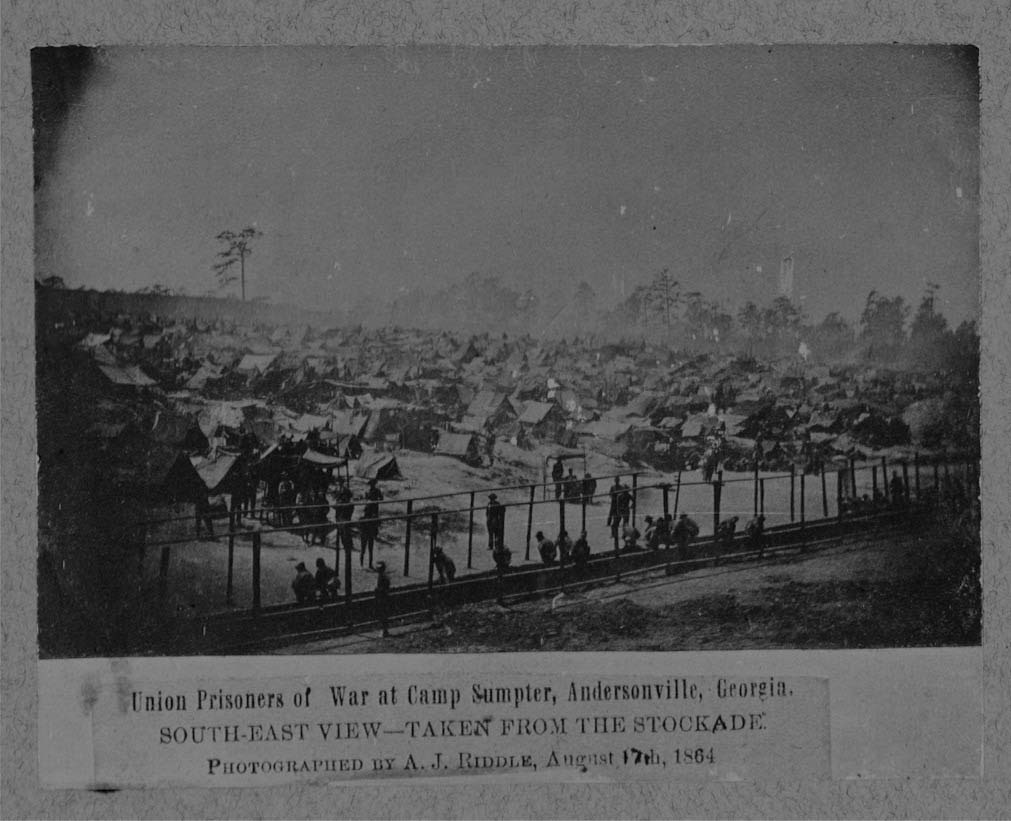
Union prisoners of war are pictured at the Andersonville Prison in Macon County on August 17, 1864. Malnutrition and poor sanitary conditions at the camp led to the deaths of nearly 13,000 of Andersonville's 45,000 prisoners, the highest mortality rate of any Civil War prison.

Courtesy of Civil War Treasures, New-York Historical Society
The New Georgia Encyclopedia does not hold the copyright for this media resource and can neither grant nor deny permission to republish or reproduce the image online or in print. All requests for permission to publish or reproduce the resource must be submitted to the rights holder.

Freedmen’s Bureau

Freedmen’s Bureau

  • Info Details
  • Citation Terms of Use

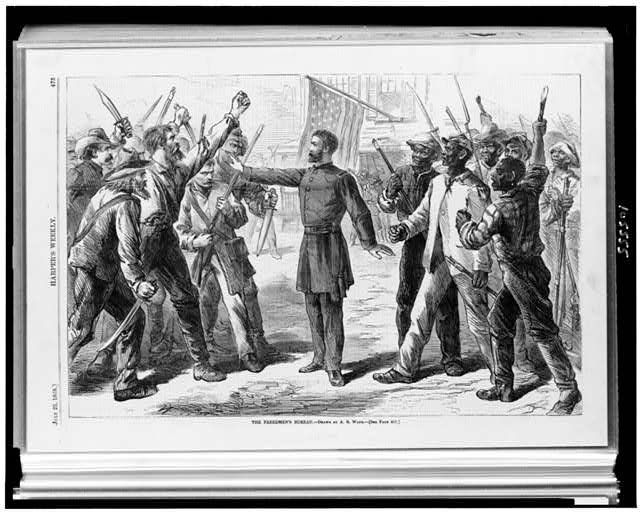
An 1868 sketch by A. R. Waud illustrates the difficulties faced by the Freedmen's Bureau, caught between white planters on one side (left) and formerly enslaved African Americans on the other (right). The bureau was established in 1865 after Union general William T. Sherman issued his Field Order No. 15, which called for the resettlement of freedpeople on confiscated lands.

Courtesy of Library of Congress, Prints and Photographs Division
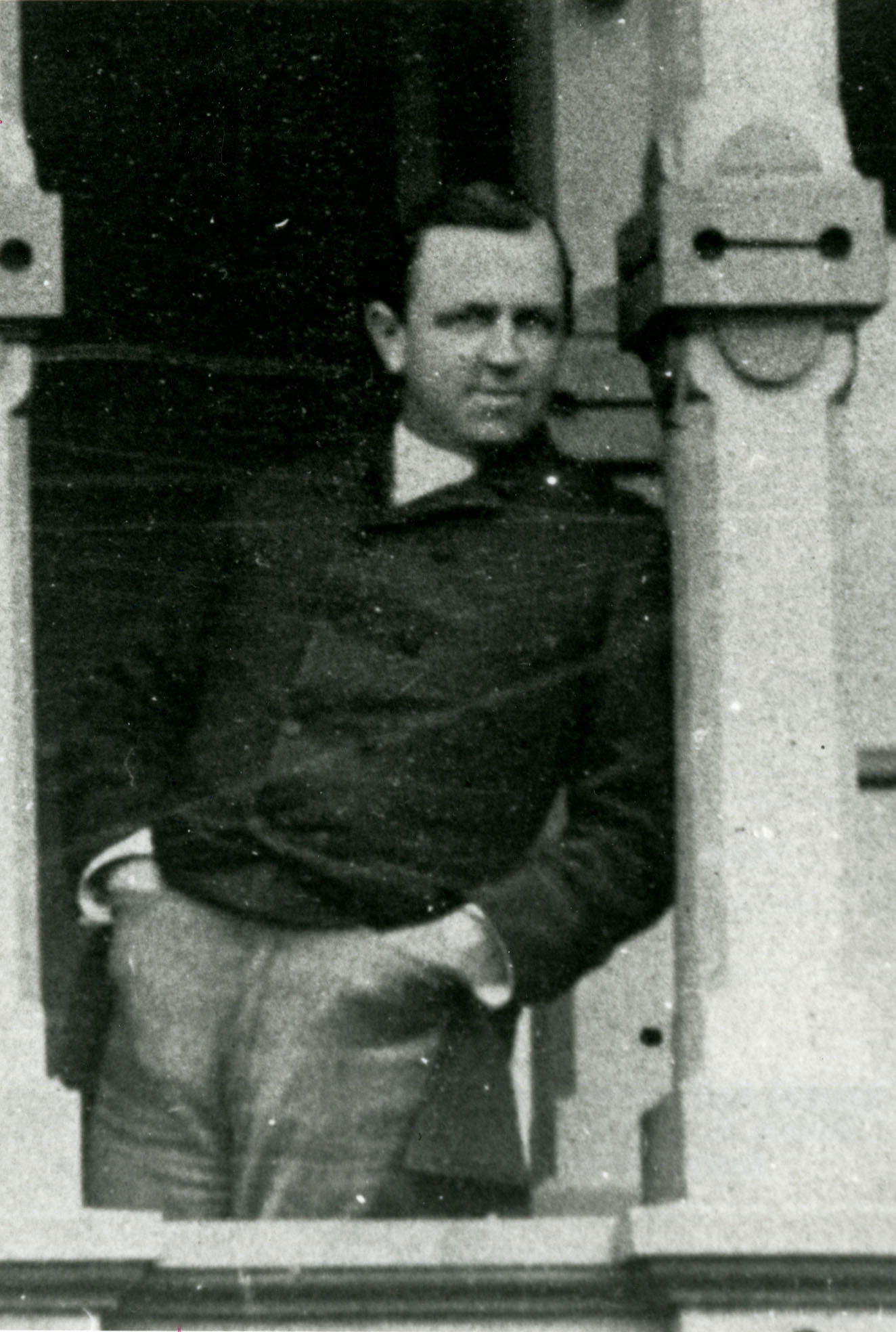
The New Georgia Encyclopedia does not hold the copyright for this media resource and can neither grant nor deny permission to republish or reproduce the image online or in print. All requests for permission to publish or reproduce the resource must be submitted to the rights holder.

Henry W. Grady

Henry W. Grady

  • Info Details
  • Citation Terms of Use

With his New South platform, Henry W. Grady advocated unity and trust between the North and South and helped to spur northern investment in Atlanta industries.

Courtesy of Stuart A. Rose Manuscript, Archives, and Rare Book Library, Emory University, Henry Woodfin Grady Papers.
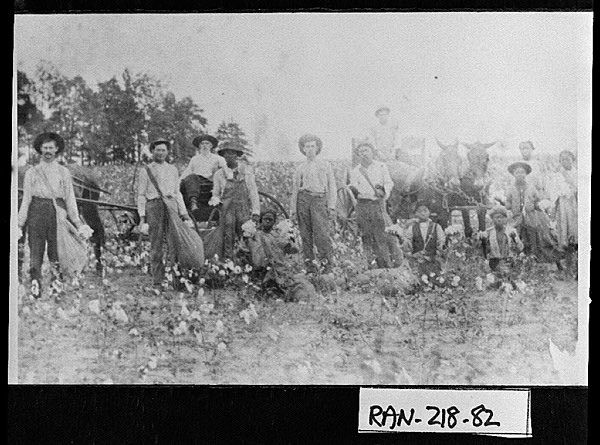
The New Georgia Encyclopedia does not hold the copyright for this media resource and can neither grant nor deny permission to republish or reproduce the image online or in print. For more information about this resource, contact the Stuart A. Rose Manuscript, Archives, and Rare Book Library at Emory University.

Sharecroppers

Sharecroppers

  • Info Details
  • Citation Terms of Use

Sharecroppers, pictured in 1910, harvest cotton in Randolph County. Theoretically beneficial to both laborers and landowners, the sharecropping system typically left workers in deep debt to their landlords and creditors from one harvest season to the next.

Courtesy of Georgia Archives, Vanishing Georgia, #ran218-82.

View on partner site

The New Georgia Encyclopedia does not hold the copyright for this media resource and can neither grant nor deny permission to republish or reproduce the image online or in print. Requests for permission to publish or reproduce the resource should be submitted to the Georgia Archives.

Thomas E. Watson

Thomas E. Watson

  • Info Details
  • Citation Terms of Use

In 1892 Georgia politics was shaken by the arrival of the Populist Party. Led by Thomas E. Watson of McDuffie County, this new party mainly appealed to white farmers, many of whom had been impoverished by debt and low cotton prices in the 1880s and 1890s. The Populists also attempted to win the support of Black farmers away from the Republican Party.

Courtesy of Georgia Historical Society.

The New Georgia Encyclopedia does not hold the copyright for this media resource and can neither grant nor deny permission to republish or reproduce the image online or in print. All requests for permission to publish or reproduce the resource must be submitted to Georgia Historical Society.

  • Info Details
  • Citation Terms of Use

The New Georgia Encyclopedia does not hold the copyright for this media resource and can neither grant nor deny permission to republish or reproduce the image online or in print. All requests for permission to publish or reproduce the resource must be submitted to the rights holder.

  • Info Details
  • Citation Terms of Use

The New Georgia Encyclopedia does not hold the copyright for this media resource and can neither grant nor deny permission to republish or reproduce the image online or in print. All requests for permission to publish or reproduce the resource must be submitted to the rights holder.

Roosevelts in Atlanta

Roosevelts in Atlanta

  • Info Details
  • Citation Terms of Use

U.S. president Franklin D. Roosevelt and his wife, Eleanor Roosevelt, visit Atlanta in 1935, during the Great Depression. From left: Franklin D. and Eleanor Roosevelt, U.S. senator Walter F. George, and U.S. senator Richard B. Russell Jr.

Courtesy of Richard B. Russell Library for Political Research and Studies, University of Georgia Libraries.

The New Georgia Encyclopedia does not hold the copyright for this media resource and can neither grant nor deny permission to republish or reproduce the image online or in print. Requests for permission to publish or reproduce the resource may need to be submitted to the Richard B. Russell Library for Political Research and Studies at the University of Georgia.

Ben Epps

Ben Epps

  • Info Details
  • Citation Terms of Use

Georgia aviation pioneer Ben Epps is pictured with his first airplane outside his garage in Athens, 1907.

Courtesy of Georgia Archives, Vanishing Georgia, #
clr176-83.
View on partner site

The New Georgia Encyclopedia does not hold the copyright for this media resource and can neither grant nor deny permission to republish or reproduce the image online or in print. Requests for permission to publish or reproduce the resource should be submitted to the Georgia Archives.

Fort Benning

Fort Benning

  • Info Details
  • Citation Terms of Use

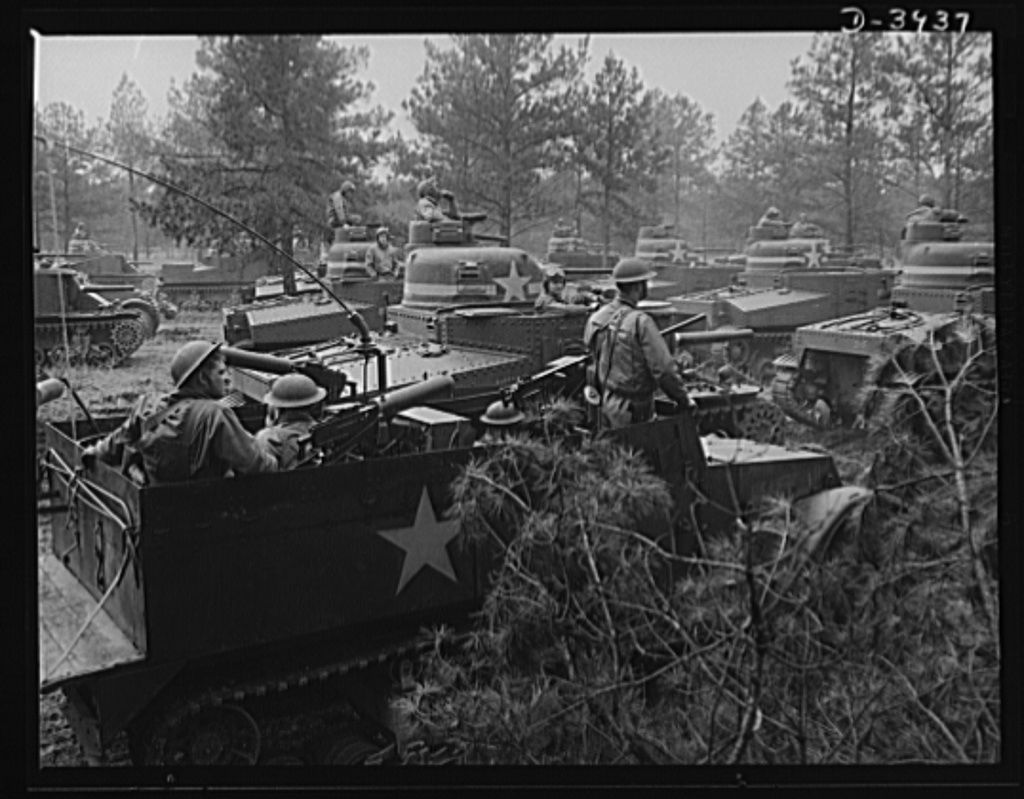
U.S. soldiers, pictured in the spring of 1942, undergo training at Fort Benning in Columbus. During World War II Fort Benning was the largest infantry training post in the world.

Courtesy of Library of Congress, Prints and Photographs Division

The New Georgia Encyclopedia does not hold the copyright for this media resource and can neither grant nor deny permission to republish or reproduce the image online or in print. All requests for permission to publish or reproduce the resource must be submitted to the rights holder.

Segregation Protest

Segregation Protest

  • Info Details
  • Citation Terms of Use

Students protest segregation at the state capitol building in Atlanta on February 1, 1962. The passage of the federal Civil Rights Act in 1964 and the Voting Rights Act in 1965 ended legal segregation across the nation.

Courtesy of Atlanta Journal-Constitution.

The New Georgia Encyclopedia does not hold the copyright for this media resource and can neither grant nor deny permission to republish or reproduce the image online or in print. All requests for permission to publish or reproduce the resource must be submitted to the Atlanta Journal-Constitution.

Integration of Atlanta Schools

Integration of Atlanta Schools

  • Info Details
  • Citation Terms of Use

Reporters gather at Atlanta's city hall on August 30, 1961, the day that the city's schools were officially integrated. The recommendations of the Sibley Commission to the state legislature in 1960 contributed to the desegregation of schools across Georgia.

Courtesy of Special Collections & Archives, Georgia State University Library, Lane Brothers Commercial Photographers Photographic Collection.

The New Georgia Encyclopedia does not hold the copyright for this media resource and can neither grant nor deny permission to republish or reproduce the image online or in print. Requests for permission to publish or reproduce the resource should be submitted to Special Collections and Archives at Georgia State University.

Hunter and Holmes, UGA

Hunter and Holmes, UGA

  • Info Details
  • Citation Terms of Use

Charlayne Hunter and Hamilton Holmes, the first Black students to enroll at the University of Georgia, are pictured here at the end of their first day on campus in January 1961.

Courtesy of Atlanta Journal-Constitution.
The New Georgia Encyclopedia does not hold the copyright for this media resource and can neither grant nor deny permission to republish or reproduce the image online or in print. All requests for permission to publish or reproduce the resource must be submitted to the Atlanta Journal-Constitution.

Albany Movement

Albany Movement

  • Info Details
  • Citation Terms of Use

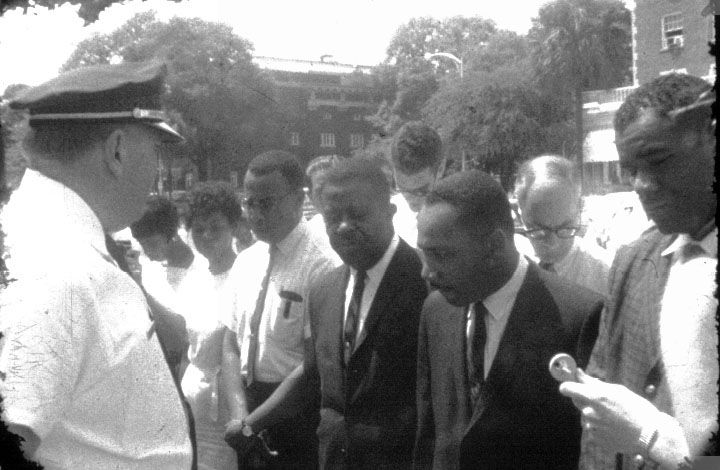
Martin Luther King Jr. (second from right) and Ralph David Abernathy (third from right) pray during their arrest in Albany on July 27, 1962. William G. Anderson, the president of the Albany Movement, asked King and Abernathy to help with efforts to desegregate the city.

Courtesy of Walter J. Brown Media Archives and Peabody Awards Collection, University of Georgia Libraries.

The New Georgia Encyclopedia does not hold the copyright for this media resource and can neither grant nor deny permission to republish or reproduce the image online or in print. All requests for permission to publish or reproduce the resource must be submitted to the Walter J. Brown Media Archives and Peabody Awards Collection.

Carl Sanders

Carl Sanders

  • Info Details
  • Citation Terms of Use

Augusta native Carl Sanders, elected governor of Georgia in 1962, brought the state into compliance with federal civil rights law during his single term in office.

Courtesy of Hargrett Rare Book and Manuscript Library, University of Georgia Libraries.

The New Georgia Encyclopedia does not hold the copyright for this media resource and can neither grant nor deny permission to republish or reproduce the image online or in print. Requests for permission to publish or reproduce the resource should be submitted to the Hargrett Manuscript and Rare Book Library at the University of Georgia.

Lester Maddox, 1964

Lester Maddox, 1964

  • Info Details
  • Citation Terms of Use

In 1966 Lester Maddox defeated former governor Ellis Arnall in the Democratic gubernatorial primary in a major political upset. Subsequently, as a result of a close race between Maddox and Republican Bo Callaway, the General Assembly chose Maddox as governor.

Courtesy of Richard B. Russell Library for Political Research and Studies, University of Georgia Libraries.

The New Georgia Encyclopedia does not hold the copyright for this media resource and can neither grant nor deny permission to republish or reproduce the image online or in print. Requests for permission to publish or reproduce the resource may need to be submitted to the Richard B. Russell Library for Political Research and Studies at the University of Georgia.

Hamilton Jordan and Jimmy Carter

Hamilton Jordan and Jimmy Carter

  • Info Details
  • Citation Terms of Use

U.S. president Jimmy Carter (right) meets with Hamilton Jordan in the Oval Office of the White House in 1977. Jordan served as Carter's chief of staff from 1977 to 1980.

Courtesy of Jimmy Carter Presidential Library and Museum.

The New Georgia Encyclopedia does not hold the copyright for this media resource and can neither grant nor deny permission to republish or reproduce the image online or in print. Requests for permission to publish or reproduce the resource may need to be submitted to the Jimmy Carter Presidential Library and Museum.

  • Info Details
  • Citation Terms of Use

The New Georgia Encyclopedia does not hold the copyright for this media resource and can neither grant nor deny permission to republish or reproduce the image online or in print. All requests for permission to publish or reproduce the resource must be submitted to the rights holder.

Peanut Farming

Peanut Farming

  • Info Details
  • Citation Terms of Use

Georgia farmers lead the United States in peanut production, raising approximately 45 percent of the nation's total harvest. Grown in most south Georgia counties, peanuts are the official state crop.

Courtesy of Explore Georgia, Photograph by Ralph Daniel.

The New Georgia Encyclopedia does not hold the copyright for this media resource and can neither grant nor deny permission to republish or reproduce the image online or in print. Requests for permission to publish or reproduce the resource may need to be submitted to Explore Georgia.

  • Info Details
  • Citation Terms of Use

The New Georgia Encyclopedia does not hold the copyright for this media resource and can neither grant nor deny permission to republish or reproduce the image online or in print. All requests for permission to publish or reproduce the resource must be submitted to the rights holder.

Latino Workers

Latino Workers

  • Info Details
  • Citation Terms of Use

Latino workers plant loblolly pine seedlings in 1999 near Bremen, in Haralson County. Latino immigrants came to Georgia in large numbers during the 1980s and 1990s to work in the agriculture, construction, carpet, and poultry processing industries.

Courtesy of Atlanta Journal-Constitution.

The New Georgia Encyclopedia does not hold the copyright for this media resource and can neither grant nor deny permission to republish or reproduce the image online or in print. All requests for permission to publish or reproduce the resource must be submitted to the Atlanta Journal-Constitution.

St. Simons Tourists

St. Simons Tourists

  • Info Details
  • Citation Terms of Use

Tourists on St. Simons Island gather outside one of the island's many shops. The island suffered an economic depression at the end of the cotton era in the 1830s, but its fortunes reversed with the arrival of the timber industry in the 1870s. Today St. Simons enjoys a strong tourist industry.

Courtesy of Explore Georgia.

The New Georgia Encyclopedia does not hold the copyright for this media resource and can neither grant nor deny permission to republish or reproduce the image online or in print. Requests for permission to publish or reproduce the resource may need to be submitted to Explore Georgia.

James Oglethorpe

James Oglethorpe

  • Info Details
  • Citation Terms of Use

James Oglethorpe, a leader in the British movement to found a new colony in America, set sail for the new world on November 17, 1732, accompanied by Georgia's first settlers.

Courtesy of Hargrett Rare Book and Manuscript Library, University of Georgia Libraries.

The New Georgia Encyclopedia does not hold the copyright for this media resource and can neither grant nor deny permission to republish or reproduce the image online or in print. Requests for permission to publish or reproduce the resource should be submitted to the Hargrett Manuscript and Rare Book Library at the University of Georgia.

Shotgun Houses

Shotgun Houses

  • Info Details
  • Citation Terms of Use

Unrestored shotgun houses line a street in Macon. The shotgun, a rectangular house type that is one room wide and two to four rooms deep, may have developed from a West African architectural tradition.

Courtesy of Elizabeth Lyon
The New Georgia Encyclopedia does not hold the copyright for this media resource and can neither grant nor deny permission to republish or reproduce the image online or in print. All requests for permission to publish or reproduce the resource must be submitted to the rights holder.

Colonoware Pitcher

Colonoware Pitcher

  • Info Details
  • Citation Terms of Use

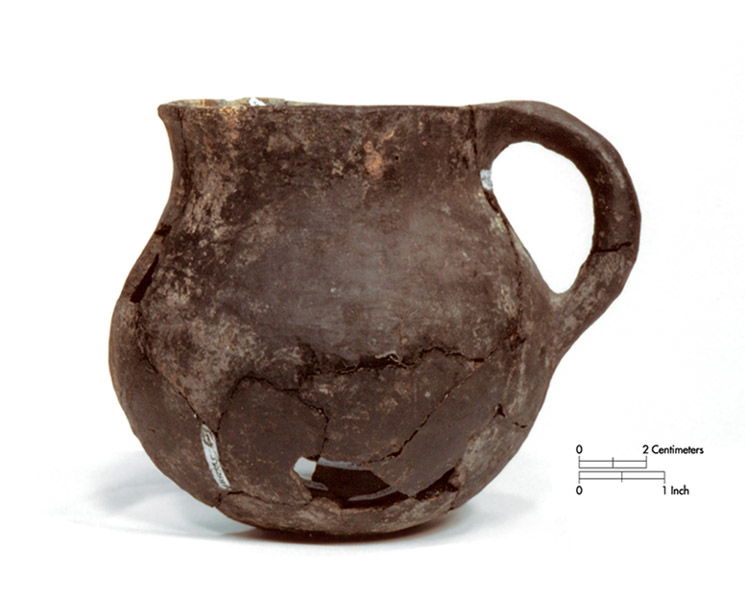
Colonoware, a form of earthenware pottery, was made by African Americans on plantations in Georgia, North Carolina, and South Carolina. Produced circa 1740, this pitcher was found during an exacavation in Charleston, South Carolina, during the late 1990s.

Courtesy of New South Associates

The New Georgia Encyclopedia does not hold the copyright for this media resource and can neither grant nor deny permission to republish or reproduce the image online or in print. All requests for permission to publish or reproduce the resource must be submitted to the rights holder.

Savannah-Ogeechee Canal

Savannah-Ogeechee Canal

  • Info Details
  • Citation Terms of Use

The Savannah-Ogeechee Canal, pictured circa 1888, was completed by enslaved laborers in 1829.

Courtesy of Georgia Historical Society, James S. Silva family papers, #GHS 2126-VM01-04 pg072.
View on partner site

The New Georgia Encyclopedia does not hold the copyright for this media resource and can neither grant nor deny permission to republish or reproduce the image online or in print. All requests for permission to publish or reproduce the resource must be submitted to Georgia Historical Society.

Slave Quarters

Slave Quarters

  • Info Details
  • Citation Terms of Use

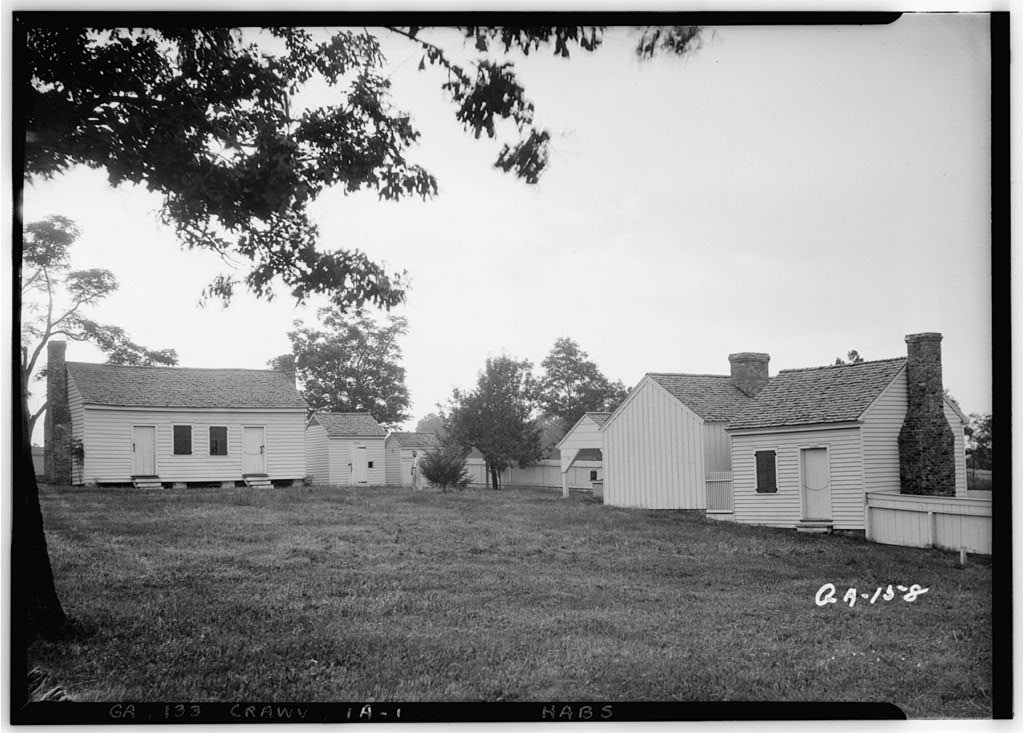
Slave quarters, pictured in 1936, stand at Liberty Hall in Taliaferro County, the homeplace of Georgia governor Alexander Stephens. African American structures on Georgia plantations were generally rectangular in shape, as opposed to the square forms preferred by Europeans.

Courtesy of Library of Congress, Prints and Photographs Division, Historic American Buildings Survey.
The New Georgia Encyclopedia does not hold the copyright for this media resource and can neither grant nor deny permission to republish or reproduce the image online or in print. All requests for permission to publish or reproduce the resource must be submitted to the rights holder.

Colonoware Jar

Colonoware Jar

  • Info Details
  • Citation Terms of Use

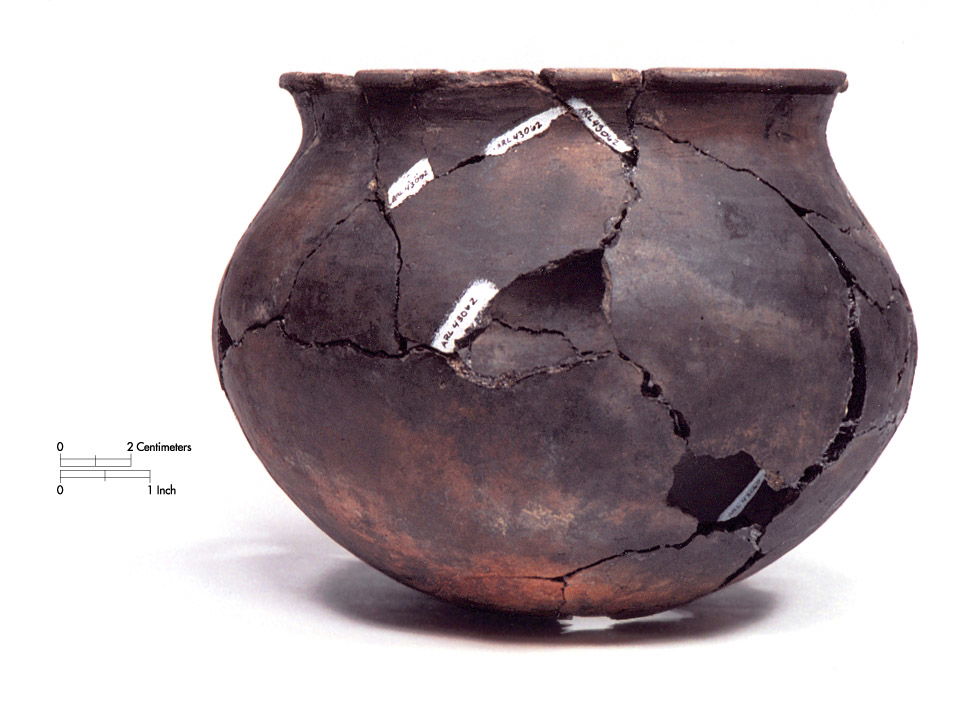
This colonoware jar, uncovered in South Carolina in the 1990s, dates to the mid-eighteenth century. Colonoware was made by African Americans on coastal plantations and has been found on several Georgia sites.

Courtesy of New South Associates
The New Georgia Encyclopedia does not hold the copyright for this media resource and can neither grant nor deny permission to republish or reproduce the image online or in print. All requests for permission to publish or reproduce the resource must be submitted to the rights holder.

Ninevian Pipe

Ninevian Pipe

  • Info Details
  • Citation Terms of Use

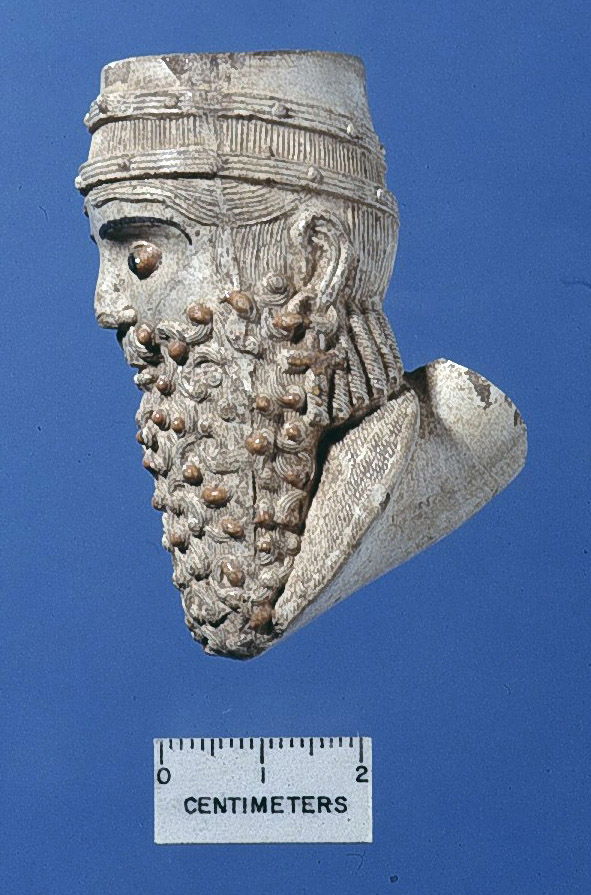
Dating to the 1850s, this Ninevian pipe was uncovered during an archaeological excavation conducted between 1989 and 1991 at the Springfield site near Augusta. The Springfield village was populated by free Blacks before the end of slavery in 1865.

Courtesy of New South Associates

The New Georgia Encyclopedia does not hold the copyright for this media resource and can neither grant nor deny permission to republish or reproduce the image online or in print. All requests for permission to publish or reproduce the resource must be submitted to the rights holder.

Wall Trench

Wall Trench

  • Info Details
  • Citation Terms of Use

The outline of a wall trench was uncovered by archaeologists in 2000 at the Silk Hope Plantation, an eighteenth-century rice plantation in Bryan County. The markings in black show the locations of a wall trench and post features that form a slave dwelling, and the red outline shows the presence of pit features that were used for storage and other functions.

Courtesy of Brockington and Associates

The New Georgia Encyclopedia does not hold the copyright for this media resource and can neither grant nor deny permission to republish or reproduce the image online or in print. All requests for permission to publish or reproduce the resource must be submitted to the rights holder.

Singer-Moye Mounds

Singer-Moye Mounds

  • Info Details
  • Citation Terms of Use

The excavation of the Singer-Moye Mounds in Stewart County has revealed the buried foundations of Indian buildings that were destroyed and abandoned more than 600 years ago. Thousands of ceramics fragments and animal bones have also been recovered.

Photograph by Elisabeth Hughes, New Georgia Encyclopedia
The New Georgia Encyclopedia does not hold the copyright for this media resource and can neither grant nor deny permission to republish or reproduce the image online or in print. All requests for permission to publish or reproduce the resource must be submitted to the rights holder.

St. Catherines Island

St. Catherines Island

  • Info Details
  • Citation Terms of Use

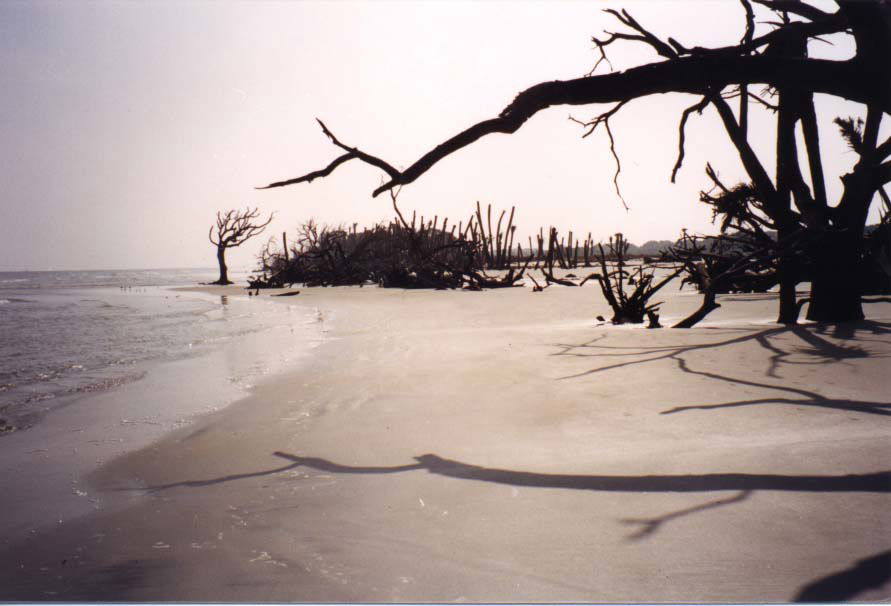
St. Catherines Island, located in Liberty County, is one of the barrier islands lining the coast of Georgia. The privately owned island, a National Historic Landmark, is about ten miles long and approximately one to three miles wide. From the 1590s to the 1680s a Spanish mission, Santa Catalina de Guale, was located on the island (at that time part of the Spanish colony La Florida).

Photograph by Jason D. Williams

The New Georgia Encyclopedia does not hold the copyright for this media resource and can neither grant nor deny permission to republish or reproduce the image online or in print. All requests for permission to publish or reproduce the resource must be submitted to the rights holder.

Lamar Period Pottery

Lamar Period Pottery

  • Info Details
  • Citation Terms of Use

An example of Mississippian Lamar pottery, on display at the Ocmulgee Mounds Visitor Center in Macon.

Courtesy of Robert Foxworth
The New Georgia Encyclopedia does not hold the copyright for this media resource and can neither grant nor deny permission to republish or reproduce the image online or in print. All requests for permission to publish or reproduce the resource must be submitted to the rights holder.

Ocmulgee National Historical Park

Ocmulgee National Historical Park

  • Info Details
  • Citation Terms of Use

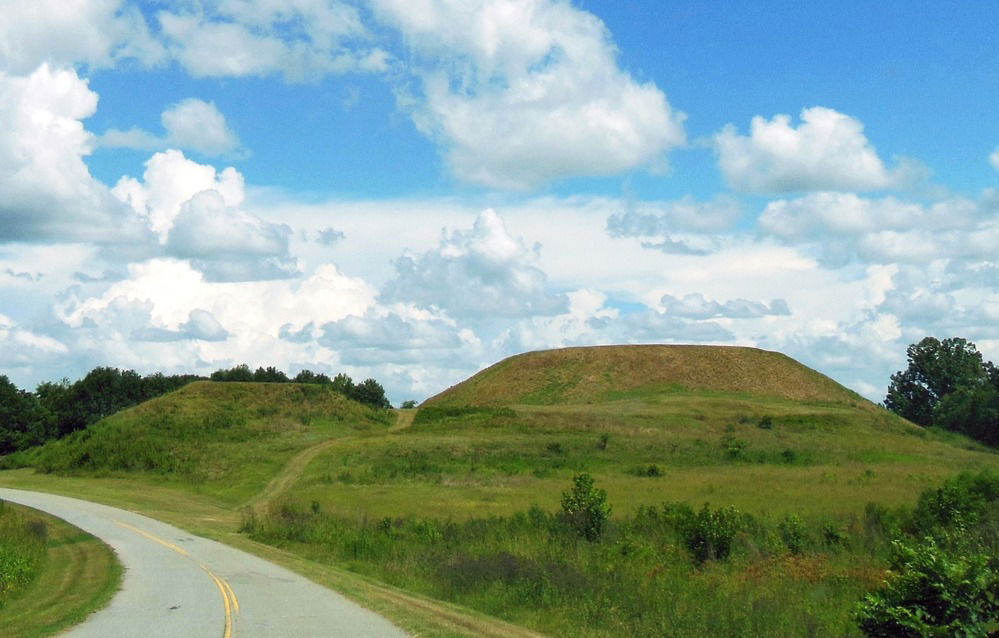
The earthen mounds at the Ocmulgee National Historical Park in Macon are the remains of a native culture that lived at the site between A.D. 800 and 1100, during the Early Mississippian period.

Photograph from National Park Service
The New Georgia Encyclopedia does not hold the copyright for this media resource and can neither grant nor deny permission to republish or reproduce the image online or in print. All requests for permission to publish or reproduce the resource must be submitted to the rights holder.

Irene Mounds

Irene Mounds

  • Info Details
  • Citation Terms of Use

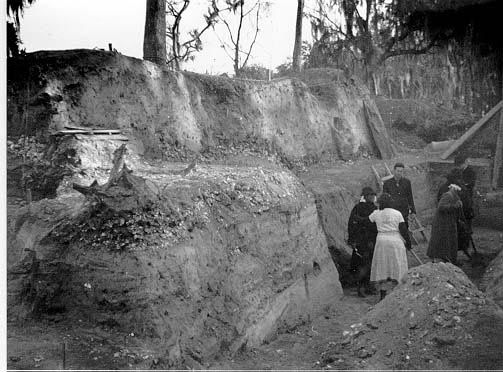
Excavation of the Irene mounds site, near Savannah, was led by several important archaeologists, especially Joseph R. Caldwell, who is pictured with an excavation team. Three different shell layers are visible in the earth behind the researchers.

Reprinted by permission of the Coastal Georgia Archaeological Society
The New Georgia Encyclopedia does not hold the copyright for this media resource and can neither grant nor deny permission to republish or reproduce the image online or in print. All requests for permission to publish or reproduce the resource must be submitted to the rights holder.

Irene Mounds

Irene Mounds

  • Info Details
  • Citation Terms of Use

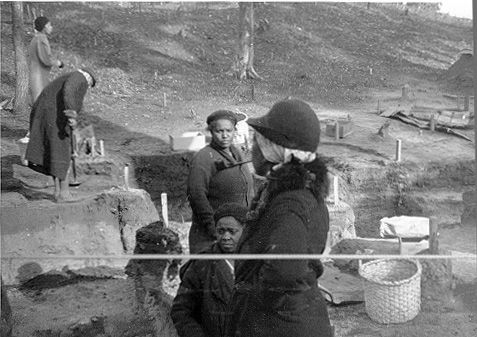
A group of African American women (pictured in December 1937) helped to excavate the Irene mounds site. The split oak basket, on the right, was made in Savannah especially for this project. The woman in the foreground is smoking a pipe.

Reprinted by permission of the Coastal Georgia Archaeological Society

The New Georgia Encyclopedia does not hold the copyright for this media resource and can neither grant nor deny permission to republish or reproduce the image online or in print. All requests for permission to publish or reproduce the resource must be submitted to the rights holder.

Sapelo Shell Ring

Sapelo Shell Ring

  • Info Details
  • Citation Terms of Use

A portion of the largest shell ring on Sapelo Island was excavated in 1950. The trench, cut into the ring by archaeologists, reveals white flecks of shell left behind by the hunter-gatherers who lived on the island during the Late Archaic Period, 5,000 to 3,000 years ago.

Courtesy of Victor D. Thompson

The New Georgia Encyclopedia does not hold the copyright for this media resource and can neither grant nor deny permission to republish or reproduce the image online or in print. All requests for permission to publish or reproduce the resource must be submitted to the rights holder.

  • Info Details
  • Citation Terms of Use

The New Georgia Encyclopedia does not hold the copyright for this media resource and can neither grant nor deny permission to republish or reproduce the image online or in print. All requests for permission to publish or reproduce the resource must be submitted to the rights holder.

Sapelo Shell Ring

Sapelo Shell Ring

  • Info Details
  • Citation Terms of Use

An archaeologist stands beside Shell Ring No. 1 on Sapelo Island. The shell rings, circular or semicircular in shape, are too large to be shown in their entirety by a single photograph.

Courtesy of Victor D. Thompson

The New Georgia Encyclopedia does not hold the copyright for this media resource and can neither grant nor deny permission to republish or reproduce the image online or in print. All requests for permission to publish or reproduce the resource must be submitted to the rights holder.

Hernando de Soto

Hernando de Soto

  • Info Details
  • Citation Terms of Use

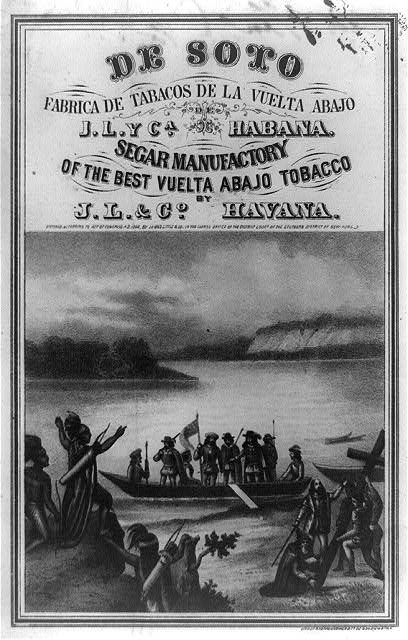
Hernando de Soto was a Spanish-born explorer and conqueror who landed in present-day Tampa Bay, Florida, in 1539 and came to the Georgia area in 1540. Chroniclers of the expedition described the Coosa River valley in glowing terms.

Courtesy of Georgia Info, Digital Library of Georgia.
The New Georgia Encyclopedia does not hold the copyright for this media resource and can neither grant nor deny permission to republish or reproduce the image online or in print. Requests for permission to publish or reproduce the resource may need to be submitted to the Digital Library of Georgia.

Hernando de Soto and Crew

Hernando de Soto and Crew

  • Info Details
  • Citation Terms of Use

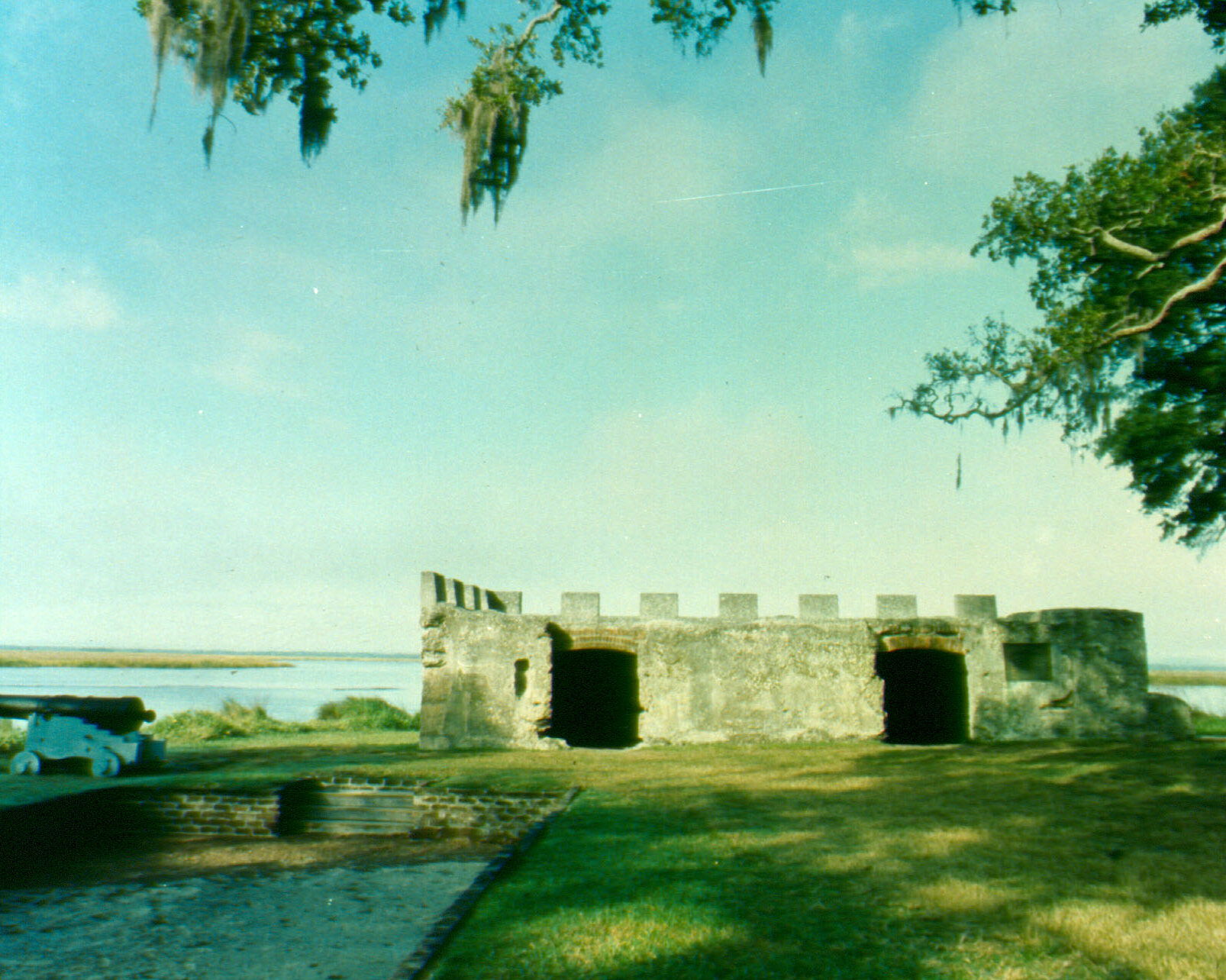
An 1866 tobacco label depicts Spanish explorer Hernando de Soto and his crew being welcomed ashore by Native Americans. De Soto entered Georgia twice in 1540, encountering the Altamaha, Capachequi, Coosa, Ichisi, Ocute, Patofa, Toa, and Ulibahali chiefdoms during his travels in the area.

Courtesy of Library of Congress, Prints and Photographs Division
The New Georgia Encyclopedia does not hold the copyright for this media resource and can neither grant nor deny permission to republish or reproduce the image online or in print. All requests for permission to publish or reproduce the resource must be submitted to the rights holder.

Fort Frederica National Monument

Fort Frederica National Monument

  • Info Details
  • Citation Terms of Use

Georgia's Department of Natural Resources and the National Park Service join forces to offer an archaeological training program for teachers each summer at Fort Frederica National Monument on St. Simons Island. Students later return with their teachers to excavate a simulated colonial site.

Courtesy of Sea Island Company

The New Georgia Encyclopedia does not hold the copyright for this media resource and can neither grant nor deny permission to republish or reproduce the image online or in print. All requests for permission to publish or reproduce the resource must be submitted to the rights holder.

  • Info Details
  • Citation Terms of Use

The New Georgia Encyclopedia does not hold the copyright for this media resource and can neither grant nor deny permission to republish or reproduce the image online or in print. All requests for permission to publish or reproduce the resource must be submitted to the rights holder.

Rock Eagle

Rock Eagle

  • Info Details
  • Citation Terms of Use

Located north of Eatonton in Putnam County, Rock Eagle is an Indian-made rock structure dating back to the Middle Woodland period (300 B.C. to A.D. 600).

Photograph by Brian McInturff

The New Georgia Encyclopedia does not hold the copyright for this media resource and can neither grant nor deny permission to republish or reproduce the image online or in print. All requests for permission to publish or reproduce the resource must be submitted to the rights holder.

Etowah Indian Mounds

Etowah Indian Mounds

  • Info Details
  • Citation Terms of Use

A path leading to two of the mounds at the Etowah Indian Mounds Historic Site. Located in Bartow County, the site is home to the second-largest Indian mound in North America, rises to a height of slightly more than 60 feet.

Photograph from Sharon Meier

The New Georgia Encyclopedia does not hold the copyright for this media resource and can neither grant nor deny permission to republish or reproduce the image online or in print. All requests for permission to publish or reproduce the resource must be submitted to the rights holder.

Augusta Canal

Augusta Canal

  • Info Details
  • Citation Terms of Use

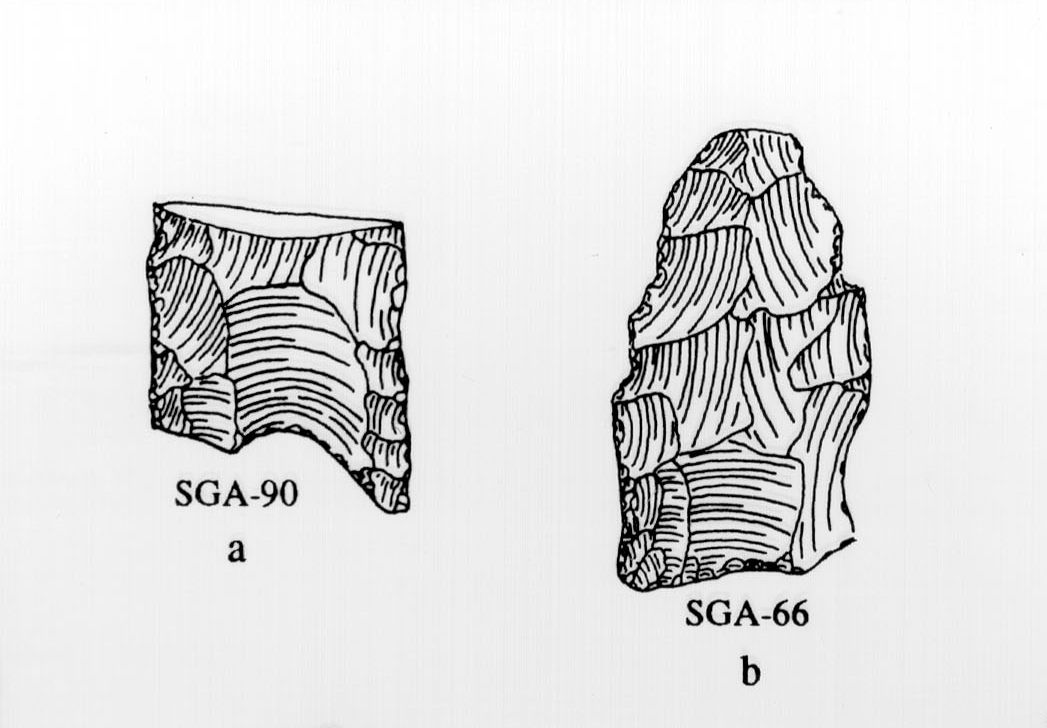
A modern tourboat passes the Confederate Powder Works chimney in Augusta along the Augusta Canal. The Georgia Community Greenspace Program has worked to preserve the Augusta Canal as an important historic and archaeological site.

Courtesy of Explore Georgia, Photograph by Ralph Daniel.
The New Georgia Encyclopedia does not hold the copyright for this media resource and can neither grant nor deny permission to republish or reproduce the image online or in print. Requests for permission to publish or reproduce the resource may need to be submitted to Explore Georgia.

Clovis Points

Clovis Points

  • Info Details
  • Citation Terms of Use

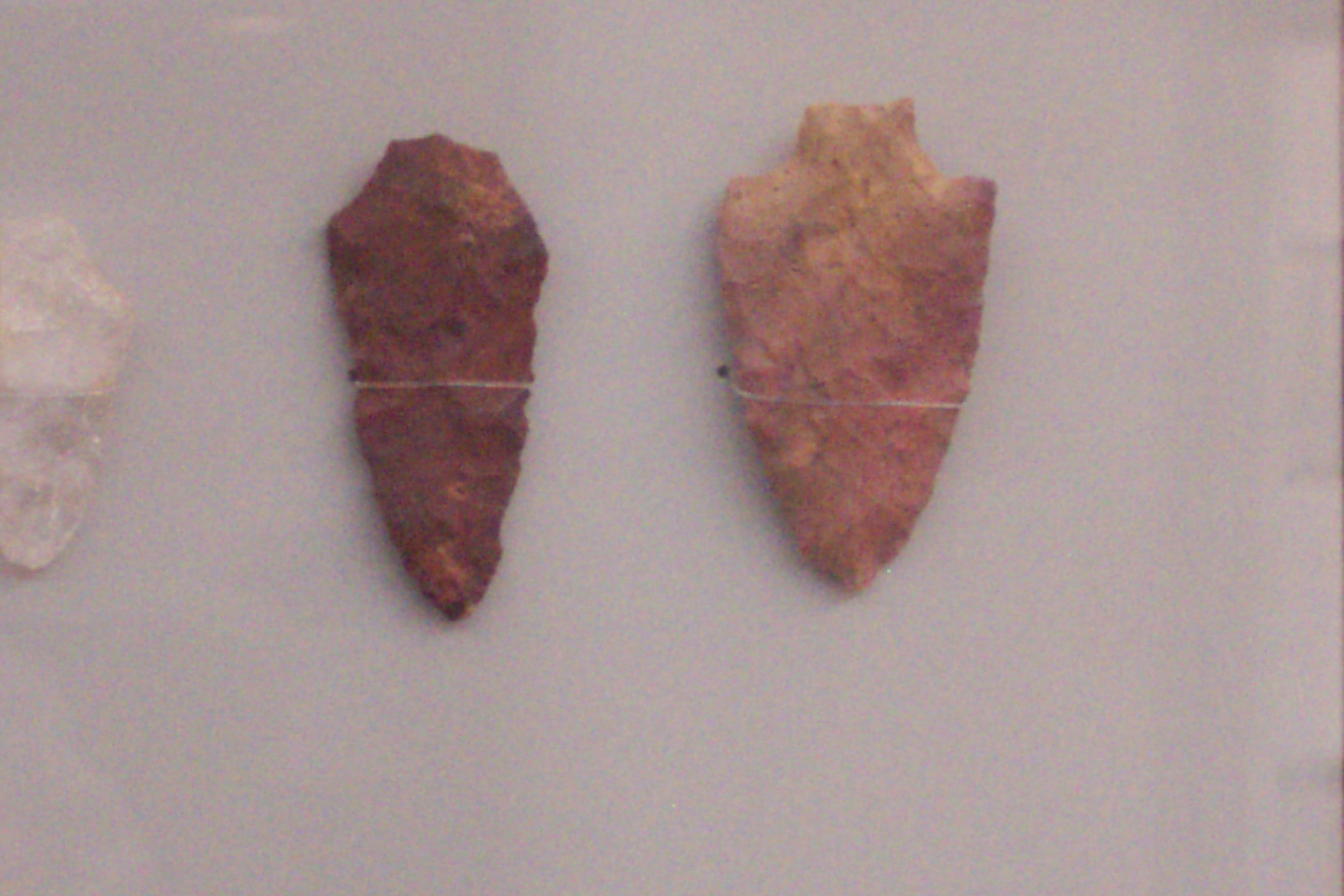
The Early Paleoindian subperiod is characterized by Clovis and related projectile point forms, relatively large lanceolate (lance-shaped) points with nearly parallel sides, slightly concave bases, and single or multiple basal flutes (channels) that rarely extend more than a third of the way up the body.

Courtesy of the University of Georgia Laboratory of Archaeology
The New Georgia Encyclopedia does not hold the copyright for this media resource and can neither grant nor deny permission to republish or reproduce the image online or in print. All requests for permission to publish or reproduce the resource must be submitted to the rights holder.

  • Info Details
  • Citation Terms of Use

The New Georgia Encyclopedia does not hold the copyright for this media resource and can neither grant nor deny permission to republish or reproduce the image online or in print. All requests for permission to publish or reproduce the resource must be submitted to the rights holder.

Flint Projectile Points

Flint Projectile Points

  • Info Details
  • Citation Terms of Use

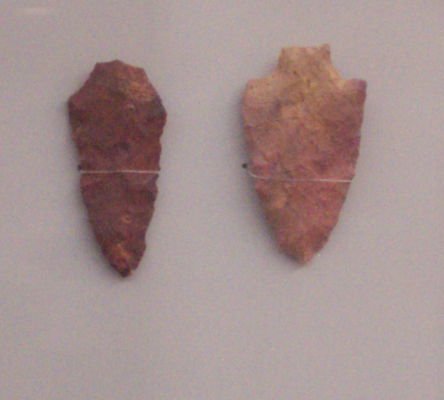
Commonly referred to as "arrowheads," these flint projectile points from the Archaic Period would have been used as spear tips or knives.

Courtesy of Ocmulgee National Monument, National Park Service

The New Georgia Encyclopedia does not hold the copyright for this media resource and can neither grant nor deny permission to republish or reproduce the image online or in print. All requests for permission to publish or reproduce the resource must be submitted to the rights holder.

Suwannee Points

Suwannee Points

  • Info Details
  • Citation Terms of Use

The Middle Paleoindian subperiod features smaller unfluted lanceolate projectile points such as the Suwannee types, among others.

Courtesy of the University of Georgia Laboratory of Archaeology
The New Georgia Encyclopedia does not hold the copyright for this media resource and can neither grant nor deny permission to republish or reproduce the image online or in print. All requests for permission to publish or reproduce the resource must be submitted to the rights holder.

Sequoyah

Sequoyah

  • Info Details
  • Citation Terms of Use

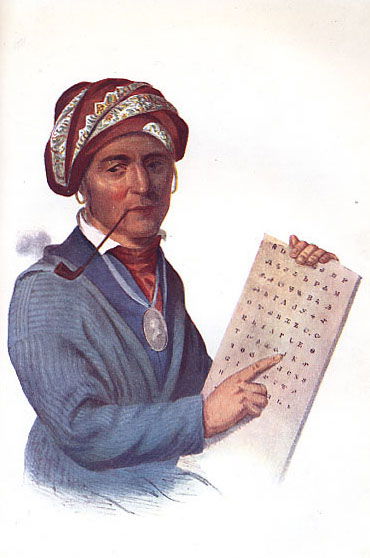
This hand-colored lithograph of Sequoyah (also called George Gist or George Guess), the legendary creator of the Cherokee syllabary, was made in 1833 after an oil portrait by Charles Bird King as part of a series depicting Native American leaders.

From The Indian Tribes of North America, by T. L. McKenney and J. Hall

The New Georgia Encyclopedia does not hold the copyright for this media resource and can neither grant nor deny permission to republish or reproduce the image online or in print. All requests for permission to publish or reproduce the resource must be submitted to the rights holder.

Ocmulgee Mounds National Historical Park

Ocmulgee Mounds National Historical Park

  • Info Details
  • Citation Terms of Use

The chiefdom of Ichisi was located between modern Macon and Perry on the Ocmulgee River. The capital town was probably located at the present-day Lamar archaeological site, a part of Ocmulgee Mounds National Historical Park.

Courtesy of Georgia Department of Economic Development.

The New Georgia Encyclopedia does not hold the copyright for this media resource and can neither grant nor deny permission to republish or reproduce the image online or in print. Requests for permission to publish or reproduce the resource may need to be submitted to the Georgia Department of Economic Development.

Riverside Etowah Indian Mound

Riverside Etowah Indian Mound

  • Info Details
  • Citation Terms of Use

The Etowah mounds were built during the Lamar Period. Modern-day steps allow tourists to climb to the summit of the Etowah mounds.

Photograph by Muora

The New Georgia Encyclopedia does not hold the copyright for this media resource and can neither grant nor deny permission to republish or reproduce the image online or in print. All requests for permission to publish or reproduce the resource must be submitted to the rights holder.

Nacoochee Mound

Nacoochee Mound

  • Info Details
  • Citation Terms of Use

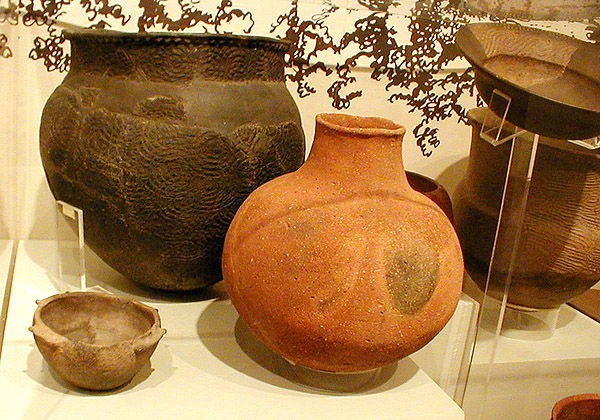
Although the original Late Prehistoric earthen platform mound has been completely excavated, a reconstruction of the Nacoochee Mound can be seen today on private property in the Nacoochee Valley.

Photograph by Martin LaBar
The New Georgia Encyclopedia does not hold the copyright for this media resource and can neither grant nor deny permission to republish or reproduce the image online or in print. All requests for permission to publish or reproduce the resource must be submitted to the rights holder.

Lamar Period Pottery

Lamar Period Pottery

  • Info Details
  • Citation Terms of Use

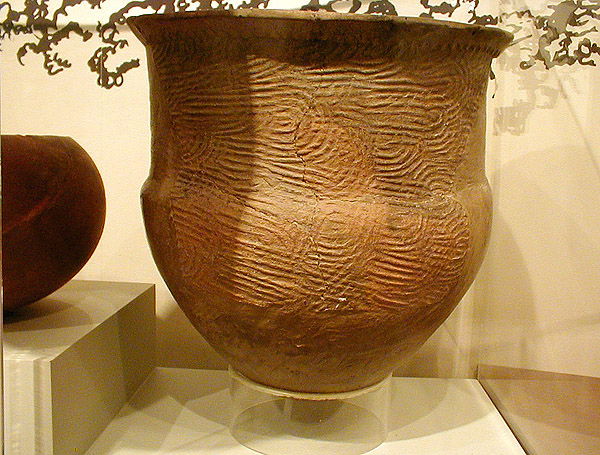
Mississippian Lamar pottery is distinctive because of its unique stamping and shape.

Courtesy of Robert Foxworth
The New Georgia Encyclopedia does not hold the copyright for this media resource and can neither grant nor deny permission to republish or reproduce the image online or in print. All requests for permission to publish or reproduce the resource must be submitted to the rights holder.

Lamar Period Pottery

Lamar Period Pottery

  • Info Details
  • Citation Terms of Use

An example of Mississippian Lamar pottery. Lamar pottery was made throughout Georgia and well into the adjacent states.

Courtesy of Robert Foxworth

The New Georgia Encyclopedia does not hold the copyright for this media resource and can neither grant nor deny permission to republish or reproduce the image online or in print. All requests for permission to publish or reproduce the resource must be submitted to the rights holder.

William McIntosh

William McIntosh

  • Info Details
  • Citation Terms of Use

Charles Bird King's portrait of William McIntosh (ca. 1825). In 1825 McIntosh negotiated and signed the Treaty of Indian Springs, signing away all Muscogee (Creek) lands in Georgia and thereby defying most of the reforms that he had encouraged and the laws that he had helped write.

Image from Archives and Rare Books Library, University of Cincinnati Libraries, McKenney and Hall: History of the Indian Tribes Collection.

The New Georgia Encyclopedia does not hold the copyright for this media resource and can neither grant nor deny permission to republish or reproduce the image online or in print. All requests for permission to publish or reproduce the resource must be submitted to the rights holder.

Tomochichi

Tomochichi

  • Info Details
  • Citation Terms of Use

As a principal mediator between the native Muscogee (Creek) and English settlers during the first years of Georgia's settlement, Tomochichi (left) contributed to the establishment of peaceful relations between the two groups. His nephew, Toonahowi, is seated on the right in this engraving, circa 1734-35, by John Faber Jr.

Courtesy of Hargrett Rare Book and Manuscript Library, University of Georgia Libraries.

The New Georgia Encyclopedia does not hold the copyright for this media resource and can neither grant nor deny permission to republish or reproduce the image online or in print. Requests for permission to publish or reproduce the resource should be submitted to the Hargrett Manuscript and Rare Book Library at the University of Georgia.

De Luna Landing

De Luna Landing

  • Info Details
  • Citation Terms of Use

A watercolor by Herbert Rudeen illustrates Tristan de Luna's historic landing at Pensacola Bay in August 1559. De Luna's failed plan to establish a Spanish presence along the lower Atlantic coast, the Gulf Coast, and the interior of the Southeast included the colonization of Ochuse (Florida), Coosa (Georgia), and Santa Elena (South Carolina).

Courtesy of Pensacola Historical Society

The New Georgia Encyclopedia does not hold the copyright for this media resource and can neither grant nor deny permission to republish or reproduce the image online or in print. All requests for permission to publish or reproduce the resource must be submitted to the rights holder.

Pedro Menendez de Aviles

Pedro Menendez de Aviles

  • Info Details
  • Citation Terms of Use

A 1791 engraving depicts Pedro Menendez de Aviles at about age fifty. Menendez de Aviles founded St. Augustine, Florida, the oldest European settlement in North America, in 1565, just before he explored the Georgia coastline.

From The Spanish Settlements within the Present Limits of the United States: Florida, 1562-1574, by W. Lowery

The New Georgia Encyclopedia does not hold the copyright for this media resource and can neither grant nor deny permission to republish or reproduce the image online or in print. All requests for permission to publish or reproduce the resource must be submitted to the rights holder.

Weeden Island Period Pottery

Weeden Island Period Pottery

  • Info Details
  • Citation Terms of Use

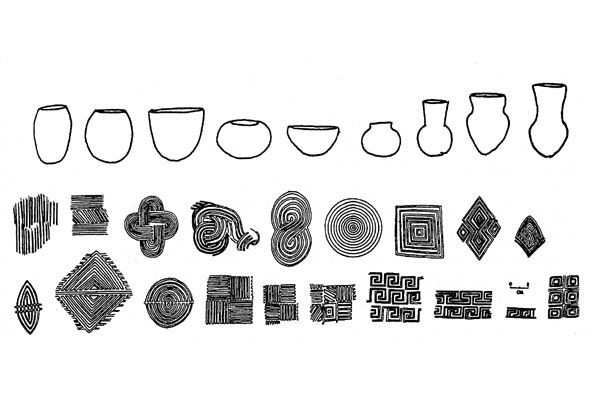
Drawings depict derived effigies with zoned incising found at the Davis Point excavation site at the Kolomoki Mounds. Weeden Island burial mounds are well known for the inclusion of elaborate animal effigy pots in large deposits.

From Excavations at Kolomoki, by W. H. Sears

The New Georgia Encyclopedia does not hold the copyright for this media resource and can neither grant nor deny permission to republish or reproduce the image online or in print. All requests for permission to publish or reproduce the resource must be submitted to the rights holder.

  • Info Details
  • Citation Terms of Use

The New Georgia Encyclopedia does not hold the copyright for this media resource and can neither grant nor deny permission to republish or reproduce the image online or in print. All requests for permission to publish or reproduce the resource must be submitted to the rights holder.

Kolomoki Mounds

Kolomoki Mounds

  • Info Details
  • Citation Terms of Use

The Kolomoki Mounds site in Early County is one of the largest prehistoric mound complexes in Georgia and includes at least eight mounds.

Courtesy of Kolomoki Mounds State Historic Park

The New Georgia Encyclopedia does not hold the copyright for this media resource and can neither grant nor deny permission to republish or reproduce the image online or in print. All requests for permission to publish or reproduce the resource must be submitted to the rights holder.

  • Info Details
  • Citation Terms of Use

The New Georgia Encyclopedia does not hold the copyright for this media resource and can neither grant nor deny permission to republish or reproduce the image online or in print. All requests for permission to publish or reproduce the resource must be submitted to the rights holder.

Fluted Cumberland Point

Fluted Cumberland Point

  • Info Details
  • Citation Terms of Use

The Middle Paleoindian subperiod features fluted or unfluted points with broad blades and constricted handle elements, which may include the Cumberland type. Fluted points (pictured) have a channel or flute running from the base of the point.

Courtesy of the University of Georgia Laboratory of Archaeology

The New Georgia Encyclopedia does not hold the copyright for this media resource and can neither grant nor deny permission to republish or reproduce the image online or in print. All requests for permission to publish or reproduce the resource must be submitted to the rights holder.

Fluted Dalton Points

Fluted Dalton Points

  • Info Details
  • Citation Terms of Use

From the Late Paleoindian subperiod come Dalton and related point types, which are characterized by a lanceolate (lance-shaped) blade outline and a concave base ground on the lateral and basal margins, occasionally well thinned. Blade edges are frequently serrated and beveled.

Courtesy of the University of Georgia Laboratory of Archaeology

The New Georgia Encyclopedia does not hold the copyright for this media resource and can neither grant nor deny permission to republish or reproduce the image online or in print. All requests for permission to publish or reproduce the resource must be submitted to the rights holder.

Macon Plateau Fluted Point

Macon Plateau Fluted Point

  • Info Details
  • Citation Terms of Use

Only one fluted point was found at Macon Plateau, in spite of a massive excavation effort. The fluted point, missing the forward one-third of its length, was of the Clovis type of these artifacts.

Courtesy of the University of Georgia Laboratory of Archaeology

The New Georgia Encyclopedia does not hold the copyright for this media resource and can neither grant nor deny permission to republish or reproduce the image online or in print. All requests for permission to publish or reproduce the resource must be submitted to the rights holder.

Muscogee Creek Indian Painting depicting figures rowing and firing guns.

Muscogee (Creek) Indian Painting

  • Info Details
  • Citation Terms of Use

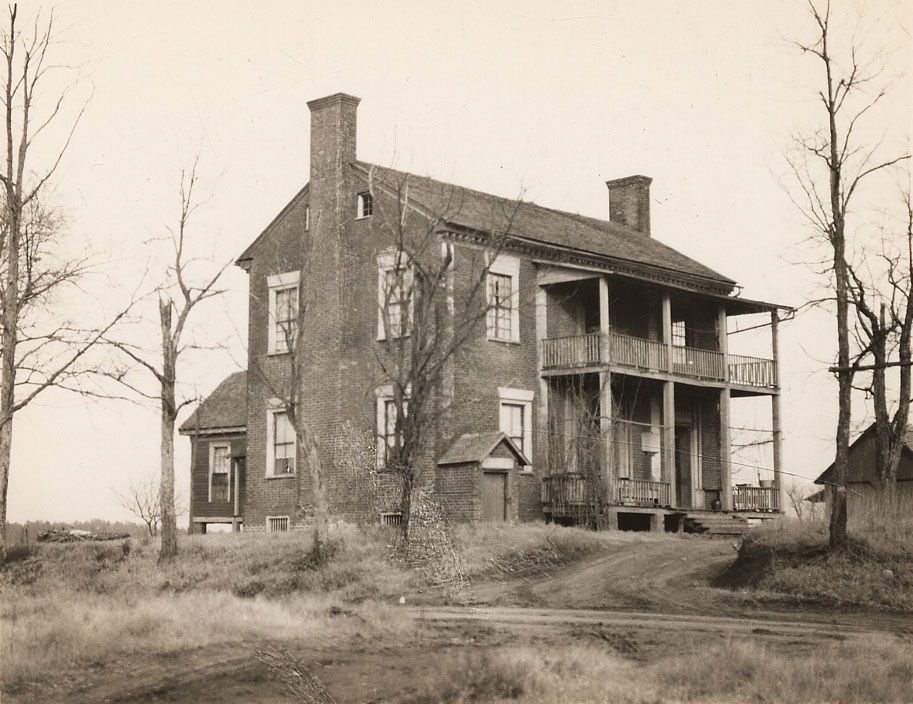
This copy of a Muscogee (Creek) "hieroglyphick painting" was made in the 1770s by Bernard Romans. Romans was a British surveyor and engineer who worked in Florida during the 1770s. He made many notes on the Muscogee.
Courtesy of Hargrett Rare Book and Manuscript Library, University of Georgia Libraries.

The New Georgia Encyclopedia does not hold the copyright for this media resource and can neither grant nor deny permission to republish or reproduce the image online or in print. Requests for permission to publish or reproduce the resource should be submitted to the Hargrett Manuscript and Rare Book Library at the University of Georgia.

Chief Vann House

Chief Vann House

  • Info Details
  • Citation Terms of Use

The home of Cherokee chief James Vann was located north of the Moravian Mission at Spring Place. Invited by Vann and other Cherokee leaders, the Moravians provided a school for Cherokee children and housed 114 students between 1804 and 1833.

Courtesy of Hargrett Rare Book and Manuscript Library, University of Georgia Libraries.

The New Georgia Encyclopedia does not hold the copyright for this media resource and can neither grant nor deny permission to republish or reproduce the image online or in print. Requests for permission to publish or reproduce the resource should be submitted to the Hargrett Manuscript and Rare Book Library at the University of Georgia.

Taloney Mission

Taloney Mission

  • Info Details
  • Citation Terms of Use

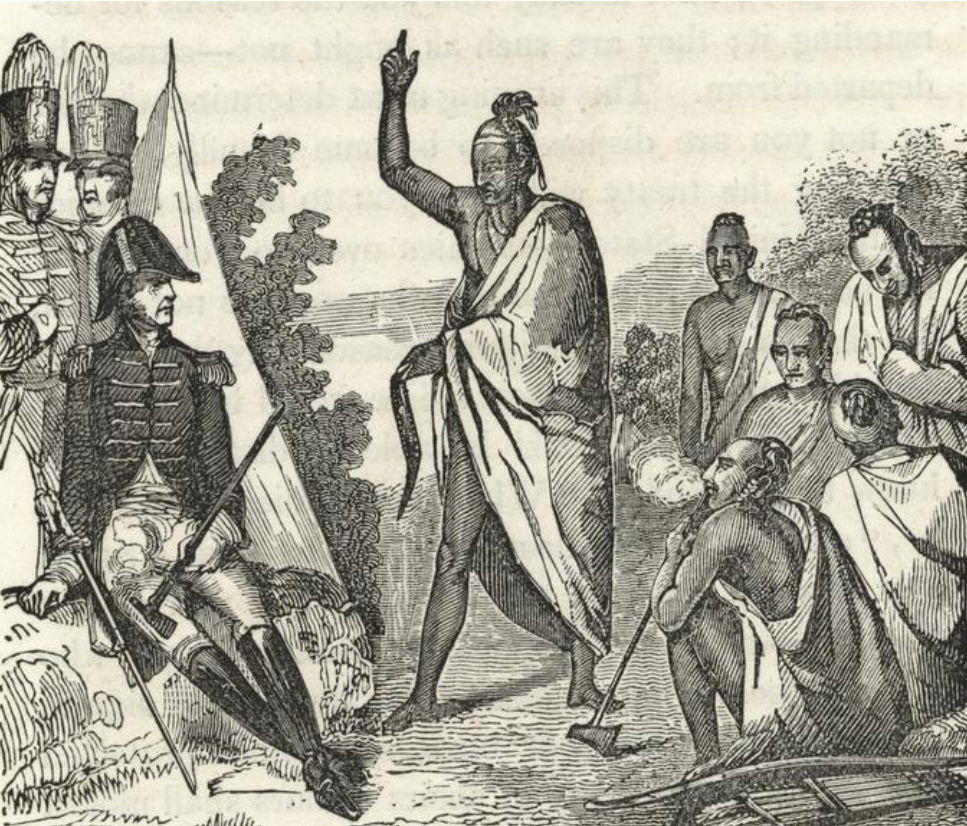
The Taloney Mission (later Carmel Mission) was founded by the Georgia Presbyterians in Pickens County along Talking Rock Creek. The Presbyterians established and ran a number of mission schools throughout Georgia from 1817 to 1833. The remains of the Taloney Mission were photographed between 1930 and 1960.
Courtesy of Hargrett Rare Book and Manuscript Library, University of Georgia Libraries.

The New Georgia Encyclopedia does not hold the copyright for this media resource and can neither grant nor deny permission to republish or reproduce the image online or in print. Requests for permission to publish or reproduce the resource should be submitted to the Hargrett Manuscript and Rare Book Library at the University of Georgia.

Etowah Complicated Stamped Pottery

Etowah Complicated Stamped Pottery

  • Info Details
  • Citation Terms of Use

This type of pottery originated in northwestern Georgia and is found in small quantities throughout the state. It is from the Middle Mississippian subperiod.

Courtesy of Mark Williams

The New Georgia Encyclopedia does not hold the copyright for this media resource and can neither grant nor deny permission to republish or reproduce the image online or in print. All requests for permission to publish or reproduce the resource must be submitted to the rights holder.

Stallings Island Site Pottery

Stallings Island Site Pottery

  • Info Details
  • Citation Terms of Use

Stallings Island, located in the Savannah River eight miles upstream from Augusta, is best known for its very early pottery, a technological development that predated the advent of farming in Georgia by several millennia. Pictured are sherds of the punctated fiber-tempered pottery, ca. 3,800-3,500 years ago. The sherd on top is actually 11 centimeters wide.

Courtesy of Kenneth E. Sassaman

The New Georgia Encyclopedia does not hold the copyright for this media resource and can neither grant nor deny permission to republish or reproduce the image online or in print. All requests for permission to publish or reproduce the resource must be submitted to the rights holder.

  • Info Details
  • Citation Terms of Use

The New Georgia Encyclopedia does not hold the copyright for this media resource and can neither grant nor deny permission to republish or reproduce the image online or in print. All requests for permission to publish or reproduce the resource must be submitted to the rights holder.

  • Info Details
  • Citation Terms of Use

The New Georgia Encyclopedia does not hold the copyright for this media resource and can neither grant nor deny permission to republish or reproduce the image online or in print. All requests for permission to publish or reproduce the resource must be submitted to the rights holder.

King Site Map

King Site Map

  • Info Details
  • Citation Terms of Use

The King site in Floyd County covers a little more than five acres and is bounded by a defensive ditch and palisade. It was first occupied at some time during the first half of the sixteenth century.

Courtesy of David Hally

The New Georgia Encyclopedia does not hold the copyright for this media resource and can neither grant nor deny permission to republish or reproduce the image online or in print. All requests for permission to publish or reproduce the resource must be submitted to the rights holder.

Mississippian Earthlodge

Mississippian Earthlodge

  • Info Details
  • Citation Terms of Use

Photograph of ceremonial earthlodge which has been reconstructed and is today part of the Ocmulgee National Monument in Macon, Georgia.

Image from Ken Lund
View on source site

The New Georgia Encyclopedia does not hold the copyright for this media resource and can neither grant nor deny permission to republish or reproduce the image online or in print. All requests for permission to publish or reproduce the resource must be submitted to the rights holder.

Etowah Indian Figures

Etowah Indian Figures

  • Info Details
  • Citation Terms of Use

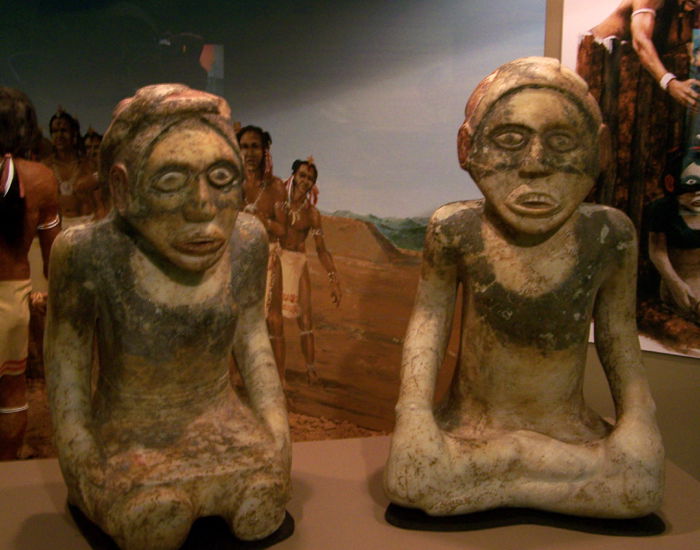
Archaeological excavation, carried out intermittently at the Etowah mound site for more than 100 years, has unearthed artifacts such as these figures, which have provided much information about life in the Mississippian Period.

Photograph from Wikimedia

The New Georgia Encyclopedia does not hold the copyright for this media resource and can neither grant nor deny permission to republish or reproduce the image online or in print. All requests for permission to publish or reproduce the resource must be submitted to the rights holder.

Swift Creek Culture

Swift Creek Culture

  • Info Details
  • Citation Terms of Use

Swift Creek pottery is noted for its distinctive decoration. Complex curvilinear patterns were first carved into a wooden paddle, which was used to stamp the design into the soft clay walls of the pottery before it was fired.

Courtesy of Kennesaw State University

The New Georgia Encyclopedia does not hold the copyright for this media resource and can neither grant nor deny permission to republish or reproduce the image online or in print. All requests for permission to publish or reproduce the resource must be submitted to the rights holder.

  • Info Details
  • Citation Terms of Use

The New Georgia Encyclopedia does not hold the copyright for this media resource and can neither grant nor deny permission to republish or reproduce the image online or in print. All requests for permission to publish or reproduce the resource must be submitted to the rights holder.

Cane Island Site

Cane Island Site

  • Info Details
  • Citation Terms of Use

In 1978 and 1979 the University of Georgia's Department of Anthropology excavated portions of the Cane Island archaeological site before it was flooded. It now lies beneath Lake Oconee in Greene County, Georgia.

Courtesy of W. Dean Wood

The New Georgia Encyclopedia does not hold the copyright for this media resource and can neither grant nor deny permission to republish or reproduce the image online or in print. All requests for permission to publish or reproduce the resource must be submitted to the rights holder.

Oconee River

Oconee River

  • Info Details
  • Citation Terms of Use

Cane Island, the site of one of the earliest Native American farming villages in Georgia, was located in present-day Greene County along a shallow portion of the Oconee River known as Long Shoals. Wild plants and animals around the river likely supplied most of the food for the Cane Island residents.

Courtesy of W. Dean Wood

The New Georgia Encyclopedia does not hold the copyright for this media resource and can neither grant nor deny permission to republish or reproduce the image online or in print. All requests for permission to publish or reproduce the resource must be submitted to the rights holder.

Sara’s Ridge

Sara’s Ridge

  • Info Details
  • Citation Terms of Use

An illustration of what Sara's Ridge probably looked like during the Middle Archaic Period. The woman in the foreground is cooking with soapstone slabs, while hunters carry a deer toward racks where fish are hung over a fire.

From Beneath These Waters, by S. Kane and R. Keeton

The New Georgia Encyclopedia does not hold the copyright for this media resource and can neither grant nor deny permission to republish or reproduce the image online or in print. All requests for permission to publish or reproduce the resource must be submitted to the rights holder.

Upper Savannah River

Upper Savannah River

  • Info Details
  • Citation Terms of Use

Archaeologists excavated a prehistoric Indian village in Rucker's Bottom near the Savannah River about 500 years after the civilization's height.

Courtesy of Hargrett Rare Book and Manuscript Library, University of Georgia Libraries.

The New Georgia Encyclopedia does not hold the copyright for this media resource and can neither grant nor deny permission to republish or reproduce the image online or in print. Requests for permission to publish or reproduce the resource should be submitted to the Hargrett Manuscript and Rare Book Library at the University of Georgia.

Etowah Indian Mounds

Etowah Indian Mounds

  • Info Details
  • Citation Terms of Use

Modern-day steps lead to the summit of one of the Indian mounds at the Etowah site.

Courtesy of Georgia Department of Natural Resources, Georgia State Parks.
The New Georgia Encyclopedia does not hold the copyright for this media resource and can neither grant nor deny permission to republish or reproduce the image online or in print. Requests for permission to publish or reproduce the resource may need to be submitted to the Georgia Department of Natural Resources.

Oglethorpe with Creek Indians

Oglethorpe with Creek Indians

  • Info Details
  • Citation Terms of Use

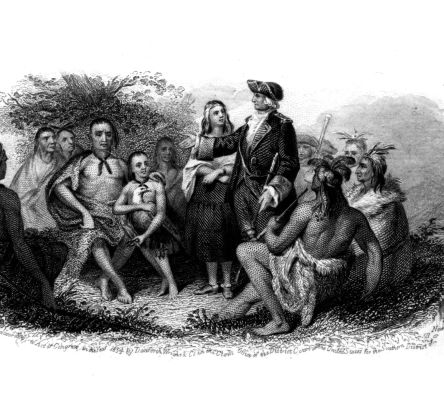
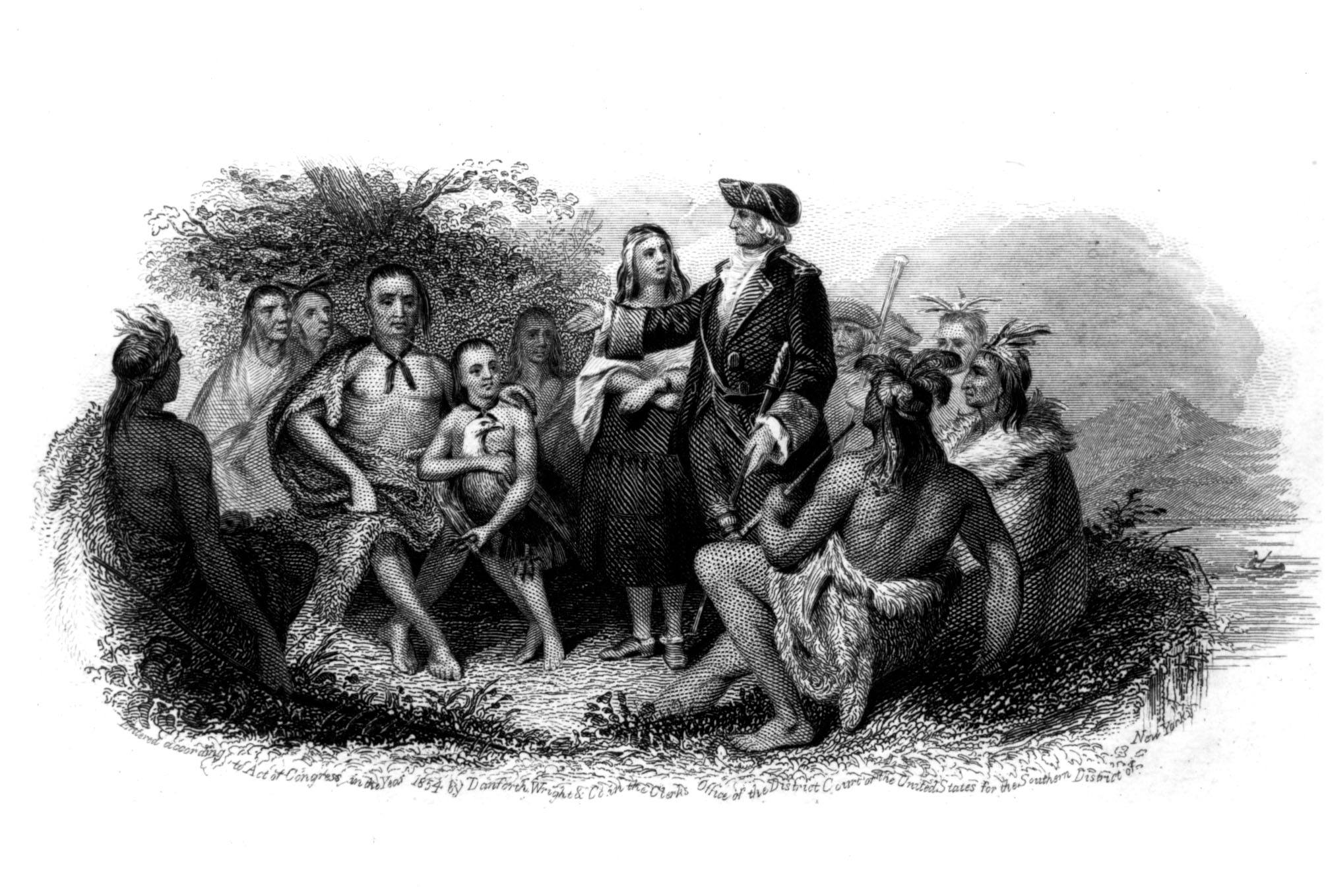
The Muscogee (Creek) Indians meet with James Oglethorpe. By the time Oglethorpe and his Georgia colonists arrived in 1733, relations between the Muscogee and the English were already well established and centered mainly on trade.
Courtesy of Hargrett Rare Book and Manuscript Library, University of Georgia Libraries.

The New Georgia Encyclopedia does not hold the copyright for this media resource and can neither grant nor deny permission to republish or reproduce the image online or in print. Requests for permission to publish or reproduce the resource should be submitted to the Hargrett Manuscript and Rare Book Library at the University of Georgia.

Treaty of Fort Jackson

Treaty of Fort Jackson

  • Info Details
  • Citation Terms of Use

A civil war between the United States and the Muscogee (Creeks) erupted in 1813. In a final battle in March 1814 at Horseshoe Bend in Alabama, General Andrew Jackson (left) directed the killing of 800 Muscogee. The Red Stick War officially ended in August 1814 with the Treaty of Fort Jackson.

Image from the New York Public Library Digital Collections, The Miriam and Ira D. Wallach Division of Art, Prints and Photographs: Picture Collection.

View on source site

The New Georgia Encyclopedia does not hold the copyright for this media resource and can neither grant nor deny permission to republish or reproduce the image online or in print. All requests for permission to publish or reproduce the resource must be submitted to the rights holder.

Color print of Muscogee Creek Indians attacking settlers at a fort.

Muscogee (Creek) Indians

  • Info Details
  • Citation Terms of Use

A brief conflict between the United States and Muscogee (Creeks) in 1836 ended with U.S. troops, assisted by Georgia and Alabama militia, rounding up Muscogee and forcibly sending them to Indian Territory (Oklahoma).

Reprinted by permission of The Granger Collection, New York
The New Georgia Encyclopedia does not hold the copyright for this media resource and can neither grant nor deny permission to republish or reproduce the image online or in print. All requests for permission to publish or reproduce the resource must be submitted to the rights holder.

Kipahalgwa

Kipahalgwa

  • Info Details
  • Citation Terms of Use

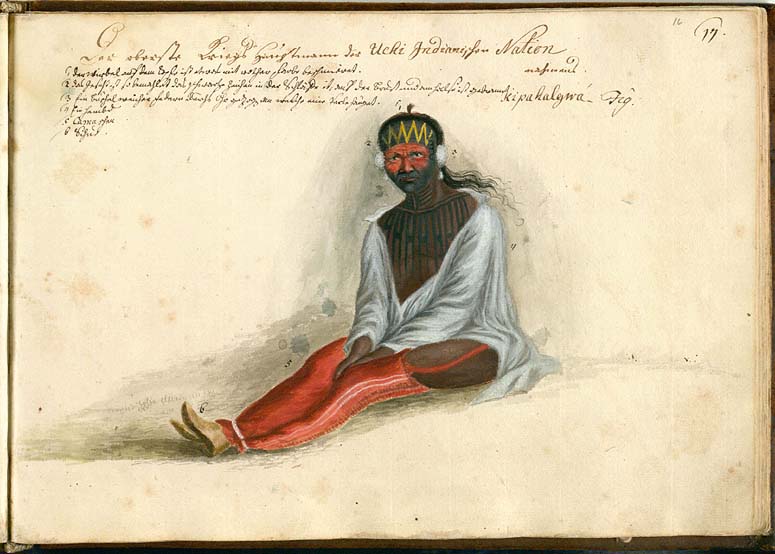
This watercolor portrait of "General" Kipahalgwa of the Yuchi Indians was painted by the German artist Philip Georg Friedrich von Reck around 1734. Kipahalgwa is depicted wearing an English-style shirt, leggings, and shoes.

Illustration by Philip Georg Friedrich von Reck

The New Georgia Encyclopedia does not hold the copyright for this media resource and can neither grant nor deny permission to republish or reproduce the image online or in print. All requests for permission to publish or reproduce the resource must be submitted to the rights holder.

Yuchi Queen and King

Yuchi Queen and King

  • Info Details
  • Citation Terms of Use

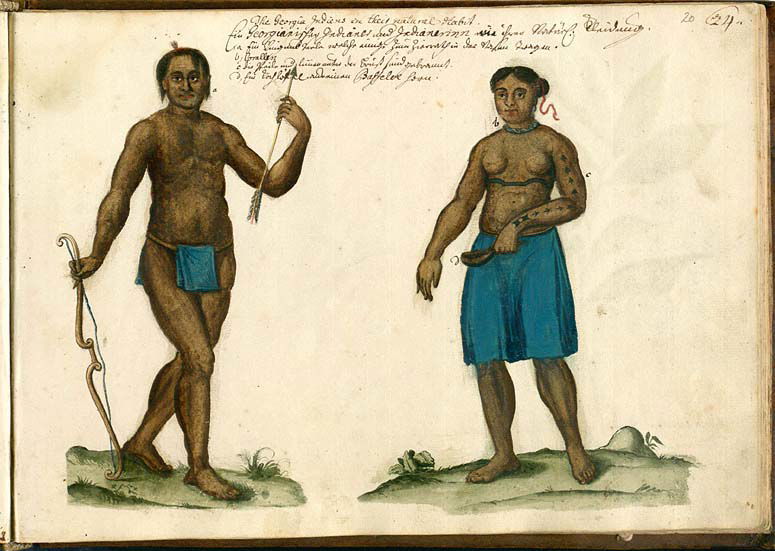
Painter Philip Georg Friedrich von Reck identifies this couple as Senkaitschi, a Yuchi king, and his queen. The queen's blanket, which the artist describes as "a British blanket from Charles Town," offers evidence of trade with Europeans.

Illustration by Philip Georg Friedrich von Reck
The New Georgia Encyclopedia does not hold the copyright for this media resource and can neither grant nor deny permission to republish or reproduce the image online or in print. All requests for permission to publish or reproduce the resource must be submitted to the rights holder.

Yuchi Indians of Georgia

Yuchi Indians of Georgia

  • Info Details
  • Citation Terms of Use

This illustration shows the Yuchi Indians of Georgia with popular adornments and accessories including: a) ring and pearl worn by some in the nose, b) corals, c) arrows and lines burned into the chest, and d) ladle made from a buffalo horn.

Illustrations by Philip Georg Friedrich von Reck

The New Georgia Encyclopedia does not hold the copyright for this media resource and can neither grant nor deny permission to republish or reproduce the image online or in print. All requests for permission to publish or reproduce the resource must be submitted to the rights holder.

Yuchi Indians of Georgia

Yuchi Indians of Georgia

  • Info Details
  • Citation Terms of Use

Georgia's Yuchi Indians were one of many refugee tribes in the area during the eighteenth century. They eventually joined with the Lower Muscogee (Creek) Indians. Here the Yuchi Indians are depicted in a war dance.

Illustration by Philip Georg Friedrich von Reck

The New Georgia Encyclopedia does not hold the copyright for this media resource and can neither grant nor deny permission to republish or reproduce the image online or in print. All requests for permission to publish or reproduce the resource must be submitted to the rights holder.

Yuchi Hunters

Yuchi Hunters

  • Info Details
  • Citation Terms of Use

Yuchi Indians, depicted in traditional hunting clothing, also carry items acquired through trade with the English, notably the central figure's blanket and rifle.

Illustration by Philip Georg Friedrich von Reck

The New Georgia Encyclopedia does not hold the copyright for this media resource and can neither grant nor deny permission to republish or reproduce the image online or in print. All requests for permission to publish or reproduce the resource must be submitted to the rights holder.

Macon Trading Post Site

Macon Trading Post Site

  • Info Details
  • Citation Terms of Use

A view of the immediate area where the Macon Trading Post was located.

Photograph by Dsdugan / CC0

The New Georgia Encyclopedia does not hold the copyright for this media resource and can neither grant nor deny permission to republish or reproduce the image online or in print. All requests for permission to publish or reproduce the resource must be submitted to the rights holder.

Etowah Indian Figures

Etowah Indian Figures

  • Info Details
  • Citation Terms of Use

Archaeological excavation, carried out intermittently at the site for more than a hundred years, has unearthed artifacts such as these stone figures, which have provided much information life in the Mississippian Period.

Courtesy of Georgia Department of Economic Development.

The New Georgia Encyclopedia does not hold the copyright for this media resource and can neither grant nor deny permission to republish or reproduce the image online or in print. Requests for permission to publish or reproduce the resource may need to be submitted to the Georgia Department of Economic Development.

Etowah River

Etowah River

  • Info Details
  • Citation Terms of Use

The Etowah River, with headwaters near Dahlonega, flows west-southwest for 140 miles to Rome, where it forms the Coosa River when it joins the Oostanaula River.

Image from Kevin Trotman

View on source site

The New Georgia Encyclopedia does not hold the copyright for this media resource and can neither grant nor deny permission to republish or reproduce the image online or in print. All requests for permission to publish or reproduce the resource must be submitted to the rights holder.

Kolomoki Mounds

Kolomoki Mounds

  • Info Details
  • Citation Terms of Use

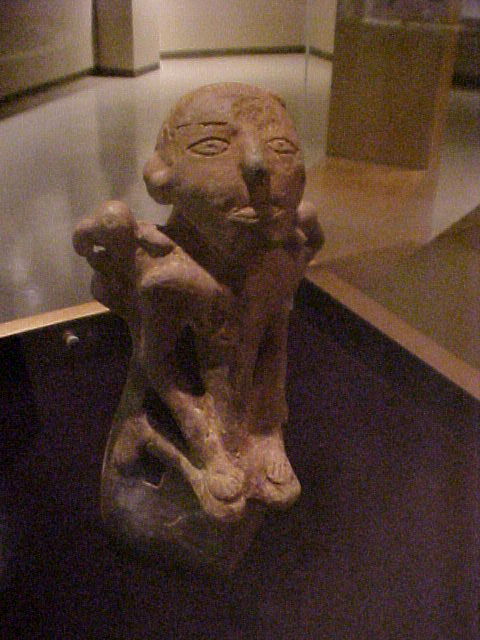
Archaeologists now recognize that the main occupation of the Kolomoki Mounds site dates to the Woodland Period (1000 B.C.-A.D. 900).
Courtesy of Historic Preservation Division, Georgia Department of Community Affairs.

The New Georgia Encyclopedia does not hold the copyright for this media resource and can neither grant nor deny permission to republish or reproduce the image online or in print. Requests for permission to publish or reproduce the resource may need to be submitted to the Georgia Department of Community Affairs, Historic Preservation Division.

Kolomoki Mounds Artifact

Kolomoki Mounds Artifact

  • Info Details
  • Citation Terms of Use

Ceramic artifacts were found during excavations of the Kolomoki Mounds in Early County.

Photograph by Bubba73, Wikimedia Commons

The New Georgia Encyclopedia does not hold the copyright for this media resource and can neither grant nor deny permission to republish or reproduce the image online or in print. All requests for permission to publish or reproduce the resource must be submitted to the rights holder.

Spanish Mission Sites in Georgia

Spanish Mission Sites in Georgia

  • Info Details
  • Citation Terms of Use

Courtesy of John Worth

The New Georgia Encyclopedia does not hold the copyright for this media resource and can neither grant nor deny permission to republish or reproduce the image online or in print. All requests for permission to publish or reproduce the resource must be submitted to the rights holder.

Confederate Earthwork
Etowah Mounds Rock Eagle
De Soto Crossing the Chattahoochee Georgia Trustees
Battle of Kettle Creek Eli Whitney
Cherokee Trail of Tears Secession Ordinance Robert Toombs Andersonville Prison Freedmen’s Bureau Henry W. Grady Sharecroppers Thomas E. Watson
Roosevelts in Atlanta Ben Epps Fort Benning Segregation Protest Integration of Atlanta Schools Hunter and Holmes, UGA Albany Movement Carl Sanders Lester Maddox, 1964 Hamilton Jordan and Jimmy Carter
Peanut Farming
Latino Workers St. Simons Tourists James Oglethorpe Shotgun Houses Colonoware Pitcher Savannah-Ogeechee Canal Slave Quarters Colonoware Jar Ninevian Pipe Wall Trench Singer-Moye Mounds St. Catherines Island Lamar Period Pottery Ocmulgee National Historical Park Irene Mounds Irene Mounds Sapelo Shell Ring
Sapelo Shell Ring Hernando de Soto Hernando de Soto and Crew Fort Frederica National Monument
Rock Eagle Etowah Indian Mounds Augusta Canal Clovis Points
Flint Projectile Points Suwannee Points Sequoyah Ocmulgee Mounds National Historical Park Riverside Etowah Indian Mound Nacoochee Mound Lamar Period Pottery Lamar Period Pottery William McIntosh Tomochichi De Luna Landing Pedro Menendez de Aviles Weeden Island Period Pottery
Kolomoki Mounds
Fluted Cumberland Point Fluted Dalton Points Macon Plateau Fluted Point Muscogee Creek Indian Painting depicting figures rowing and firing guns. Chief Vann House Taloney Mission Etowah Complicated Stamped Pottery Stallings Island Site Pottery
King Site Map Mississippian Earthlodge Etowah Indian Figures Swift Creek Culture
Cane Island Site Oconee River Sara’s Ridge Upper Savannah River Etowah Indian Mounds Oglethorpe with Creek Indians Treaty of Fort Jackson Color print of Muscogee Creek Indians attacking settlers at a fort. Kipahalgwa Yuchi Queen and King Yuchi Indians of Georgia Yuchi Indians of Georgia Yuchi Hunters Macon Trading Post Site Etowah Indian Figures Etowah River Kolomoki Mounds Kolomoki Mounds Artifact Spanish Mission Sites in Georgia