Race and Reckoning in Forsyth County, 1912-2020
From the violent expulsion of its Black residents in 1912 to the terrorism perpetrated against Black visitors in the 1980s, Forsyth County’s history has been marred by racial violence. Now known as a peaceful bedroom community of the Atlanta area, the county still tries to reconcile with its past.

Courtesy of Atlanta History Center
Introduction
Throughout the twentieth century, Forsyth County, located forty miles north of the state capital, was the site of horrific racial violence. Following Reconstruction, it was home to a small Black community that included dozens of landholders. But in 1912, the murder of a young white woman precipitated a campaign of terror against the county’s Black citizens. By the end of the year, nearly all of the county’s Black residents were gone.
In the decades that followed, white residents sought to maintain the area’s policy of racial exclusion, and Forsyth was widely recognized as a sundown town until the 1990s. Though the county’s population boomed at the turn of the twenty-first century, African Americans still composed a smaller proportion of the population in 2010 than in 1910. As of the 2020s, though, Forsyth County has one of the fastest-growing Asian American populations in the nation.
The Bloody Roots
On the eve of the Civil War (1861-65), Forsyth County’s population of 7,749 included 890 enslaved African Americans who were forced to work in gold mines, on mid-sized cotton farms, and in the homes of their enslavers. Another 461,000 enslaved people labored elsewhere in the state. Many worked on rice plantations across the Coastal Plain. But the largest share—some three-quarters of Georgia’s enslaved population—worked on cotton plantations in the rich soils of the state’s Black Belt.
Violence was an intrinsic feature of American slavery. Slaveholders frequently beat and sometimes killed the people they enslaved. Families were often separated by the sale of one family member or another, and regular slave patrols terrorized both enslaved and free Black people as they traveled or rested in their homes at night. Oral histories document Forsyth County’s slave patrols, which brutalized the area’s Black residents. All the while, though, enslaved people resisted their captors and sustained a rich culture in the face of horrible cruelty.
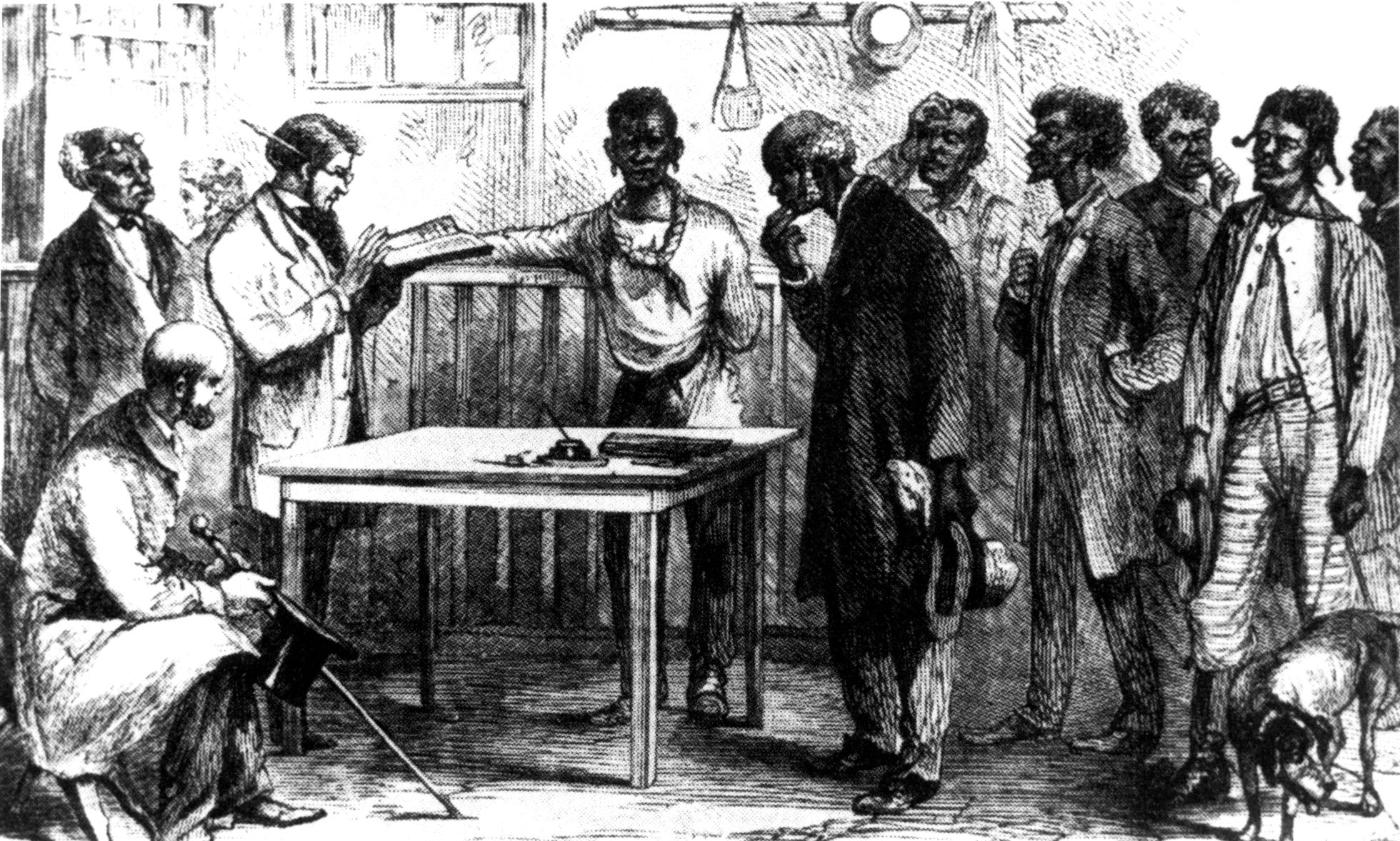
The war’s end afforded new opportunities to African Americans in Georgia. General William T. Sherman had promised “forty acres and a mule” to former bondsmen in the conflict’s final days, and the Freedmen’s Bureau established local offices around the state to help secure food, shelter, and education for Black Georgians. Thirty-three Black men even joined the state legislature thanks to the votes of freedmen, but full citizenship remained an illusory promise.
Although the Civil War ended enslavement, violence against Black citizens continued across the South. The Ku Klux Klan (KKK) launched a massive campaign to keep Black men from exercising their right to vote, which helped the ex-Confederate “Redeemers” expel the Black legislators in 1868 and then take control of the state government shortly after Georgia reentered the Union in 1870.
Conditions only worsened after Reconstruction, when federal soldiers left the state, and racial violence became more common. The new convict lease system allowed the state to lease prisoners to private businesses, and racial inequalities in the justice system meant that performed much of the work to rebuild the region and its economy. By the 1890s, Black Georgians had little political representation and few voting rights.
Despite these obstacles, Forsyth County had a relatively prosperous Black community in 1912, including about 1,098 Black residents, 58 of whom were landowners. A total of 109 Black families paid the farm tax, which indicates that they either rented or owned their farms, unlike the county’s sharecroppers, who did not own or rent the land they plowed. Other Black residents worked in the county seat of Cumming, often as craftsmen or domestic laborers.
Several Black churches were anchors in the community. Pastors like Grant Smith and Levi Greenlee Jr. were both spiritual leaders and outspoken advocates for Black residents. They organized church picnics for their congregants and secured regular tithes even from members of the white community, according to surviving records from Greenlee’s church. By the end of the year, though, their churches were turned to ash, and their worshippers had become refugees.
Expulsion, 1912
In 1912 lynching was a common practice throughout the South—the Equal Justice Initiative has documented nearly 6,500 lynchings between 1865 and 1950. Lynch mobs targeted Black people for exercising free speech or for attempting to vote. They also frequently lynched accused criminals, and those who were not lynched rarely received fair trials. All-white juries often condemned Black defendants to death regardless of the evidence. By resorting to extralegal violence and public spectacle, lynchers sought to reinforce white supremacy throughout the region.
Racial violence sometimes took place on a massive scale. In 1906, after weeks of sensational newspaper coverage of alleged assaults on white women by Black men, white mobs killed between twenty-one and forty Black Georgians in what came to be known as the Atlanta Race Massacre.
Other communities committed waves of racial terrorism that sought to expel Black residents entirely. The list is long: Comanche, Texas; Polk County, Tennessee; Pierce City, Missouri; Marshall County, Kentucky; Harrison, Arkansas; and many others whose stories were never recorded. Forsyth County would join that list, becoming the most well-documented racial expulsion in Georgia.
In early September 1912, a pair of assaults against white women took place in Forsyth County. The first allegedly took place against Ellen Grice on September 5; she reported that a Black man appeared in her bed overnight. By Saturday morning, September 7, Sheriff William Reid had arrested a young Black man, Toney Howell, and four “accomplices.”
That afternoon, a lynch mob formed outside of the jail in Cumming, demanding that Reid hand Howell over. Black preacher Grant Smith tried to intervene, but the mob whipped and beat him in the town square. Reid and his deputy, Gay Lummus, then dragged Smith into the courthouse vault, saving his life. The mob later besieged the courthouse until the state militia, dispatched by Governor Joseph M. Brown, arrived and escorted Smith and Howell to safety.
Then, on September 9, local white residents found eighteen-year-old Mae Crow mortally injured from an assault in the woods a few miles east of Cumming. The white community, still enraged by the weekend’s events, immediately concluded Black people were to blame. Reid rounded up four men and a woman. The accused mastermind, Ernest Knox, was whisked away to Atlanta, but the other four remained in the Cumming jail.
On the evening of September 10, another lynch mob formed outside of the Cumming jail. After Sheriff Reid (who later joined the Klan) abandoned his post, the mob easily overpowered Deputy Gay Lummus and dragged Rob Edwards, a twenty-four-year-old farmhand from South Carolina, out of jail and around the town square. Punches, bullets, and crowbar blows rained down on his body before the mob placed a noose around his neck and hung him from a telephone pole. The remaining Black prisoners in the Cumming jail are soon moved to Atlanta.
While Ernest Knox and accused accomplice Oscar Daniel survived that day, they were later convicted by all-white juries in rushed trials on October 4. The following morning, Judge Newt Morris (who later participated in the infamous Leo Frank Case) sentenced them to death.
The hangings took place on October 25. Sheriff Reid had placed the gallows in a natural depression ringed by three hills, and a fifteen-foot privacy fence mysteriously burned the night before Knox and Daniel were put to death. Although Georgia no longer allowed public executions, an estimated 5,000 white people cheered as Knox and Daniel died.
Before Knox and Daniel came to trial in October, white residents had already initiated a wave of violence against their Black neighbors. Similar to those who previously rode as Klansmen or in slave patrols, the region’s white residents unleashed their terror from horseback at night. The night riders fired guns into homes, shattered windows, and sometimes burned or dynamited houses and outbuildings. The mob also burned the county’s Black churches to the ground. The violence escalated after Mae Crow died on September 23 and only worsened after the October hangings. The message was clear to Black residents: leave Forsyth County.
Not all local white people supported the mob’s actions, however. In mid-October, a group of prominent white residents, including Cumming mayor Charlie Harris, sent a letter to Governor Brown begging him to declare martial law and protect Black families—requests that reflected the dependance of large landholders on Black labor. Brown refused, and the violence did not stop until nearly all 1,098 of the county’s Black residents were gone.
Forsyth County’s Black residents fled in all directions from the racial terror. The majority moved east across the Chattahoochee River to Hall County and Gainesville, a bustling city compared to the fields of Forsyth County. Several former Forsythians found success there, opening businesses and securing railroad jobs to climb their way into the middle class. Others went west into Cherokee County, towards the county seat of Canton.
Escaping Forsyth County did not guarantee an escape from the terror of the night riders, however. Newspapers from 1912 indicate that attacks against refugees continued in Hall County until the local sheriff successfully fought off the local night riders. In neighboring Dawson County, gangs succeeded in forcing Black residents (including Forsyth refugees) from their borders.
“As White as You Can Get,” 1913-1987
After 1912, Forsyth County was nearly all white, and the existence of its former Black residents was quietly erased. As a result, Cumming had few of the segregation signs that marked public places across the Jim Crow South. White residents lived on and worked land previously owned by their Black neighbors, much of it stolen.
After white mobs forced Black residents from the county, Black landowners faced the agonizing decision of selling their property below market value or attempting to retain ownership. According to the historian Elliot Jaspin, only twenty-four of the county’s fifty-eight Black landholders managed to sell. One man, Alex Hunter, bought a farm for $1,500 in mid-1912. He sold it in December for only $550. For thirty-four landowners, though, there is no record of sale. Their white neighbors simply took the abandoned land through a legal process called “adverse possession” and gained ownership over the following decades by paying the property taxes. The issue of stolen land would spark a debate about reparations in the 1980s.
The ongoing prohibition of Black residents was enforced through violence or threats of violence, with Forsyth County becoming known as a sundown town. Sundown towns are white communities that intentionally prevent Black people (and sometimes other racial or ethnic groups) from residing or even visiting there. Most sundown towns were created and enforced by mob violence. However, powerful white residents established others by organizing “buyout campaigns” that made it too expensive for most Black people to own homes and by restrictive covenants that banned property sales or leases to Black people. In many cases, local white residents even posted signs warning African Americans not to remain in town overnight. Oral evidence suggests that such a sign may have once stood in Forsyth County, though no documentation has been identified. James W. Loewen, a leading researcher on sundown towns, identified Forsyth County as one of the South’s most notorious examples of the phenomena.
A pattern of violence against African Americans who attempted to defy Cumming’s sundown town emerged in the years after 1912. Even if they were accompanied by white people, Black visitors were frequently threatened or attacked by white supremacists.
In 1915, three years after the racial cleansing, Cumming was a scheduled stop for the “Seeing Georgia” driving tour. Driving tours were common during this era. The tour took wealthy Georgians to small towns around the state, frequently resulting in valuable investments. But when the convoy pulled into the Cumming square, a mob attacked the Black chauffeurs, and a lynching nearly took place before one passenger pointed a gun at the rioters.
Fifty years later, little had changed. Ten Black schoolchildren and their camp counselors tried to hold a campout by Lake Lanier in 1968, but after nightfall, a gang of white men surrounded the campground, chanting slurs and threatening them until they left.
Another shocking incident occurred in 1980 when Black firefighter Miguel Marcelli attended a work party with his girlfriend at a Lake Lanier campground. Two white men stalked them after the sun went down and shot Marcelli in the head as he drove away. He survived.
Brotherhood, 1987
Between 1910 and 1960, Forsyth County’s population experienced a net gain of only 230 people. But as de jure segregation faded away following the Civil Rights Act of 1964, white residents of Atlanta began moving to the suburbs in a process called “white flight.”
Growth in Forsyth County only accelerated with the extension of Georgia 400 in the 1970s. The multilane expressway made it easier for the county’s residents to commute to Atlanta, and more than 11,000 people moved to the county over the course of the decade. Although the population remained almost entirely white, many of the new residents were from other parts of the country and did not share the same racist beliefs that some locals held.
One new resident, a martial arts instructor named Charles Blackburn, hoped to show that the county had overcome its prior racial intolerance. Blackburn had moved to Cumming from San Francisco in the early 1980s, and after learning that his Black friends feared Forsyth County, he organized a walk against “fear and intimidation.” Blackburn selected January 17, 1987—the weekend of the second-ever Martin Luther King Jr. Day—for a march marking the seventy-fifth anniversary of the 1912 expulsion. Soon after his announcement, though, Blackburn began receiving death threats, prompting him to cancel the march.
Dean Carter, a white construction worker who lived in nearby Gainesville, decided to continue the march, and he involved Atlanta-based civil rights activist Hosea Williams. During the civil rights movement of the 1950s and 1960s, Williams was a leader in the Southern Christian Leadership Conference (SCLC) alongside Martin Luther King Jr. and other civil rights luminaries. In 1965, he jointly organized the first Selma-to-Montgomery march with John Lewis—a day known as “Bloody Sunday.” Now a city councilman in Atlanta, Williams agreed to lend his time, expertise, and connections to organize a small march in Forsyth County.
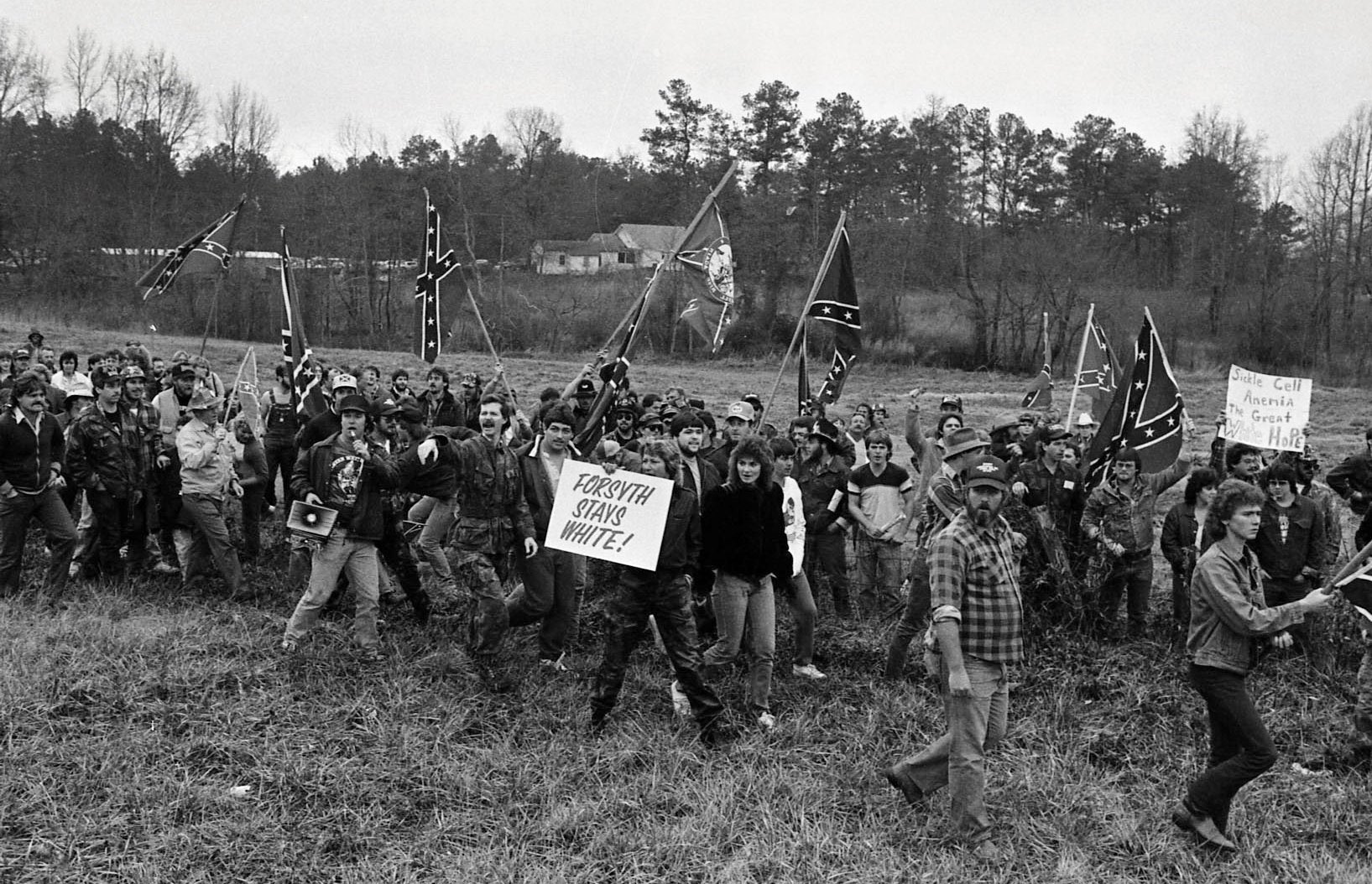
While Williams and Carter were organizing the march, a group of white supremacists in Cumming created the Forsyth County Defense League (FCDL) and scheduled a “White Power Rally” for the day of the march. The FCDL, which was later linked to the KKK, posted signs and flyers around town to advertise the event, which featured convicted church bomber J. B. Stoner as a speaker.
On the morning of January 17, Williams, Carter, and between fifty and one hundred marchers gathered near the corner of Georgia 9 and Bethelview Road. Shortly after they started their three-mile trek toward town, the white supremacists attacked them with rocks, bottles, and bricks. Forsyth County sheriff Wesley Walraven and state law enforcement officers quickly realized they could not control the situation and encouraged the marchers to re-board the bus and abandon the remaining portion of the walk.
Photos of the shocking violence made the front pages of newspapers nationwide. Determined to persevere, Williams reached out to old civil rights colleagues and began planning a second march for the following weekend. Thanks to Coretta Scott King and other supporters, the response was overwhelming.
On the morning of January 24, King Center organizers discovered there were thousands more marchers—some of whom came from as far as Nigeria—than they could transport to Cumming. Around 20,000 made the trip up Georgia 400 and marched in defiance of the previous weekend’s violence.
More than 2,500 National Guard soldiers and state law enforcement officers coordinated with federal law enforcement and the Forsyth County Sheriff’s Office to protect the marchers from thousands of gathered white supremacists. Their efforts helped prevent a repeat of the previous weekend’s violence.
After arriving in the courthouse square, the massive throng of cheering and chanting activists drowned out the screams of racist counter-protestors. They listened to speeches from Williams, Coretta Scott King, Atlanta mayor Andrew Young, and comedian Dick Gregory, among others. Many other notable politicians joined the march, including U.S. Congressman John Lewis, U.S. Senators Sam Nunn and Wyche Fowler, and civil rights activists Jesse Jackson, Ralph David Abernathy, and Benjamin Hooks, executive director of the National Association for the Advancement of Colored People (NAACP).
In the wake of the march, Williams and his compatriots presented a list of demands to Forsyth County officials that included financial reparations for descendants of the Black landholders from 1912, investigations into violations of federal employment law and housing law, and affirmative action programs to hire more Black teachers and police officers. Governor Joe Frank Harris created the Cumming/Forsyth County Biracial Committee to explore these issues. The committee included six members endorsed by Cumming residents and six backed by civil rights leaders.
In December 1987, after ten months of negotiation, the committee failed to reach a unified recommendation and instead published two separate position papers. Local representatives scoffed at the civil rights activists’ demands and insisted that Black residents had “voluntarily relocated” in 1912. In their eyes, Forsyth County had “no apologies to make to anyone,” much less reparations. The pro-civil rights group recommended that Harris establish a permanent race-relations committee to root out racial hatred in the long term. But Harris did nothing, effectively granting victory to the local white residents. Integration slowed after that, and the county’s Black population was estimated at only thirty-nine a decade later.
The Suburban Shift, 1990s–Present
Forsyth County had only 16,928 residents as of the 1970 Census, but that number would balloon to 98,407 by 2000. While the county remained majority white during that time, new white residents with less hostile racial views would play a major role in Cumming’s transformation. Attitudinal changes only accelerated as Forsyth County became the fastest-growing county in the nation for the first time starting in the late 1990s. By the mid-1990s, the county was no longer a sundown town. Nevertheless, strict zoning laws and a lack of affordable housing kept the proportion of Black residents lower than it was in 1912.
Forsyth County has diversified dramatically in recent years. The 2020 census reported over 250,000 residents, and while the county’s Black population is still low for the state, it has one of the fastest-growing Asian populations in the nation, anchored by a growing community of Indian immigrants. This influx of new residents has caused tensions, but it has also contributed to growing local support for recognizing and memorializing the community’s history of racial violence. Around 1,000 residents participated in a Black Lives Matter protest in June 2020, and in January 2021, the Community Remembrance Project of Forsyth County unveiled a historical marker to document the lynching of Rob Edwards.